书籍暂未推出简体中文版——当前显示英文版。
University Earth and Space Sciences — Year 3 · 本科三年级
27Planetary Atmospheres and Habitability
Venus and the Earth are near twins: almost the same size, similar mean densities, neighbouring orbits. Yet Venus keeps of carbon dioxide over a surface at , and so little water that, spread over its surface, it would make a layer about a centimetre deep. The mass spectrometer of the Pioneer Venus probe, falling through its clouds, measured the ratio of deuterium to hydrogen in that water: , a hundred times the ratio in the Earth’s oceans. Light hydrogen escapes to space more easily than heavy deuterium; what is left of a large reservoir that has lost most of its hydrogen is rich in deuterium. The ratio is the trace of water that Venus once had, and lost. This chapter asks how a planet holds on to its air and its water, and how it loses them.
You already know
The scale height, the barometric formula, the Maxwell–Boltzmann distribution, the escape velocity, the mean free path and the greenhouse effect are in the physics books. The habitable zone of a star is in the school books. The equilibrium temperature and the Bond albedo are in the Year 1 volume, in its chapter on comparative planetology; the optical depth, in its chapter on telescopes and photometry; the lapse rates, in its chapter on the structure of the atmosphere and the ocean; the outgoing longwave radiation (OLR) and the emission temperature, in its chapter on radiation and heat transport. The moist adiabat is in the Year 2 volume, in its chapter on atmospheric thermodynamics; the snow line, in its chapter on planet formation; the long-term carbon cycle and the silicate-weathering thermostat, in its chapter on climate over geological time. Rayleigh distillation is in this volume, in its chapter on stable isotopes.
27.1 The structure of an atmosphere
An isothermal atmosphere of molecular mass at temperature thins with height as , with the scale height . At the surface of the Earth is about ; at the surface of Titan, where gravity is weak and the air cold, about .
The temperature, though, is not uniform. Sunlight that reaches the ground warms it; the air above, which absorbs and emits in the infrared, is warmed from below. Radiation alone would make the lower atmosphere so steep in temperature that it would overturn.
Definition 27.1 (Radiative–convective equilibrium)
A column of atmosphere is in radiative–convective equilibrium when, at every level, the net flux of radiation is balanced, except in a lower layer where convection carries heat upwards and holds the temperature gradient at the adiabatic one. The lower, convective layer is the troposphere; the upper layer, in radiative equilibrium, the stratosphere; the tropopause is the level where they meet.
The simplest atmosphere in which this can be followed is grey: it is transparent to sunlight and absorbs every infrared wavelength alike, with an optical depth counted downwards from the top.
Proposition 27.2 (Grey radiative equilibrium)
In a grey atmosphere in radiative equilibrium that emits the flux to space, the temperature at the optical depth obeys
where accounts for the slant paths of the radiation. The top of the atmosphere is at the skin temperature , where is the emission temperature.
The proposition is admitted; it follows from the two-stream equations for the upward and downward fluxes. Where is large, near the ground, the radiative temperature changes fast with , and itself grows quickly with depth because the absorbing gas is densest there: the radiative profile is steeper than the adiabat, and convection takes over. High up, is small and the temperature tends to the skin temperature. The Earth emits about to space, an emission temperature of and a skin temperature of ; the standard atmosphere sets its tropopause at and . The grey model, crude as it is, places the cold top of the troposphere about right.
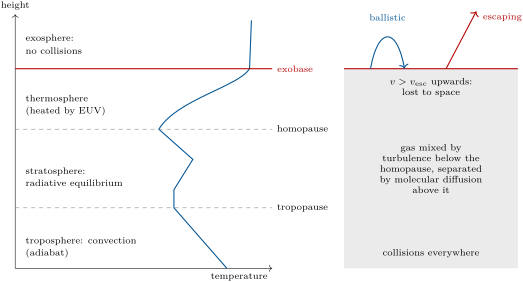
High in the atmosphere the air is so thin that a molecule may travel far between collisions. Where it can travel farther than a scale height, it no longer belongs to a fluid.
Definition 27.3 (Exobase; exosphere)
The exobase of an atmosphere is the level at which the mean free path of its particles equals the scale height. Above it, the exosphere, a particle moving upwards is unlikely to meet another, and one faster than the local escape velocity leaves the planet.
Proposition 27.4 (Exobase condition)
In an isothermal atmosphere of particles of collision cross-section , a particle moving vertically upwards from the level of density escapes every collision with the probability . At the exobase : the probability is .
Proof. Along a path the particle meets on average others. The probability of meeting none on the way up from is , and in an isothermal atmosphere . The mean free path is ; the condition is . ∎
The exobase lies at about on the Earth, on Venus and on Mars, and near on Titan, more than half the radius of the moon.
27.2 Atmospheric escape
At the exobase the particles keep the Maxwell–Boltzmann distribution of speeds of the gas below. Its tail always holds some particles faster than the escape velocity.
Definition 27.5 (Jeans escape; escape parameter)
Jeans escape is the loss to space of the particles of the Maxwell–Boltzmann tail that move upwards at the exobase faster than the escape velocity. The escape parameter of particles of mass at the exobase, of radius and temperature , on a planet of mass , is
the ratio of their gravitational binding energy to , and also the square of the escape velocity over the most probable thermal speed .
Theorem 27.6 (Jeans flux)
At an exobase of density , the number of particles that escape per unit area and per unit time is
Proof. The Maxwell–Boltzmann distribution of velocities is . A particle of speed moving at the angle from the vertical crosses a horizontal unit area at the rate . Counting only upward velocities () faster than ,
where the last integral follows from the substitution and one integration by parts: . Collecting, . ∎
The factor is the flux of all the particles that cross the exobase upwards; is the fraction of them that escape. It falls exponentially with the mass of the particle, since . At the Earth’s exobase, at , hydrogen has and escapes at the rate of 0.7 % of its upward flux; deuterium, , at ; helium, , at ; oxygen, , not at all. At the exobase of Venus, colder and as deep in the gravity well, even for hydrogen; at Mars ; at Titan for hydrogen and 3.0 for molecular hydrogen.
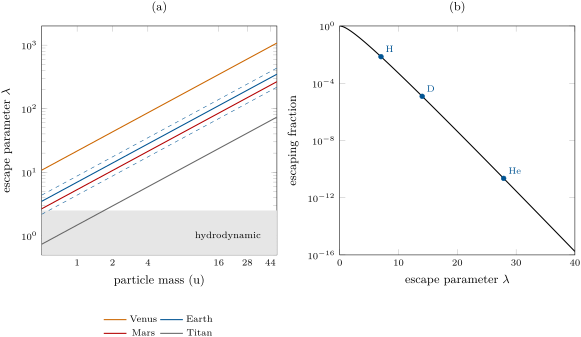
When falls to a few, the picture of particles leaking one by one from a static atmosphere fails: the upper atmosphere expands and flows away as a wind. Models place the transition at between about 1.5 and 3.
Definition 27.7 (Hydrodynamic, non-thermal and diffusion-limited escape)
Hydrodynamic escape is the loss of an upper atmosphere that flows away as a whole, heated from above, when its escape parameter is small; the flow may drag heavier particles with it. Non-thermal escape is the loss of particles accelerated by processes other than heat: photochemical reactions that give fragments more than the escape energy, ions picked up by the electric field of the solar wind, sputtering by ions that strike the upper atmosphere, and the outflow of ions along magnetic field lines. Diffusion-limited escape is escape whose rate is set not at the exobase but lower down, by the rate at which the escaping gas can diffuse up through the heavier gas above the homopause, the level above which molecular diffusion, not turbulence, controls the mixture.
Proposition 27.8 (Diffusion limit)
A light gas of mixing ratio and molecular mass , diffusing through a heavier gas of molecular mass and scale height with the binary diffusion parameter , cannot rise faster than
Proof. Kinetic theory (admitted) gives the upward flux of the light gas relative to the heavy one, in an isothermal column, as : the light gas diffuses down its own gradient, and its own scale height is larger than . The flux is largest when the mixing ratio is uniform, ; the escaping gas cannot be drawn faster without its mixing ratio falling with height. With the two forms follow. ∎
For molecular hydrogen rising through carbon dioxide, at , and with the Earth’s gravity the limit is molecules of per square centimetre and per second, counting all the hydrogen as . On the Earth today the escape of hydrogen is diffusion-limited: at solar minimum, when the exobase is colder and Jeans escape slower, escape by charge exchange with ions takes up the slack, and the total stays about the same. The supply, not the exobase, sets the rate.
27.3 Venus and the runaway greenhouse
Venus receives from the Sun, 1.91 times the Earth’s share. Its clouds of sulfuric acid reflect 77 % of it, so it absorbs less than the Earth; yet its surface is at under of an atmosphere 96.5 % carbon dioxide. It holds of water, against on the Earth, about 30 parts per million by volume below the clouds.
A planet with an ocean is held in balance by its outgoing radiation. If it warms, more water evaporates; water vapour is a greenhouse gas, so the outgoing radiation grows less than , but it grows, and the warming stops. There is a limit to that growth.
Proposition 27.9 (Radiation limit of a moist atmosphere)
When the surface of an ocean planet is hot enough for water vapour to dominate its upper atmosphere, the temperature there follows the saturation curve of water, and the infrared radiation to space comes from a level of fixed pressure. Its temperature, and the outgoing radiation, stop growing with the surface temperature.
Proof. In a saturated column dominated by vapour, the pressure at every level is the saturation pressure at the local temperature, . The radiation to space leaves from around the level where the optical depth from the top is about one. For a grey gas of mass absorption coefficient the optical depth above the pressure is , so that level sits at , whatever the surface temperature, and its temperature is the one at which . Warming the surface only adds vapour below it. ∎
Definition 27.10 (Runaway greenhouse; runaway greenhouse limit; moist greenhouse)
The runaway greenhouse limit is the largest flux of infrared radiation that a planet with an ocean can send to space. A runaway greenhouse is the state of a planet that absorbs more sunlight than that limit: it cannot balance its budget until the whole ocean has evaporated and the surface has heated far beyond it. A moist greenhouse is the state of a planet, short of the runaway, whose surface is warm enough for its stratosphere to hold a large mixing ratio of water vapour, which ultraviolet light splits and whose hydrogen escapes.
Simple models such as that of the proposition give such a limit; with the real lines of water vapour, a cloud-free line-by-line calculation puts it at for an Earth-like planet, and reviews quote about . Beyond about the outgoing flux grows again, as the hot lower atmosphere radiates in the visible and near infrared, where water absorbs little: a planet in a runaway greenhouse settles at a very high temperature, once its ocean is all vapour.
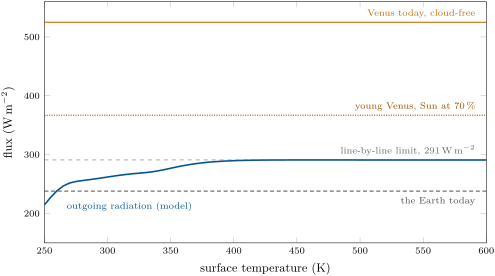
With the albedo of a cloud-free steam atmosphere, 0.193, an Earth-like planet around the Sun runs away when it receives 1.06 times the Earth’s sunlight, at . Before that, at 1.015 times the Earth’s sunlight and a surface temperature of , its stratosphere turns moist: on the Earth today water is cold-trapped at the tropopause, near , but on a warmer planet the cold trap rises and lets vapour through. When the mixing ratio of water in the stratosphere reaches about , diffusion-limited escape removes an ocean of hydrogen in about the age of the Earth.
The deuterium of Venus measures what was lost. Each atom that escapes removes hydrogen and a little deuterium from the remaining reservoir, as each drop that rains out removes a little of the heavy isotopes from a cloud.
Proposition 27.11 (Isotopic enrichment by escape)
Let a reservoir of water lose hydrogen to space, each atom of deuterium escaping with the efficiency relative to an atom of hydrogen (). When the reservoir has shrunk from to , its ratio has grown from to
Proof. Losing hydrogen atoms costs the reservoir deuterium atoms: , so and . The mass of water is proportional to . This is Rayleigh distillation, with escape in the place of rain. ∎
If no deuterium escaped at all (), a hundredfold enrichment would mean that Venus once held at least a hundred times its present water. Escape that fractionates less needs far more: in diffusion-limited escape , and a hundredfold enrichment would require the reservoir to shrink by a factor of . The ratio is read as a lower bound: at least a few tenths of a percent of a terrestrial ocean, and estimates of an early Venus ocean range from 4 to spread over its surface. Two cautions remain. Most of the fractionation may have happened only in the loss of the last few bars of water, and a steady supply of water from comets or volcanoes, lost as fast as it came, could build the same ratio. Venus is still losing water: its escaping ions are hydrogen and oxygen in the ratio of two to one, pulled out by an electric field five times stronger than the one in the Earth’s ionosphere, around a planet with no magnetic field.
27.4 Mars: a thin atmosphere and a wet past
Mars keeps a mean surface pressure of , between 4.0 and with the seasons, 95 % carbon dioxide, at about . The pressure barely exceeds the triple-point pressure of water, : liquid water cannot last at its surface, where ice sublimes. Yet ancient terrains are cut by branching valleys, and carry minerals that form only in liquid water.
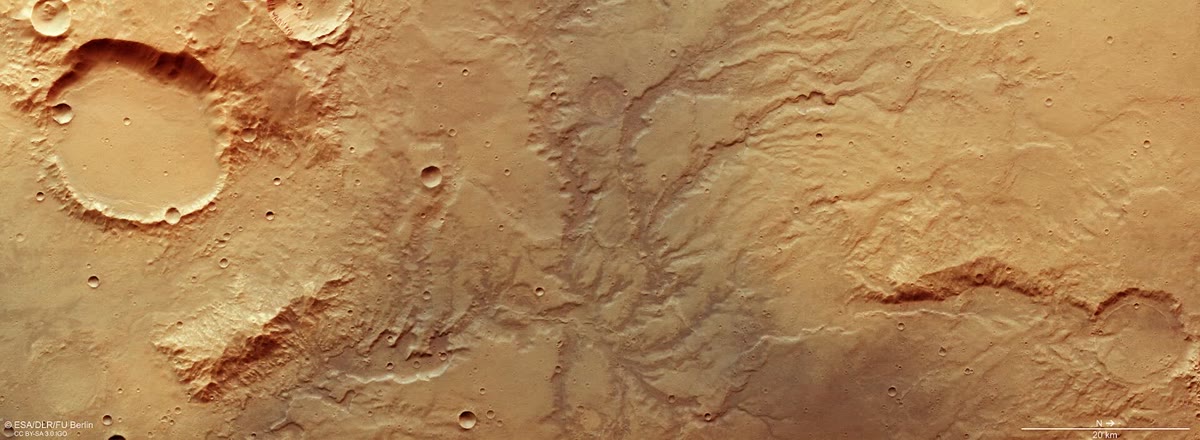
The valleys and the flow channels of Mars need, by geological estimates, a global layer of water 100 to deep, against 3 to in its ice and air today. Much of the rest went to space. The MAVEN orbiter measured the solar wind stripping gas from Mars at about per second, three quarters of it down the tail behind the planet, where the solar wind flows, and a quarter in a plume over the poles; during the solar storms of March 2015 the loss sped up, and it was probably much faster when the young Sun was more active. Mars also loses hydrogen, about atoms per second on average today: kept up for four billion years, a loss worth a global layer of water only about deep.
The rate has not always been today’s. The obliquity of Mars, now, has wandered between 0 and over the last 250 million years, around a mean near , while the Earth’s varies by little more than a degree. The motion is chaotic and cannot be traced back over billions of years; elliptical craters made by grazing impacts, whose orientations record the obliquity, suggest a mean between about 10 and over the last 3.5 billion years or so. At high obliquity the summer pole warms, more water vapour rises, and climate models make the loss of hydrogen twenty times faster: over Mars’s history, a layer of the order of .
27.5 Titan: a methane cycle
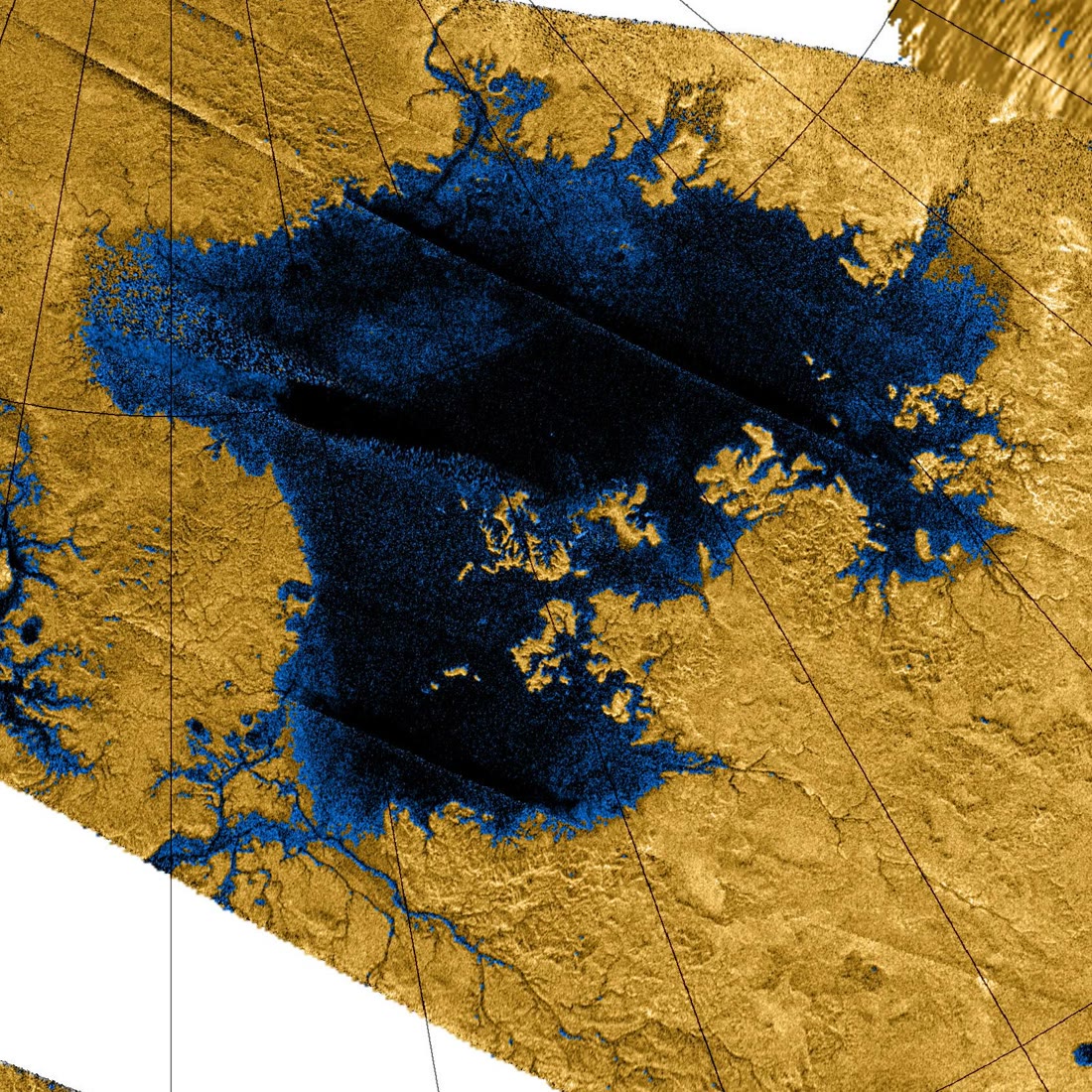
Titan, a moon smaller than Mars, has a thicker atmosphere than the Earth: a surface pressure about 60 % higher, at . The atmosphere is about 95 % nitrogen and 5 % methane, and because the moon’s gravity is weak it extends ten times higher than the Earth’s, to nearly . Ultraviolet light splits the methane and nitrogen high up; the fragments recombine into an orange haze of heavier hydrocarbons that hides the surface from visible light. Below the haze, methane plays the part of water: it condenses into clouds, rains, cuts river channels and fills lakes and seas of methane and ethane.
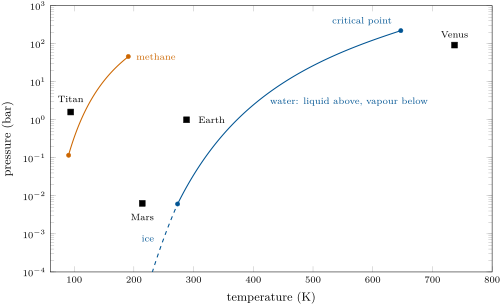
Whether a liquid can lie on a surface depends on its phase diagram and on the pressure and temperature there. Titan’s surface lies just above the triple point of methane, and , and below its critical point: liquid methane is possible, and methane at 5 % of is not far from saturation. The surface of Mars sits near the triple point of water, the Earth’s well inside its liquid field, and Venus’s above water’s critical temperature, , where no liquid can exist at all.
Titan keeps its nitrogen easily: at its exobase for nitrogen. Its hydrogen, at near 1.5, leaves almost freely, and the escape of molecular hydrogen is set lower down by the limiting flux through the homopause, as on the Earth. The heavy compounds made from the broken methane settle to the surface, where they make the sand of vast fields of dunes.
27.6 Planetary habitability
The habitable zone of the school books is the range of distances from a star at which a planet like the Earth can keep liquid water at its surface. Its edges are the limits met in this chapter.
Definition 27.12 (Planetary habitability)
The planetary habitability of a planet is its capacity to keep liquid water at its surface over geological times: it receives a stellar flux within the limits of the habitable zone, it holds on to its atmosphere and its water against escape, and a long-term carbon cycle regulates its climate.
The inner edge of the habitable zone is the moist or the runaway greenhouse: an Earth-like planet around the Sun turns moist at and runs away at . The outer edge is the maximum greenhouse: adding carbon dioxide warms a planet only until the extra gas scatters back more sunlight than its greenhouse effect gains; around the Sun this happens at , under some of carbon dioxide. Those are conservative edges, computed without clouds. Two empirical ones are wider: Venus seems to have had no surface water for at least a billion years, when it received 1.76 times the Earth’s present sunlight (); Mars had flowing water when it received 0.32 times that sunlight, if its valleys are 3.8 billion years old (). Around cooler stars the same limits come at lower fluxes, because their redder light is scattered less and absorbed more by water and carbon dioxide.
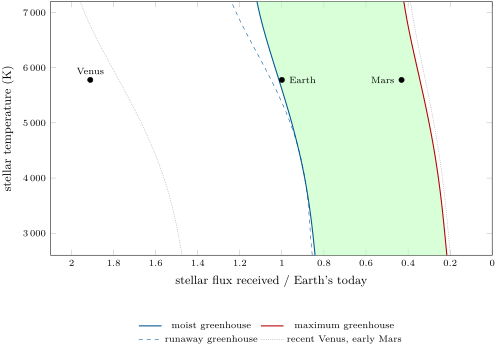
Distance is not enough. A planet must hold on to its atmosphere: a small or hot one, whose escape parameter is low, loses its hydrogen and with it its water, and a planet in a moist greenhouse dries out from the top. It must also keep its climate stable over billions of years while its star brightens: on the Earth, the silicate-weathering thermostat of the long-term carbon cycle draws carbon dioxide down when the climate warms and lets it build up when it cools. On Venus, without plate tectonics, outgassed carbon dioxide has had no way back into the rocks and has accumulated in the air; it now holds about as much carbon dioxide as the Earth has locked in carbonate rocks. Whether a magnetic field protects an atmosphere is debated: it shields the upper atmosphere from the solar wind, but it also opens other paths of escape, such as the outflow of ions near the poles, and the habitability of a planet cannot be read from its place in the habitable zone alone.
27.7 Exercises
Exercise 27.1 ★
Compute the scale height near the surface of Venus (, carbon dioxide of molar mass , ), the Earth (, , ), Mars (, , ) and Titan (, , ). Which atmosphere is the most extended, and why?
Solution
Solution of Exercise 27.1.
: Venus ; the Earth ; Mars ; Titan . Titan’s atmosphere, cold as it is, is the most extended: its gravity is seven times weaker than the Earth’s.
Exercise 27.2 ★
The Earth’s exobase lies at (radius ); its temperature varies from 800 to over the solar cycle. Take the mass of the Earth as . Compute the escape parameter of hydrogen atoms at both temperatures, and the escaping fraction . By what factor does the solar cycle change it?
Solution
Solution of Exercise 27.2.
: 8.78 at , 4.39 at . The escaping fractions are and : the solar cycle changes the escaping fraction of hydrogen by a factor of about 44.
Exercise 27.3 ★
Around the Sun, an Earth-like planet turns moist at the flux , runs away at 1.0512 and reaches the maximum greenhouse at 0.3438 (fluxes relative to the Earth’s). (a) Compute the three distances, in astronomical units. (b) Venus and Mars receive 1.91 and 0.43 times the Earth’s sunlight. Place them.
Solution
Solution of Exercise 27.3.
(a) : moist greenhouse , runaway , maximum greenhouse . (b) Venus, at 1.91, receives more than the runaway flux and even more than the empirical recent-Venus limit (1.78): it lies inside the inner edge. Mars, at 0.43, lies between 1.014 and 0.3438, inside the conservative habitable zone: its dryness comes from its small size and the loss of its atmosphere, not from its distance.
Exercise 27.4 ★
The vapour pressure of liquid methane is . (a) Compute it at the surface of Titan, . (b) Methane makes 5 % of Titan’s air at . Compute its partial pressure and its relative humidity. (c) What does the result suggest about evaporation from Titan’s seas?
Solution
Solution of Exercise 27.4.
(a) , . (b) , a relative humidity of . (c) The air above the seas is far from saturated: methane evaporates from them, as water does from the Earth’s oceans, and the humid air must rise and cool before it rains.
Exercise 27.5 ★★
At the Earth’s exobase (, for hydrogen), compute the escape parameter of deuterium, its thermal speed relative to hydrogen’s and the ratio of the Jeans fluxes per atom, D to H. Is Jeans escape a strong isotopic filter?
Solution
Solution of Exercise 27.5.
. . Ratio per atom . Jeans escape lets almost no deuterium out: it is a strong filter, with .
Exercise 27.6 ★★
The ratio D/H of the water of Venus is ; that of ocean water on the Earth is . (a) Compute the enrichment. (b) With no escape of deuterium at all, what is the smallest past inventory of water of Venus, given today? What depth would it make spread over the planet’s ? (c) What shrinking of the reservoir would diffusion-limited escape, with , require? Conclude.
Solution
Solution of Exercise 27.6.
(a) . (b) With the enrichment is : , or of water over Venus. (c) , a past inventory of , twelve times the mass of the Earth: impossible. The enrichment needs a strongly fractionating escape (Jeans or non-thermal), active at least during the loss of the last of the water, or a steady state with a supply of water.
Exercise 27.7 ★★
Mars, of radius , loses about hydrogen atoms per second. (a) If each pair of atoms came from a molecule of water, what global layer of water does the loss remove in four billion years? (b) Same question at atoms per second, the rate of a high obliquity. (c) Compare with the 100 to the valleys and channels need.
Solution
Solution of Exercise 27.7.
(a) In four billion years ( s) Mars loses atoms, molecules of water, ; over that is a layer deep. (b) Twenty times more, . (c) Even the high-obliquity rate reaches only the lower end of the 100 to ; the rest went into the crust and the ice, or was lost faster when the Sun was young.
Exercise 27.8 ★★
(a) Compute the mass of the atmosphere of Mars from its mean surface pressure, , its gravity, , and its radius. (b) The solar wind strips about of gas per second. What mass does that remove in four billion years, and in how long would it remove the present atmosphere? (c) Why is that an underestimate of the past loss?
Solution
Solution of Exercise 27.8.
(a) . (b) , half the present atmosphere; the whole of it in , billion years. (c) The young Sun was more active and its storms more frequent, and the loss grows during storms; other channels (hydrogen, sputtering, photochemical escape) are not counted.
Exercise 27.9 ★★
An Earth-like planet with a cloud-free steam atmosphere reflects 19.3 % of the sunlight it receives; its infrared output cannot exceed . (a) Above what flux of sunlight, in watts per square metre and relative to the Earth’s , does it run away? (b) Compare with Venus today, , and with a young Venus under a Sun at 70 % of its present luminosity. (c) Why is the conclusion for the young Venus not final?
Solution
Solution of Exercise 27.9.
(a) gives , 1.06 times the Earth’s. (b) Venus today would absorb ; a young Venus, received, absorbed: both above the limit, so a cloud-free young Venus would have run away from the start. (c) Clouds raise the albedo; three-dimensional models with clouds have found a path to a habitable young Venus.
Exercise 27.10 ★★★
A model thermosphere of atomic oxygen is isothermal at , with at ; take at that height and a collision cross-section . (a) Compute the scale height of the oxygen. (b) Compute the density at the exobase and the height of the exobase. (c) Gravity decreases with height. Does that move the exobase up or down?
Solution
Solution of Exercise 27.10.
(a) . (b) ; . (c) Gravity weaker higher up makes the scale height grow with height, so the density falls more slowly than assumed: the exobase moves up.
Exercise 27.11 ★★★
(a) Suppose the Earth’s stratosphere turned moist, with a mixing ratio of water vapour of (counted as ). With the diffusion limit molecules of per square centimetre and per second, at , compute the loss of hydrogen of the whole Earth (radius ). (b) How long would an ocean, of water, last? Compare with the age of the Earth.
Solution
Solution of Exercise 27.11.
(a) ; over , molecules of per second. (b) An ocean holds molecules of water, one each: it lasts , comparable with the age of the Earth, which is why a mixing ratio of marks the moist greenhouse limit.
Exercise 27.12 ★★★
In a pure-steam upper atmosphere absorbing as a grey gas with , on a planet with and : (a) compute the pressure of the radiating level; (b) with , , , , compute its temperature and the radiation limit. (c) The line-by-line limit is . Should the effective of real water vapour be larger or smaller?
Solution
Solution of Exercise 27.12.
(a) . (b) , , and . (c) The real limit is lower, so the radiating level is colder and at lower pressure: real water vapour is more opaque than this grey gas, and its effective larger.
27.8 Problem: Will Kepos Keep Its Water?
Problem 27.1
Weekend problem — escape and habitability of an invented ocean planet
Kepos is an invented planet of mass and radius , with oceans and an atmosphere of nitrogen and carbon dioxide. It orbits at a star of luminosity 0.30 times the Sun’s and effective temperature . Its exobase lies above the surface, at , with hydrogen atoms; its homopause is at , where carbon dioxide dominates and where hydrogen in all its forms makes a mixing ratio , counted as . An Earth ocean is of water.
Part I — The exobase.
- Compute the surface gravity and the mean density of Kepos.
- Compute the escape velocity at the exobase.
- Compute the thermal speed of hydrogen, helium and oxygen atoms at the exobase.
- Compute their escape parameters.
- Which of them can escape by Jeans escape at a significant rate? Is any close to the hydrodynamic regime?
- During an active youth of its star the exobase of Kepos may have reached . What was then the escape parameter of hydrogen, and what does it suggest?
Part II — Jeans escape of hydrogen.
- Compute the escaping fraction for hydrogen.
- Compute the Jeans flux of hydrogen, per square metre and per second.
- Compute the number of hydrogen atoms that leave the whole exobase per second.
- How many hydrogen atoms does an Earth ocean hold?
- At this rate, how long would Kepos take to lose them?
- Compute the escape parameter of deuterium and its escape efficiency relative to hydrogen, per atom.
Part III — The diffusion limit.
- Compute the scale height of carbon dioxide at the homopause.
- The binary diffusion parameter of hydrogen in carbon dioxide is at . Compute the diffusion-limited flux of , per square metre and per second.
- Check it against the Earth’s limit, molecules per square centimetre and per second, scaled by gravity.
- Compute the number of hydrogen atoms that the diffusion limit can supply to the upper atmosphere of the whole planet per second (take the area of the surface).
- Compare with question 9. Which process limits the escape, and what happens to the hydrogen of the thermosphere?
- What density of hydrogen at the exobase would let Jeans escape carry the whole supply?
- How long would Kepos take to lose an Earth ocean of hydrogen at the diffusion limit?
Part IV — Is Kepos in the habitable zone?
- Compute the stellar flux Kepos receives, relative to the Earth’s.
- For a star of the moist greenhouse limit is at and the maximum greenhouse at 0.290. Compute the edges of the habitable zone, in astronomical units, and place Kepos.
- By what factor must the star brighten before Kepos reaches the inner edge?
- With an albedo of 0.3, compute the sunlight Kepos absorbs per square metre, and its equilibrium temperature. Compare with the runaway greenhouse limit.
- If a warmer climate made the stratosphere of Kepos moist, with , how long would an Earth ocean last?
- Give the time for Kepos to lose an Earth ocean of hydrogen by diffusion-limited escape with , in billions of years, to two significant figures.
Solution
Solution of Problem 27.1.
1. ; .
2. .
3. : hydrogen , helium , oxygen .
4. : 4.49, 17.8, 71.2.
5. Only hydrogen: its escaping fraction is 0.06, helium’s , oxygen’s . None is near the hydrodynamic regime, to 3.
6. : within the transition; hydrogen would have streamed away hydrodynamically, perhaps dragging heavier gases.
7. .
8. ; .
9. ; atoms per second.
10. , molecules, hydrogen atoms.
11. , about 310 billion years.
12. ; escaping fraction ; relative efficiency .
13. .
14. , so
15. : the same within 1 %.
16. ; molecules of , atoms per second.
17. The diffusion limit supplies 28 times what the exobase lets out at its present density. Hydrogen piles up in the thermosphere until the Jeans flux matches the supply: in the long run the escape is diffusion-limited, as on the Earth.
18. .
19. , 11.2 billion years.
20. .
21. : inner edge , outer edge . Kepos, at , is inside, close to the inner edge.
22. : a brightening of 13 %.
23. , ; well below the limit (computed for a Sun-like star, but the margin is wide).
24. Three times faster: 3.7 billion years.
25. 11 billion years.