সব বই

পেশাদার

1 Markets I: The Ecosystem and Exchange-Traded Marketsবাজার অনলাইন 2 Markets II: Rates, FX and Creditবাজার অনলাইন 3 Markets III: Commodities, Energy and Cryptoবাজার অনলাইন 4 Quantitative Methodsপদ্ধতি অনলাইন 5 Derivatives and Volatilityডেরিভেটিভস অনলাইন 6 Rates, Credit, XVA and Riskসুদহার, ঋণ ও ঝুঁকি অনলাইন 7 Research Craft: Predictors, Backtests, Measurement, Portfoliosগবেষণা অনলাইন 8 Strategies I: Equities and Futuresকৌশল অনলাইন 9 Strategies II: Volatility, Relative Value, Macro and the Bank Desksকৌশল অনলাইন 10 Microstructure and Executionএক্সিকিউশন অনলাইন 11 Market Making and High-Frequency Tradingমার্কেট মেকিং অনলাইন 12 Machine Learning for Marketsমেশিন লার্নিং অনলাইন 13 Low-Latency Softwareপ্রযুক্তি অনলাইন 14 Networks, Hardware and Trading Infrastructureপ্রযুক্তি অনলাইন 15 Research, Data and Risk Platformsপ্রযুক্তি অনলাইন 16 The Desk and the Firmপ্রতিষ্ঠান অনলাইন 17 The Industry: Firms, Roles and Careersক্যারিয়ার অনলাইন 18 Interviews I: Maths, Probability and Speedক্যারিয়ার অনলাইন 19 Interviews II: Markets, Trading Games and the Final Roundক্যারিয়ার অনলাইন 20 Interviews III: Codeক্যারিয়ার অনলাইন
অ্যাপ পরিচিতি Coach সাইন ইন পড়া শুরু করো

বইগুলো এখনো বাংলা ভাষায় পাওয়া যায় না — ইংরেজি সংস্করণ দেখানো হচ্ছে।

Earth and Space Sciences · পরিভাষা

Mantle end-member কী?

Definition 4.8 University Earth and Space Sciences — Year 2 · অধ্যায় 4 — Isotope Geochemistry

A mantle end-member is one of the extreme isotopic compositions from which the Sr, Nd and Pb isotope ratios of oceanic basalts can be built by mixing. Four are commonly named: DMM, the depleted MORB mantle (low 87Sr/86Sr^{87}\mathrm{Sr}/^{86}\mathrm{Sr}, high εNd\varepsilon_{\mathrm{Nd}}); HIMU, for a high μ=238U/204Pb\mu = {}^{238}\mathrm{U}/^{204}\mathrm{Pb} in its source (very radiogenic lead, 206Pb/204Pb^{206}\mathrm{Pb}/^{204}\mathrm{Pb} above 20, with low 87Sr/86Sr^{87}\mathrm{Sr}/^{86}\mathrm{Sr}); EM1, enriched mantle 1 (moderately high 87Sr/86Sr^{87}\mathrm{Sr}/^{86}\mathrm{Sr}, negative εNd\varepsilon_{\mathrm{Nd}}, unradiogenic lead); and EM2, enriched mantle 2 (high 87Sr/86Sr^{87}\mathrm{Sr}/^{86}\mathrm{Sr}).

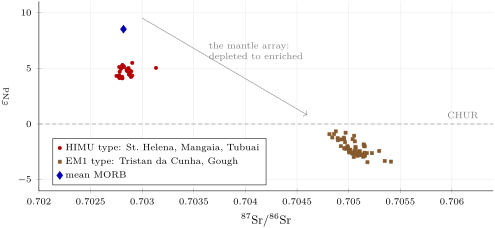
Strontium and neodymium isotopes of 89 basalts from five ocean islands and of the mean mid-ocean ridge basalt. The HIMU-type islands plot below the main array, with the low strontium ratio of MORB but a lower _ Nd; the EM1-type islands lie on the enriched side of CHUR. Samoan lavas of the EM2 type reach 87 Sr/86 Sr = 0.7205, far off this scale to the right. Data: Stracke and others (2022), CC BY 4.0; Gale and others (2013); Edwards and others (2019).
Strontium and neodymium isotopes of 89 basalts from five ocean islands and of the mean mid-ocean ridge basalt. The HIMU-type islands plot below the main array, with the low strontium ratio of MORB but a lower εNd\varepsilon_{\mathrm{Nd}}; the EM1-type islands lie on the enriched side of CHUR. Samoan lavas of the EM2 type reach 87Sr/86Sr=0.7205^{87}\mathrm{Sr}/^{86}\mathrm{Sr} = 0.7205, far off this scale to the right. Data: Stracke and others (2022), CC BY 4.0; Gale and others (2013); Edwards and others (2019).
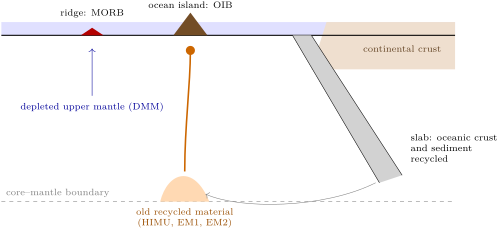
One widely used interpretation of the mantle reservoirs, not to scale: the ridges sample the depleted upper mantle; oceanic crust and sediment return to the mantle at subduction zones; plumes rising from the deep mantle bring up material in which old recycled components are mixed, and give the islands their HIMU, EM1 or EM2 character.
প্রসঙ্গসহ পড়ো →