
全部书籍

专业

应用 关于 Coach 登录 开始阅读

书籍暂未推出简体中文版——当前显示英文版。

Earth and Space Sciences · 术语表

什么是 Metallicity?

Definition 30.2 University Earth and Space Sciences — Year 3 · 第 30 章 — Where the Elements Come From

The metallicity of a star or of a gas is its content of elements heavier than helium, called metals in astronomy whatever their chemistry: as a mass fraction ZZ, or, as it is usually measured, as the iron abundance relative to the Sun, [Fe/H][\mathrm{Fe/H}]. A star with [Fe/H]=−1[\mathrm{Fe/H}] = -1 has a tenth of the Sun’s iron per hydrogen atom.
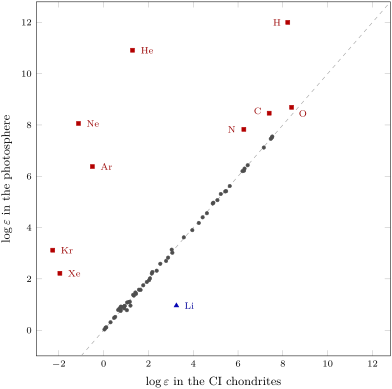
The Sun against the CI chondrites: each point is one element with both values (Asplund, Amarsi and Grevesse, 2021; the meteoritic scale is fixed so that silicon agrees). The dashed line is equality. Black dots: the 58 elements that agree. Squares: hydrogen, helium, carbon, nitrogen, oxygen and the noble gases, which the meteorites did not keep. Triangle: lithium, destroyed in the Sun.
在原文中阅读 →