All books

Professional

Apps About Coach Log in Start reading

Earth and Space Sciences · Glossary

What is Mineral dissolution rate law?

Definition 15.5 University Earth and Space Sciences — Year 3 · Chapter 15 — Water–Rock Interaction

The mineral dissolution rate law gives the rate of dissolution per unit of mineral surface, in mol m−2 s−1\mathrm{mol}\,\mathrm{m}^{-2}\,\mathrm{s}^{-1}, as a sum over acid, neutral and basic mechanisms,

r=∑jkj e−EjR(1T−1298.15) aHX+nj (1−Ωpj)qj,r = \sum_j k_j\,e^{-\frac{E_j}{R}\left(\frac1T - \frac1{298.15}\right)}\, a_{\ce{H+}}^{n_j}\,\bigl(1 - \Omega^{p_j}\bigr)^{q_j},

with rate constants kjk_j at 25 ∘C25\,{}^{\circ}\mathrm{C}, activation energies EjE_j, reaction orders njn_j (negative for the basic mechanism) and two exponents pjp_j, qjq_j, commonly taken as 1.

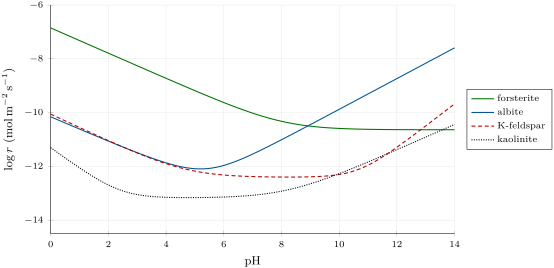
Dissolution rates far from equilibrium at 25\, C, against pH, from a published compilation of laboratory rate parameters. The olivine end-member forsterite has no basic mechanism in the compilation; its curve stops falling at the neutral floor.
Dissolution rates far from equilibrium at 25 ∘C25\,{}^{\circ}\mathrm{C}, against pH, from a published compilation of laboratory rate parameters. The olivine end-member forsterite has no basic mechanism in the compilation; its curve stops falling at the neutral floor.
Read in context →