书籍暂未推出简体中文版——当前显示英文版。
University Earth and Space Sciences — Year 3 · 本科三年级
15Water–Rock Interaction
A spring at the foot of a limestone escarpment leaves a white crust on every twig and stone it touches; a stream draining a granite carries silica, sodium and a little potassium, and leaves no crust at all. The difference is in the water’s chemistry, and the chemistry is a record of the rock the water crossed: how much carbon dioxide it carried, how long it stayed, which minerals it dissolved and which it built. This chapter reads that record with the tools of solution chemistry, from the analysis of a water to the rates of mineral dissolution and the isotopic traces of hot fluids in the crust.
You already know
Activity, activity coefficient, ionic strength, speciation, the solubility product, alkalinity, the saturation state , Henry’s law, rate laws, the Arrhenius law, the transition state and the value are in the chemistry books’ university volumes. Chemical weathering, the hydrolysis of silicates, clay minerals and kaolinite are in the Year 1 volume, in its chapter on weathering and clays; the lysocline and the carbonate compensation depth in its chapter on carbonate, siliceous and evaporite sediments. The hydrothermal fluid is in the Year 2 volume, in its chapter on ore deposits, and the silicate-weathering thermostat in its chapter on climate over geological time; hydrothermal circulation is in the school books.
15.1 The analysis of a natural water
A water analysis lists the major ions in milligrams per litre: calcium, magnesium, sodium and potassium; bicarbonate, chloride, sulfate and nitrate; dissolved silica as ; and the pH and temperature measured at the source, since both change once the sample leaves it. Dividing by the molar mass gives millimoles per litre, and multiplying by the charge, milliequivalents. A dilute water is electrically neutral, so the sum of the cations must equal the sum of the anions.
Method 15.1 (Checking a water analysis)
- convert each concentration to and to ;
- sum the cations and the anions in ;
- compute the charge-balance error , in per cent;
- accept the analysis if the error is within 1 or for a water of 250 to , a little more for a more dilute one; otherwise look for a missing ion or an analytical error.
The activity of an ion is its molality times its activity coefficient . In natural waters is computed from the ionic strength with the extended Debye–Hückel equation
with and for water at , and an ion size in ångströms: 9 for , 8 for , 6 for , 5 for , 4 for , and , 3 for , , and . The equation is good up to about of univalent salts, which covers rivers and most ground waters but not seawater or brines. Temperature changes only from 0.4883 at to 0.5425 at , so the values at serve for cool waters too.
The inorganic carbon of a water is shared among dissolved carbon dioxide (written for the sum of and ), bicarbonate and carbonate, linked by
with , and at , and , and at ( in atmospheres). Between pH 6.4 and 10.3 bicarbonate dominates, and in most natural waters the alkalinity is nearly all bicarbonate. A measured pH and bicarbonate then give the other two species, and the partial pressure of carbon dioxide the water would be in equilibrium with.
15.2 Saturation
Definition 15.2 (Saturation index)
The saturation index (of a mineral) in a water is , where IAP is the ion activity product of the water written like the mineral’s solubility product : .
A water with can dissolve the mineral, one with can precipitate it, and is equilibrium. Since the free energy of the dissolution reaction is , the saturation index is also a measure of the driving force, in units of , about at . For calcite and at , at : calcite is more soluble in cold water. For gypsum, ; for quartz, whose dissolution gives neutral , , and for amorphous silica the constant is 2.71 instead of 3.98. Measured indices carry an uncertainty of at least , and a water within of zero is taken as close to equilibrium.
15.3 Carbonate equilibria in rocks
Calcite dissolves in water charged with carbon dioxide by
with at and at . How much dissolves depends on where the carbon dioxide comes from.
Definition 15.3 (Open and closed carbonate systems)
A water dissolves calcite in an open carbonate system when it stays in contact with a gas of fixed , which replaces the carbon dioxide used. It does so in a closed carbonate system when it was charged with carbon dioxide first and then isolated from the gas, so that the carbon dioxide it holds is all it can use.
Theorem 15.4 (Calcite solubility, open and closed)
For a water of calcium bicarbonate type, with the molality of calcium,
where is the carbon dioxide taken up before the system closed.
Proof. Between pH 6.5 and 8.5 carbonate, and are negligible next to bicarbonate, so the charge balance is . Open: , which gives the cube root. Closed: each calcium dissolved uses one , so and gives the cubic. ∎
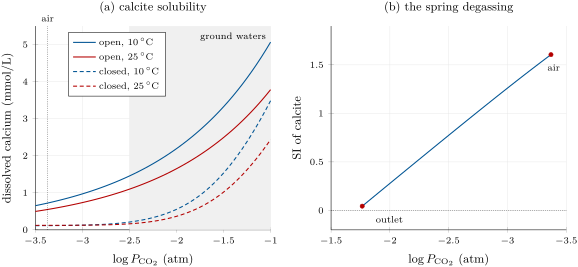
In the open system the calcium grows as the cube root of ; in the closed system it is capped by , and the carbon dioxide left at the end, hence the final , is much lower than at the start. Soil air holds 10 to 100 times the carbon dioxide of the atmosphere, made by roots and by the decay of plant matter, and ground waters commonly show between and atmosphere. Water in contact with calcite and air holds only about of calcium; rain that reaches a limestone through a soil, still open to the soil gas, can take four or five times more. Karst is carved by this soil carbon dioxide.
The way back is degassing. A spring that emerges from a limestone carries the of the soil and the rock, ten to a hundred times that of the air. In the open it loses carbon dioxide, bicarbonate turns into carbonate, the pH rises, and the saturation index climbs by more than a unit, as panel (b) of the figure below shows for the spring of this chapter’s weekend problem. Calcite precipitates on the stream bed and on mosses and twigs: tufa from cold springs, travertine from hot ones. Springs that pass through the rock quickly, in days or weeks, by conduits, commonly reach the surface undersaturated; those that seep slowly through it for months emerge near saturation.
The same chemistry, run at the scale of the ocean, is in the chemistry books’ university volumes; the depth at which seawater becomes undersaturated with calcite, the lysocline, and the depth below which calcite does not accumulate are in the Year 1 volume.
In the field — A spring that builds its own terraces
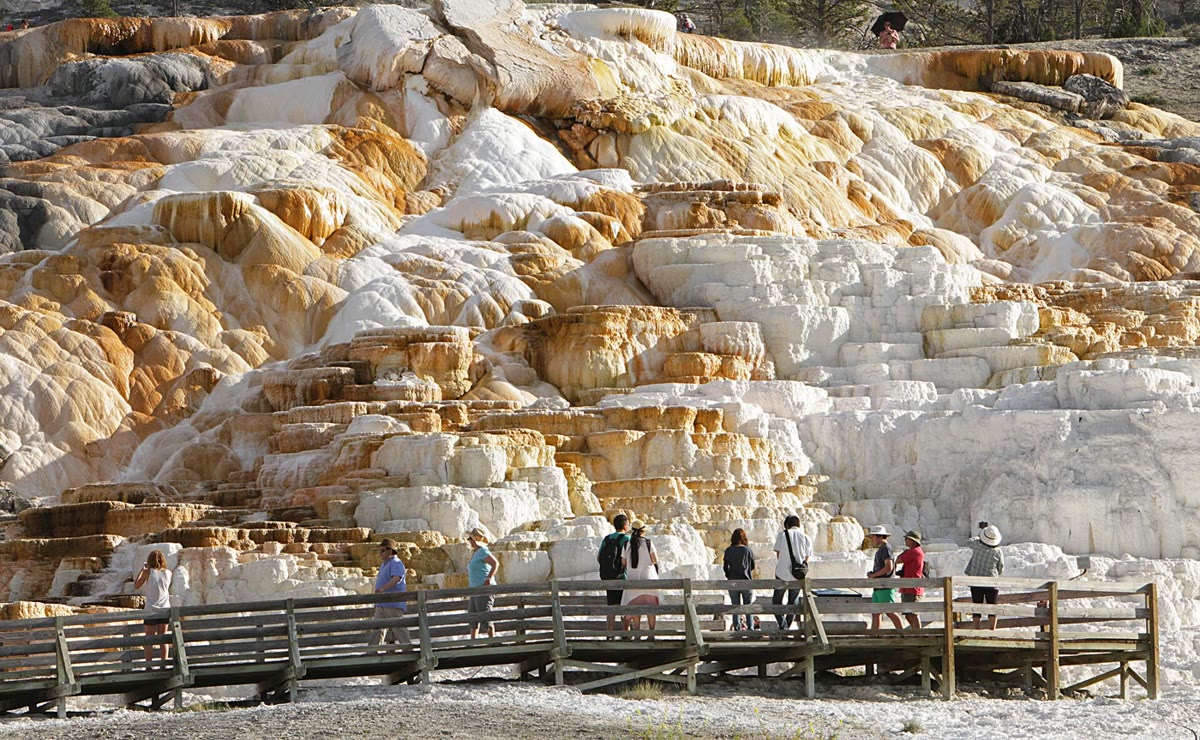
At Palette Spring, one of the Mammoth Hot Springs of the Yellowstone plateau, thermal water rises through a buried limestone and carries it away dissolved. At the surface the water spreads over its own deposits and loses carbon dioxide, and calcium carbonate precipitates as travertine, on the rim of each pool first, where the water is thinnest. Geologists who survey these springs measure deposition of about three millimetres a day, fifteen times the rate of the tufas of cold springs. The orange and brown stripes are mats of heat-loving microbes living in the warm runoff.
15.4 Silicate weathering kinetics
Silicates dissolve far more slowly than calcite, and a water seldom reaches equilibrium with them: their dissolution has to be described by a rate.
Definition 15.5 (Mineral dissolution rate law)
The mineral dissolution rate law gives the rate of dissolution per unit of mineral surface, in , as a sum over acid, neutral and basic mechanisms,
with rate constants at , activation energies , reaction orders (negative for the basic mechanism) and two exponents , , commonly taken as 1.
Proposition 15.6 (Far from and near equilibrium)
With , the rate does not depend on the saturation of the water when , and near equilibrium it is proportional to the saturation index: , where is the rate far from equilibrium.
Proof. The factor is . For it tends to 1; for near 0, . ∎
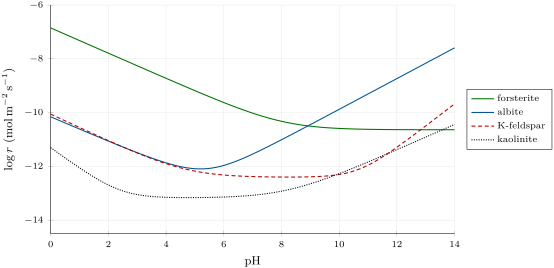
The rate constants come from laboratory experiments on fresh mineral powders, in flow-through reactors kept far from equilibrium. The figure below draws the rate law for four minerals at . Each curve is a V or a U: protons speed dissolution in acid water, hydroxide in basic water, and in between the neutral mechanism sets a floor. Olivine dissolves about three orders of magnitude faster than albite at pH 5, which is why it is the first of the common silicates to disappear from a soil. The activation energies of albite and forsterite, 65 to , make their rates four to five times faster at than at .
Field rates are lower, by orders of magnitude. In column experiments on a freshly crushed granite, the rate of plagioclase fell steadily over six years to ; the same granite, naturally weathered and partly turned to kaolinite, dissolved at under the same conditions, and both are still far faster than the rate measured in the weathering profile itself. Over many minerals and ages, the rate falls with the time the mineral has been weathering as (mol m s, in years). Part of the decline is in the mineral, whose most reactive surfaces dissolve first; the rest is in the setting: slow water, much mineral for little fluid, and pore waters close to equilibrium, where the proposition above makes the rate small.
Definition 15.7 (Weathering regimes)
Chemical weathering in a landscape is in a supply-limited regime when it is limited by the rate at which erosion brings fresh minerals to the weathering front, and in a weathering-limited regime when fresh minerals are abundant and the rate of the reactions limits it.
A compilation of small catchments shows both. Where erosion is slow, under thick and leached soils on gentle relief, the weathering flux follows the erosion rate: whatever fresh rock arrives is fully leached, and a warmer or wetter climate changes little. Where erosion is fast, in steep mountains, the flux grows with runoff, as the square root of the erosion rate, and with temperature, with an apparent activation energy of . Only in the second regime can silicate weathering act as the climate thermostat of the Year 2 volume.
Which secondary mineral a weathering water forms is read on another diagram.
Definition 15.8 (Activity diagram)
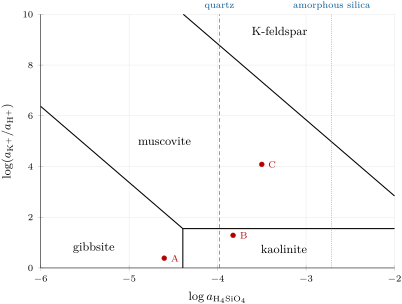
An activity diagram (mineral stability) divides a plane of activity ratios of a water, such as against , into the fields where each mineral of a chemical system is the stable one.
Proposition 15.9 (Boundaries of an activity diagram)
In the system –––, with aluminium conserved in the solids and water at unit activity, a mineral with potassium, aluminium and silicon atoms per formula and dissolution constant (to , , ) fixes
The stable mineral gives the lowest aluminium activity, and the boundary between two minerals is a straight line in .
Proof. The dissolution consumes protons, by charge balance, so ; dividing by and moving to the left gives the expression. A water in equilibrium with one mineral is undersaturated with any mineral that would need more aluminium, and supersaturated with any that would need less, so the least soluble one is stable. Equating two such expressions, linear in and , gives a line. ∎
With the constants at , gibbsite gives way to kaolinite at ( of silica) and kaolinite to muscovite at , and K-feldspar is stable only in waters rich in potassium and silica. The diagram is the weathering sequence of the Year 1 volume in numbers: a dilute water that flushes potassium and silica away strips a feldspar down to gibbsite; a water that keeps more silica makes kaolinite; one that keeps more potassium, as at depth, makes a mica.
15.5 Hydrothermal fluids
Hot water circulating through the crust, near a ridge or an intrusion, exchanges oxygen with the rock it crosses. At high temperature the fractionation between rock and water is small, and both move toward isotopic equilibrium: meteoric water, light, makes the rock lighter, and the water heavier. How far the rock has moved measures how much water has passed.
Definition 15.10 (Water–rock ratio)
The water–rock ratio of a hydrothermal system is the mass of water that has exchanged with a mass of rock, divided by that mass of rock.
Proposition 15.11 (Water–rock ratios from oxygen isotopes)
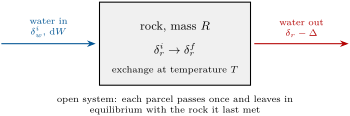
Let a rock of initial exchange oxygen with a water of initial until it reaches , in equilibrium with the water it last met, , and let and be the oxygen concentrations of rock and water. In a closed system (one batch of water) and in an open one (water passing once),
Proof. Closed: oxygen-18 is conserved, , with ; solve for . Open: a parcel enters at and leaves in equilibrium with the rock, at , so . Separating, , and the integral is , which is the expression. ∎
For oxygen is close to 0.5. The open system always needs less water than the closed one for the same shift, because every parcel leaves as heavy as it can. Around many intrusions the of the country rock draws a bull’s-eye of low values, from about down to below 0, centred where the most water passed; the ores of the hydrothermal fluid are often inside the lowest contour, which makes the map an exploration tool.
Definition 15.12 (Reaction-path model)
A reaction-path model follows the composition of a water and the minerals it forms as a reaction progresses, by adding small amounts of a reactant (a mineral dissolving, a gas leaving, heat removed) and recomputing the speciation and the saturation indices at each step, precipitating any mineral that reaches saturation.
A reaction-path model run on the spring of the weekend problem, degassing step by step, precipitates calcite as soon as its index exceeds zero; run on a granite and a rain water, it makes gibbsite first, then kaolinite, then mica as the water collects silica and potassium, tracing a path across the activity diagram. Speciation programs do this with databases of equilibrium constants such as the ones used in this chapter.
15.6 Exercises
Exercise 15.1 ★
A water has (in ) 48, 9.7, 23, 3.9, 183, 35.5 and 48. Compute its charge-balance error. Is the analysis acceptable?
Solution
Solution of Exercise 15.1.
Cations: ; anions: . Error : far beyond the 1 or of a careful analysis of such a water. A cation is missing or under-reported, or an anion is too high.
Exercise 15.2 ★
At an ionic strength of 0.0050, compute the activity coefficients of , and .
Solution
Solution of Exercise 15.2.
. : , ; : ; : .
Exercise 15.3 ★
A water draining a gypsum-bearing marl holds of calcium and of sulfate, at an ionic strength of 0.016. Compute the saturation index of gypsum. Can the water still dissolve gypsum?
Solution
Solution of Exercise 15.3.
; , ; ; . The water is undersaturated and can still dissolve gypsum.
Exercise 15.4 ★
A ground water holds of silica, reported as and present as . Compute its saturation indices for quartz and for amorphous silica at .
Solution
Solution of Exercise 15.4.
, . Quartz: , slightly supersaturated; amorphous silica: , undersaturated.
Exercise 15.5 ★★
With activity coefficients taken as 1, compute the calcium dissolved by an open system at atm at and at , in and .
Solution
Solution of Exercise 15.5.
At , , , ; at , , , : a third more in the cold.
Exercise 15.6 ★★
A water at has pH 7.60 and of bicarbonate. With activity coefficients of 1, compute its dissolved carbon dioxide and carbonate, its and the share of each species in the dissolved inorganic carbon.
Solution
Solution of Exercise 15.6.
; ; , 16 times the air. Total : , , .
Exercise 15.7 ★★
An albite grain is a sphere across in a soil water of pH 5 at , dissolving at the rate of the figure, . With a molar volume of , how fast does its radius shrink, and how long does it last?
Solution
Solution of Exercise 15.7.
(acid, neutral and basic terms contribute , and ). The radius shrinks at , a year; the radius lasts s, about years.
Exercise 15.8 ★★
By what factor does the neutral dissolution rate of albite () grow from to ? And a weathering flux with ?
Solution
Solution of Exercise 15.8.
; with , 8.6.
Exercise 15.9 ★★
Derive the kaolinite–muscovite boundary of the activity diagram from the constants (kaolinite, 2 Al, 2 Si) and (muscovite, 1 K, 3 Al, 3 Si). A water at has of potassium, of silica and pH 7.0: which mineral does it form?
Solution
Solution of Exercise 15.9.
Equating and removes : , a horizontal line. The water has and : above 1.55 and far below the muscovite–K-feldspar line (), so it forms muscovite.
Exercise 15.10 ★★★
Near an intrusion, a granodiorite of is found at (). The meteoric water had , and at the temperature of exchange the rock was heavier than the water. With , compute the water–rock ratio for a closed and an open system, and explain why they differ.
Solution
Solution of Exercise 15.10.
. Closed: . Open: . In the open system each parcel leaves in equilibrium with the rock it last met, carrying away as much oxygen-18 as it can; in the closed system the whole batch ends at and takes away less per kilogram.
Exercise 15.11 ★★★
Rain charged with soil gas at atm at reaches a limestone. With activity coefficients of 1, compute the calcium it dissolves if it stays open to the soil gas and if it is first isolated from it. What fraction of its carbon dioxide is left in the closed case, and what is its final ?
Solution
Solution of Exercise 15.11.
Open: , , . Closed: and ; the cubic gives , , about half. The carbon dioxide left is , of , so falls from to .
Exercise 15.12 ★★★
Using the proposition on rates near equilibrium, what fraction of its far-from-equilibrium rate does a mineral dissolve at with , and ? A laboratory rate measured after 6 years of reaction follows the power law of the chapter: by what factor will it have fallen after years? Combine both effects to explain why field rates are so low.
Solution
Solution of Exercise 15.12.
: 0.99, 0.90 and 0.21. The power law gives : a rate about 90 times lower. A field mineral is old, with its reactive surfaces gone, and bathed in slow pore water close to equilibrium; both factors multiply, and the field rate falls orders of magnitude below the laboratory rate.
15.7 Problem: The Spring below the Varden Limestone
Problem 15.1
Weekend problem — the analysis, carbon dioxide and saturation of an invented limestone spring, and a granite stream
A spring rises at the foot of the Jurassic limestone of the Varden Hills, at and pH 7.20. Its analysis is (in ): 112, 4.0, 7.0, 1.2, 340, 11, 14, 9. At : , , , . Use the extended Debye–Hückel equation of the chapter, ignore ion pairs, and take the air at .
Part I — The analysis.
- Convert the analysis to .
- Compute the charge-balance error. Is the analysis acceptable?
- Compute the ionic strength.
- Compute the activity coefficients of , and .
- Is the extended Debye–Hückel equation valid here?
Part II — Carbon dioxide.
- Compute the activity of bicarbonate.
- Compute the activity of dissolved carbon dioxide.
- Compute the of the spring. How many times that of the air is it, and where can the carbon dioxide come from?
- Compute the carbonate concentration and the share of each species in the dissolved inorganic carbon.
- Check that the alkalinity is nearly all bicarbonate.
Part III — Saturation and travertine.
- Compute the ion activity product and the saturation index of calcite at the outlet.
- Is the spring in equilibrium with calcite? Is it a conduit spring or a slow, diffuse one?
- Compute the calcium of an open system in equilibrium with calcite at the spring’s , with the activity coefficients of question 4, and compare with the analysis.
- The water degasses to the air before any calcite forms. Keeping the bicarbonate activity unchanged, compute its pH and its saturation index.
- Estimate the calcium it keeps once it has precipitated calcite back to equilibrium with the air (open system, activity coefficients at the new ionic strength ), and the mass of calcite per litre.
- The spring flows at and spreads its deposit over . If all that calcite stayed there, at a density of , how fast would the deposit grow?
Part IV — The granite stream. A stream on the Varden granite, under a thick soil on gentle slopes, has (at ) of potassium, of silica and pH 5.8.
- Compute its position on the activity diagram.
- Which mineral does it form? Compute its saturation index for quartz.
- Below what silica concentration would it make gibbsite?
- At what pH would it reach the kaolinite–muscovite boundary?
- Compute the dissolution rate of K-feldspar in this water, far from equilibrium, from the parameters , (acid); (neutral); , (basic).
- Is the weathering of this catchment more likely supply-limited or weathering-limited? Why?
- With an apparent activation energy of , by what factor would a weathering-limited flux change between and ?
- State the saturation index of calcite of the spring water at its outlet.
Solution
Solution of Problem 15.1.
1. 2.795, 0.165, 0.305, 0.031, 5.572, 0.310, 0.146, .
2. Cations , anions : error , acceptable.
3. .
4. : , , .
5. Yes: is a tenth of the limit of about 0.1.
6. ().
7. ().
8. , : times the air, within the ground-water range. The carbon dioxide comes from the soil air of the recharge area, from roots and decay.
9. , . Total : , , .
10. Alkalinity : bicarbonate.
11. ; ; .
12. Within , the uncertainty of the index: the water is in equilibrium with calcite. It has stayed long in the rock: a slow, diffuse spring.
13. , , against measured: more, as an index of means.
14. ; , pH 8.80; ; (1.61 with the full alkalinity balance of the figure).
15. Iterating with : (), . Calcite precipitated: , about per litre.
16. , a year, ; over , a year, a day: well below the cold-spring tufas quoted in the chapter.
17. ; .
18. and : kaolinite. Quartz: .
19. Below , of silica.
20. needs pH .
21. Acid ; neutral ; basic . Sum: , the neutral term dominant.
22. Supply-limited: thick soil and gentle slopes mean slow erosion; the fresh feldspar that reaches the weathering front is fully leached, and the flux follows the erosion rate rather than the climate.
23. .
24. The calcite saturation index of the spring water at its outlet is .