
全部书籍

专业

应用 关于 Coach 登录 开始阅读

书籍暂未推出简体中文版——当前显示英文版。

Earth and Space Sciences · 术语表

什么是 Mixed layer, thermocline, halocline, pycnocline?

又称: mixed layer · thermocline · halocline · pycnocline

Definition 26.12 University Earth and Space Sciences — Year 1 · 第 26 章 — Structure of the Atmosphere and the Ocean

The mixed layer is the surface layer of the ocean whose temperature, salinity and density are nearly uniform with depth; its depth is read on a profile as the depth where the temperature first differs from its surface value by a chosen threshold, often 0.5 ∘C0.5\,{}^{\circ}\mathrm{C}. The thermocline, the halocline and the pycnocline are the layers below it in which the temperature, the salinity and the density respectively change fastest with depth.
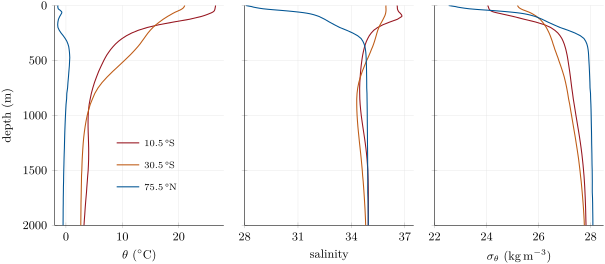
Potential temperature, salinity and potential density anomaly () in the upper 2000\, m, in the annual mean, at three places: the tropical South Atlantic (10.5 S, 25.5 W), the subtropical South Atlantic (30.5 S, 25.5 W) and the Canada Basin of the Arctic Ocean (75.5 N, 150.5 W). Data: World Ocean Atlas 2023.
Potential temperature, salinity and potential density anomaly (Definition 26.13) in the upper 2000 m2000\,\mathrm{m}, in the annual mean, at three places: the tropical South Atlantic (10.5∘S10.5{}^{\circ}\mathrm{S}, 25.5∘W25.5{}^{\circ}\mathrm{W}), the subtropical South Atlantic (30.5∘S30.5{}^{\circ}\mathrm{S}, 25.5∘W25.5{}^{\circ}\mathrm{W}) and the Canada Basin of the Arctic Ocean (75.5∘N75.5{}^{\circ}\mathrm{N}, 150.5∘W150.5{}^{\circ}\mathrm{W}). Data: World Ocean Atlas 2023.
在原文中阅读 →