
全部书籍

专业

应用 关于 Coach 登录 开始阅读

书籍暂未推出简体中文版——当前显示英文版。

Earth and Space Sciences · 术语表

什么是 Modal analysis, point counting?

又称: modal analysis · point counting

Definition 31.5 University Earth and Space Sciences — Year 2 · 第 31 章 — Field and Lab Methods II

A modal analysis is the measurement of the modal composition of a rock. In point counting, a thin section is moved under the cross-wires of the microscope in equal steps along a regular grid, and the mineral under the cross-wires is recorded at each point; the proportion of the points that fall on a mineral estimates its proportion in the rock.
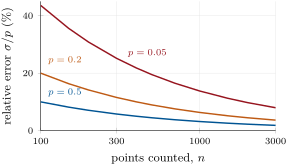
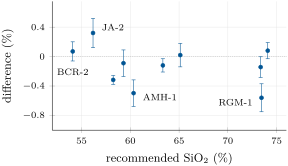
Left: relative standard error of a modal proportion p measured by point counting, , for a rare, a common and an abundant mineral. Right: accuracy of silica by X-ray fluorescence on fused beads for ten rock reference materials, from basalt to granite; each dot is the mean of 2 to 30 analyses minus the recommended value, with the standard deviation of the analyses as a bar. Data: Taggart and Siems (2002), USGS.
Left: relative standard error of a modal proportion pp measured by point counting, (31.2), for a rare, a common and an abundant mineral. Right: accuracy of silica by X-ray fluorescence on fused beads for ten rock reference materials, from basalt to granite; each dot is the mean of 2 to 30 analyses minus the recommended value, with the standard deviation of the analyses as a bar. Data: Taggart and Siems (2002), USGS.
在原文中阅读 →