
全部书籍

专业

应用 关于 Coach 登录 开始阅读

书籍暂未推出简体中文版——当前显示英文版。

Earth and Space Sciences · 术语表

什么是 Normal fault?

Definition 14.7 High School Earth and Space Sciences · 第 14 章 — Ocean Ridges and the Oceanic Lithosphere

A normal fault is an inclined fault along which the block above the fault plane has moved down relative to the block below it. Normal faults form where the crust is stretched.
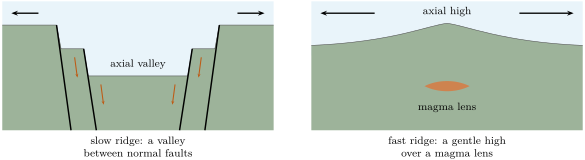
Sections across a slow and a fast ridge (drawings, not to scale; the height is exaggerated). Left: the axial valley of a slow ridge, 1 to 2\, km deep, has dropped between normal faults dipping toward the axis (orange arrows: the blocks above the faults slide down). Right: a fast ridge rises gently above a lens of magma.
Sections across a slow and a fast ridge (drawings, not to scale; the height is exaggerated). Left: the axial valley of a slow ridge, 1 to 2 km2\,\mathrm{km} deep, has dropped between normal faults dipping toward the axis (orange arrows: the blocks above the faults slide down). Right: a fast ridge rises gently above a lens of magma.

示例

Example 14.8 (A slow and a fast ridge)

In a million years the East Pacific Rise at 30∘30{}^{\circ} South makes 14.6 cm/yr×106 years=146 km14.6\,\mathrm{cm}/\mathrm{yr} \times 10^6\ \text{years} = 146\,\mathrm{km} of new ocean floor, 73 km73\,\mathrm{km} on each side; the Mid-Atlantic Ridge at the same latitude makes 33 km33\,\mathrm{km}, 16.5 km16.5\,\mathrm{km} on each side. The deep hole of the eastern Pacific went into crust made at more than 20 cm20\,\mathrm{cm} a year, among the fastest spreading ever recorded.

在原文中阅读 →