High School Earth and Space Sciences · Grades 10–12
14Ocean Ridges and the Oceanic Lithosphere
In February 1977 a camera sled towed 2500 metres down over the Galápagos Rift, in the eastern Pacific, photographed the bare black lava of the ridge frame after frame. Then its thermometer recorded a small rise in the temperature of the water, and on the photographs the lava was covered with hundreds of white clams. A few days later the submersible Alvin took two geologists down to the spot: warm, shimmering water was flowing out of cracks in the lava, and around it lived clams as long as a forearm, mussels and white crabs; on a later dive, tubeworms with red tops. Nobody had expected life there, so no biologist was on board. This chapter explains what the geologists had found: how the ocean floor is made at the ridges, why it is hot there, and what becomes of it as it moves away.
You already know
At the ridges new ocean floor is made and moves away on both sides, so that its age grows with distance from the axis; the ridges form a system about long, with a rift valley along slow ridges and a smooth crest along fast ones (Chapter 10). Plates move apart across a ridge at a few centimetres a year, faster across the East Pacific Rise than across the Mid-Atlantic Ridge (Chapter 13). The lithosphere is the rigid outer shell, the asthenosphere beneath it flows; the temperature of the asthenosphere rises by only about per kilometre of depth, and the melting temperature of mantle rock rises with depth (Chapter 12). Magma is molten rock below the surface, basalt the dark rock that lava makes when it cools, and a fault a break along which rocks have moved (Book 1, grades 6 and 7).
14.1 The oceanic lithosphere
Two rocks that are rare at the surface of the continents make most of the oceanic lithosphere.
Definition 14.1 (Peridotite)
Peridotite is a dark, coarse-grained rock made mostly of the mineral olivine, with some pyroxene. It is usually green and dense. Much of the Earth’s mantle is believed to be made of peridotite.
Definition 14.2 (Gabbro)
Gabbro is a dark, coarse-grained igneous rock made mainly of plagioclase feldspar and pyroxene. It has the same composition as basalt, but it crystallised slowly, deep underground, which gave its crystals time to grow. It is the most abundant rock of the deep oceanic crust.
The minerals named here, olivine, pyroxene and feldspar, are described in Chapter 16.
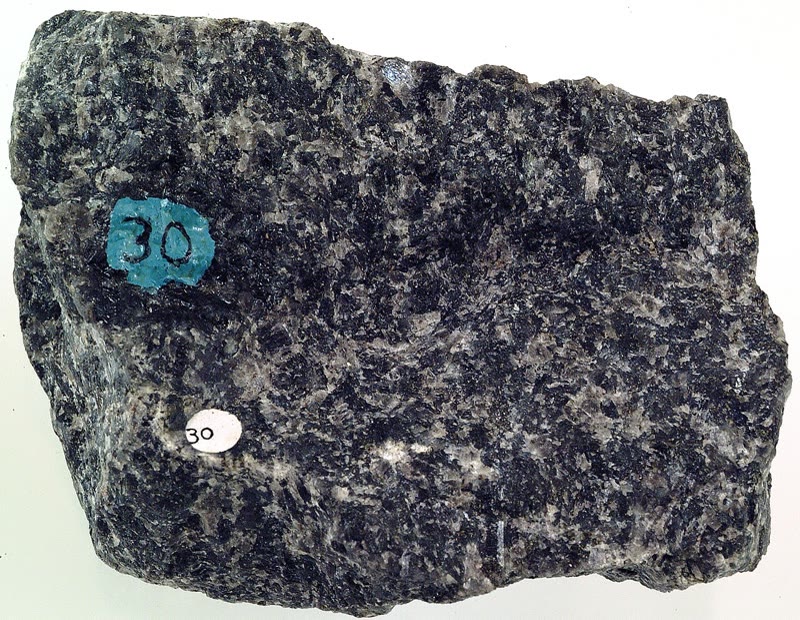
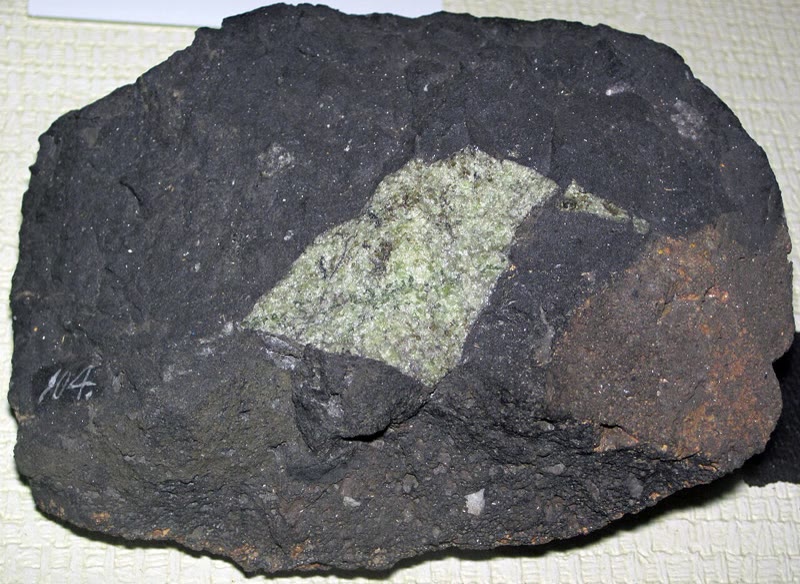
Definition 14.3 (Oceanic crust; oceanic lithosphere)
The oceanic crust is the crust of the ocean floor: about of basalt and gabbro, made at the ridges. The oceanic lithosphere is the oceanic crust together with the rigid peridotite of the uppermost mantle beneath it.
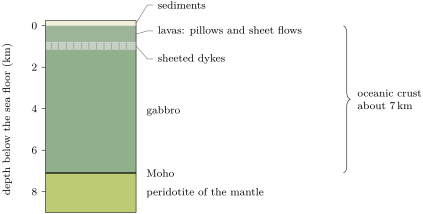
Seismic surveys all over the oceans give the oceanic crust an average thickness of , give or take , away from fracture zones and hotspots. Its layers are known from deep drilling and from slices of old ocean floor pushed up onto the continents. In 2005 a drill ship finished a hole deep into 15-million-year-old crust of the eastern Pacific, the first to go from the lavas, through the dykes, into the gabbros:
- at the top, a thin cover of sediments, absent at the ridge axis and thicker on older floor;
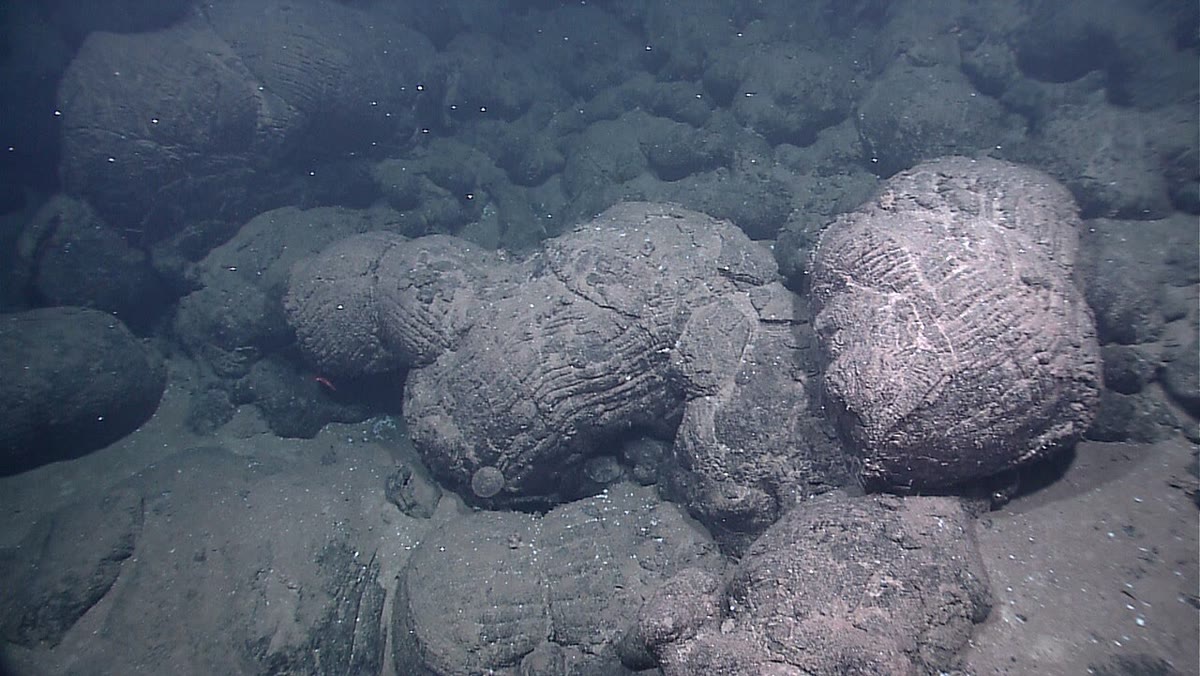
- more than of basalt lavas, erupted on the sea floor as sheets and as pillows, rounded tubes and blobs of lava with a glassy skin;
- the sheeted dykes, in this hole: hundreds of vertical sheets of basalt, each the frozen crack through which magma rose to an eruption, side by side like the pages of a book;
- gabbro, reached below the sea floor, the magma that crystallised slowly below the dykes, down to the Moho;
- below the Moho, the peridotite of the mantle.
14.2 Melting without heating
The mantle beneath a ridge is solid peridotite, as everywhere else. Yet of basalt and gabbro, a molten rock frozen, come out of it. Where does the melt come from?
Definition 14.4 (Partial melting; decompression melting)
Partial melting is the melting of only part of a rock: some of its minerals, or some of their components, melt, while the rest stays solid. Decompression melting is the partial melting of a rock that rises, and so is less and less squeezed, without being heated.
As two plates move apart, the asthenosphere rises beneath the ridge to fill the gap. It rises too fast to lose much heat, so its temperature falls only by about per kilometre on the way up. Its melting temperature, which depends on the pressure, falls much faster: about per kilometre at a depth of . At some depth the rising rock reaches its melting temperature and starts to melt, although no heat has been added.
Method 14.5 (Where does the rising mantle melt?)
- Write the temperature of the rising rock at each depth: its potential temperature (the temperature it would have at the surface) plus per kilometre of depth.
- Write the melting temperature of the rock at each depth, from the pressure at that depth.
- Find the depth where the two are equal. Deeper, the rock is solid; shallower, it is partly molten.
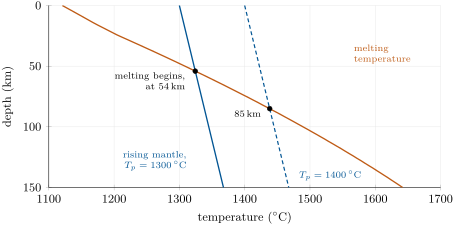
Example 14.6 (The depth of melting)
For a mantle of potential temperature , the rising rock is at when it reaches , exactly its melting temperature at that depth: melting begins about down. Above that depth it goes on melting as it rises.
Only a small fraction of the peridotite melts, and the melt is not peridotite: it is basalt. Basalt melts gather from the whole melting region, which reaches from the onset depth up to the base of the crust; being lighter than the solid rock around them, they rise to the ridge axis. There part of the magma erupts as lava, part freezes in the cracks it rose through as dykes, and part crystallises slowly below as gabbro. The solid peridotite left behind, depleted of its basalt, becomes the mantle part of the oceanic lithosphere.
Where a ridge crosses a region of hotter mantle, around a hotspot, melting begins deeper, a longer column of rock melts and more basalt is made: there the crust is about thick instead of 7. Conversely, beneath very slow ridges the rising mantle has time to lose heat, melts less, and makes an unusually thin crust.
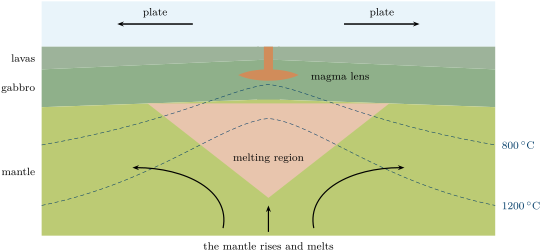
14.3 Fast and slow ridges
Ridges open at very different speeds. Computed from the rotation poles of Chapter 13, the East Pacific Rise at South opens at a year, the Mid-Atlantic Ridge at the same latitude at a year. The shape of the axis is not the same.
Along slow ridges, the axis is a valley 1 to deep and 20 to wide. Too little magma reaches the axis to fill the gap continuously: the cold, brittle lithosphere is pulled apart and breaks along faults.
Definition 14.7 (Normal fault)
A normal fault is an inclined fault along which the block above the fault plane has moved down relative to the block below it. Normal faults form where the crust is stretched.
The valley of a slow ridge is a block that has dropped between normal faults facing each other; nearly all of them dip toward the axis. Such a down-dropped block between normal faults is called a graben.
Along fast ridges, magma arrives often enough to fill the gap. The axis is a smooth, gentle high, above a lens of magma that lies beneath it.
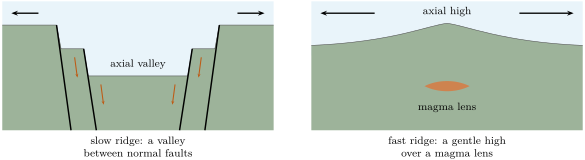
Example 14.8 (A slow and a fast ridge)
In a million years the East Pacific Rise at South makes of new ocean floor, on each side; the Mid-Atlantic Ridge at the same latitude makes , on each side. The deep hole of the eastern Pacific went into crust made at more than a year, among the fastest spreading ever recorded.
14.4 Hydrothermal vents
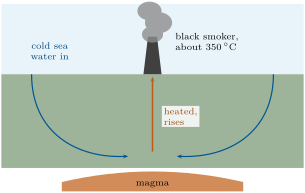
The young crust at the axis is hot, and it is broken by cracks. Sea water finds its way in.
Definition 14.9 (Hydrothermal circulation; black smoker)
Hydrothermal circulation is the flow of sea water down through the cracks of the hot oceanic crust, where it is heated by the magma below and reacts with the rock, and back up to the sea floor, where it comes out at hydrothermal vents. A black smoker is a vent from which very hot water carrying dissolved metals pours out; as it meets the cold sea water, iron sulfides and other minerals precipitate as a black cloud, and build a chimney around the vent.
Black-smoker water typically leaves its chimney at about , and vent waters can reach . They do not boil, because two and a half kilometres of water press on them. The chimneys can grow more than high. Around the vents, bacteria draw their energy from the hydrogen sulfide of the vent water, and feed tubeworms, shrimp and mussels: the clams of the Galápagos Rift lived on this. Most vents lie along the mid-ocean ridges.
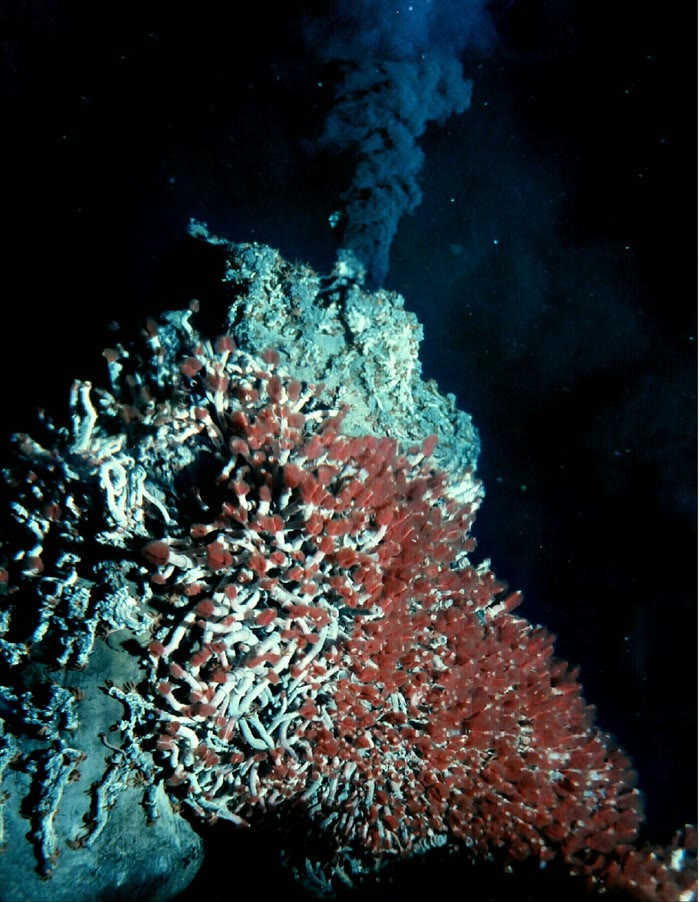
History — Alvin on the Galápagos Rift, 1977
The expedition, funded by the National Science Foundation, began on 8 February 1977 aboard the research ship Knorr. The camera sled ANGUS, towed down over the rift, recorded a rise in the temperature of the water, and in the same frames its photographs showed hundreds of white clams and brown mussel shells on the lava. On Alvin’s dive 713, the geologists Jack Corliss and Tjeerd van Andel found water at shimmering out of the cracks, then up to , while the deep water around was at ; white clams up to long covered an area about across. No biologist was aboard: the expedition had come for the hot water, and found a community of animals that nobody had imagined.
14.5 Cooling, thickening, sinking
As it moves away from the axis, the lithosphere cools from the top, through the cold ocean above it. The cooled layer grows thicker with time: the lithosphere thickens, from a few kilometres at the axis to about a hundred kilometres on old floor. Cooled rock contracts and becomes denser, so the lithosphere floats lower on the asthenosphere (isostasy, Chapter 12): the ocean floor sinks as it ages. For a body that cools by conduction from its surface, the thickness of the cooled layer grows like the square root of the time.
Proposition 14.10 (Depth of the ocean floor against its age)
On average, ocean floor of age (in millions of years) lies at the depth
and, for floor older than about 20 million years,
the floor sinks quickly while it is young, then more and more slowly, toward about . (Admitted: the formulas were fitted to the depths of the North Pacific and North Atlantic, corrected for the weight of their sediments, by Parsons and Sclater in 1977.)
The square root makes the young floor sink fast: in its first million years the floor sinks by , in the next three million years by another , and between 16 and 64 million years by , as much as in its first sixteen million years. The exponential law describes how old floor stops sinking: it behaves as if the cooling plate had a fixed thickness, about .
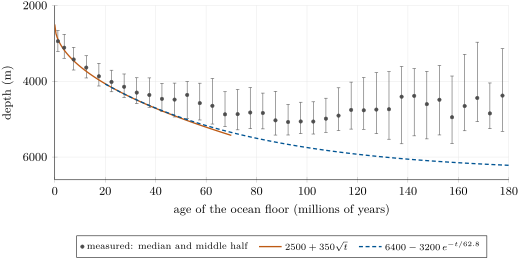
The measured depths of young floor agree with the law to within about . On older floor the measured medians lie several hundred metres above the laws. The laws describe the depth of the floor itself, as if its sediments were removed; the measured cells still carry their sediments, which grow thicker with the age of the floor and are more than a kilometre thick on the oldest floor of the western North Atlantic, and they include seamounts and volcanic plateaus.
Old oceanic lithosphere is therefore thick, cold and dense. The next chapter shows that it can become denser than the asthenosphere beneath it, and sink back into the mantle (Chapter 15).
14.6 Exercises
Exercise 14.1 ★
Define peridotite and gabbro. Which of the two belongs to the oceanic crust, and which to the mantle? Gabbro has the same composition as basalt: why are its crystals so much larger?
Solution
Solution of Exercise 14.1.
Peridotite is a dark, coarse-grained rock made mostly of olivine, with some pyroxene; much of the mantle is made of it. Gabbro is a dark, coarse-grained igneous rock of plagioclase feldspar and pyroxene, the most abundant rock of the deep oceanic crust. Gabbro belongs to the crust, peridotite to the mantle. Gabbro crystallised slowly, deep under the sea floor, where the magma cooled slowly: its crystals had time to grow. Basalt lava cooled quickly at the sea floor, and its crystals stayed small.
Exercise 14.2 ★
List the layers of the oceanic lithosphere from the sea floor down. The deep hole of the eastern Pacific reached below the sea floor: what fraction of a crust did it cross?
Solution
Solution of Exercise 14.2.
From the sea floor down: sediments (none at the axis), basalt lavas (pillows and sheet flows), sheeted dykes, gabbro, then, below the Moho, the peridotite of the mantle. The hole crossed , about a fifth of the crust: the deep gabbros and the Moho have never been reached by a drill.
Exercise 14.3 ★
Using , find the depth of ocean floor 0, 9 and 25 million years old.
Solution
Solution of Exercise 14.3.
; ; .
Exercise 14.4 ★
Define a normal fault. At a slow ridge, what force makes normal faults, and in which direction do the blocks above the faults move?
Solution
Solution of Exercise 14.4.
A normal fault is an inclined fault along which the block above the fault plane has moved down relative to the block below. At a slow ridge the plates pull the cold, brittle lithosphere apart: it is stretched, and it breaks. The blocks above the faults slide down, toward the axis, and the axial valley is the block that has dropped between them.
Exercise 14.5 ★
Black-smoker water comes out at about . Why does it not boil? What is the black “smoke”?
Solution
Solution of Exercise 14.5.
It does not boil because of the pressure: more than two kilometres of water press on it, and under that pressure water stays liquid far above . The black “smoke” is a cloud of tiny grains of iron sulfides and other minerals, which precipitate when the hot vent water, rich in dissolved metals, meets the cold sea water.
Exercise 14.6 ★★
Using the melting figure: (1) at what depth does a mantle of potential temperature begin to melt, and at what temperature? (2) And a mantle hotter? (3) Which of the two makes the thicker crust? Why?
Solution
Solution of Exercise 14.6.
(1) About down, at about . (2) About down, at about . (3) The hotter mantle starts to melt deeper, so a longer column of rising rock melts before reaching the crust: it makes more basalt, and a thicker crust.
Exercise 14.7 ★★
Rising mantle rock of potential temperature is at at a depth of , where its melting temperature is . (1) How far below its melting temperature is it? (2) It starts to melt at . By how many degrees per kilometre, on average, has the gap closed on the way up? (3) Has the rock been heated?
Solution
Solution of Exercise 14.7.
(1) below its melting temperature. (2) It rises ; the gap closes by per kilometre on average. (3) No: on the way up the rock even cools a little, by about . It is its melting temperature that falls, much faster, as the pressure decreases.
Exercise 14.8 ★★
The East Pacific Rise opens at a year at South, the Mid-Atlantic Ridge at a year. Assuming symmetric spreading, how long does each ridge take to make of floor on one side?
Solution
Solution of Exercise 14.8.
The half rates are and a year, i.e. and per million years. To make of floor on one side: million years for the East Pacific Rise, million years for the Mid-Atlantic Ridge.
Exercise 14.9 ★★
The ridges are about long. Suppose they open on average at a year and make a crust thick. (1) What area of new ocean floor do they make each year? (2) What volume of crust? (3) How long would they take to make an area equal to that of the oceans, ?
Solution
Solution of Exercise 14.9.
(1) is : of new floor a year. (2) of crust a year. (3) years, about 110 million years: at this pace the ridges could make the whole ocean floor in about a hundred million years, a short time compared with the age of the Earth. This is why no ocean floor is very old.
Exercise 14.10 ★★
An axial valley is deep. It dropped along two normal faults facing each other, each dipping at . (1) By how much did each fault move along its plane? (2) How far apart did the two sides move horizontally because of the two faults? (3) The valley is wide: did faulting alone make it?
Solution
Solution of Exercise 14.10.
(1) The fault plane makes with the horizontal, and the drop is the vertical side of a right triangle whose hypotenuse is the slip: . (2) Each fault moves the sides apart horizontally by ; the two faults together, by about . (3) No. The is the distance between the faults that bound the dropped block, not the amount of stretching, which is only about ; and the ridge keeps opening by fresh dykes and lavas at the axis as well as by faulting.
Exercise 14.11 ★★
Using , find the depth of floor 25 and 100 million years old, and how much the floor sinks between these ages. Compare the first value with that of the square-root law.
Solution
Solution of Exercise 14.11.
; . Between 25 and 100 million years the floor sinks by about . The square-root law gives at 25 million years: the two laws agree, where both apply.
Exercise 14.12 ★★★
A column of mantle thick cools by on average. Rock contracts by of its length for each degree of cooling. (1) By how much does the column shorten? (2) As it sinks, sea water () fills the space above it; with a mantle density of , isostasy makes the floor sink by . Compute . (3) Compare with the total sinking that the exponential law allows, from to .
Solution
Solution of Exercise 14.12.
(1) . (2) . (3) The exponential law allows of sinking in all: cooling and contraction alone explain about four fifths of it, with simple values for the temperature drop and the thickness.
Exercise 14.13 ★★★
Melting begins down in a mantle at , down in one at ; in both, melting goes on up to the base of the crust, about down. (1) Compare the lengths of the two melting columns. (2) If each kilometre of rising rock gave the same amount of melt, how thick would the crust be over the hotter mantle, for a crust over the normal one? (3) Compare with the measured where ridges meet hotter mantle.
Solution
Solution of Exercise 14.13.
(1) against : the hotter column is times longer. (2) . (3) The measured is thicker than normal, as predicted, but less than the estimate: the deepest kilometres of the column, just above the onset of melting, give less melt than the shallower ones, so the assumption of the same melt per kilometre overestimates.
Exercise 14.14 ★★★
The measured median depths of the ocean floor are at an age of million years, at , at and at . (1) Compute the depth given by the square-root law at each age, and the difference with the measurement. (2) How does the difference change with age? (3) Explain it.
Solution
Solution of Exercise 14.14.
(1) The law gives , , and ; the measured medians are shallower by , , and . (2) The difference grows with age. (3) The law gives the depth of the floor itself, corrected for its sediments; the measured cells carry their sediments, which are thicker on older floor, and include seamounts and volcanic plateaus, which are shallower than the floor around them.
Exercise 14.15 ★★★
Water’s critical point is at and : above that pressure, water does not boil at any temperature. (1) Compute the pressure of the water down (sea water , , plus the atmosphere’s ). (2) Can the water of a vent boil at that depth, however hot it is? (3) Below about what depth is this true for every vent?
Solution
Solution of Exercise 14.15.
(1) , plus : about . (2) This is above the critical pressure, : the vent water cannot boil, however hot it is. (3) The pressure reaches at the depth : every vent deeper than about is safe from boiling.
14.7 Problem: The Life of a Piece of Pacific Floor
Problem 14.1
Weekend problem — from the ridge to the deep ocean
A piece of ocean floor is born today on the East Pacific Rise at South, where the Pacific and Nazca plates move apart at a year. It moves west with the Pacific plate. Take the spreading as symmetric, the crust thick, and the depth law metres ( in millions of years).
Part I — Birth at the ridge.
- What is the half spreading rate, in centimetres a year and in kilometres per million years?
- At what depth is the piece of floor born?
- List the rocks it is made of, from the sea floor down to the base of the lithosphere.
- The magma that made it came from the mantle below. Explain how the mantle melted without being heated.
- What volume of crust does this ridge make each million years, on both sides, for each kilometre of its length?
Part II — The journey.
- How far from the ridge will the piece be after 1, 4, 16 and 64 million years, if the rate stays the same?
- How long will it take to travel ?
- Why may the real distance after 64 million years differ from the answer of question 6?
- Near the ridge, sea water circulates through the young crust and comes out at vents. Why does this circulation stop on old floor?
- On which plate does the piece travel, and toward which kind of plate boundary does that plate carry it, on its western side?
Part III — Sinking as it ages.
- Compute its depth at 1, 4, 16 and 64 million years.
- By how much does it sink during its first 16 million years, and between 16 and 64 million years? Comment.
- At what age does it reach a depth of ?
- Compare its depth at 64 million years with the exponential law, .
- The measured median depth of ocean floor 60 to 65 million years old is . Explain the difference.
Part IV — Its density and its fate.
- By 64 million years, take its lithosphere as thick and on average colder than the asthenosphere. With per degree, by what fraction has the mantle part become denser? Starting from , what is its density?
- Its crust is thick, with a density of . Compute the mean density of the whole of lithosphere.
- Compare with the asthenosphere beneath it, taken at .
- What can such a lithosphere do when it reaches a trench?
- Conclude: at what depth does this piece of floor lie when it is 64 million years old?
Solution
Solution of Problem 14.1.
1. a year, i.e. per million years.
2. At the depth of the ridge axis, .
3. From the sea floor down: basalt lavas (pillows and sheet flows), sheeted dykes and gabbro, about of crust in all; below the Moho, the peridotite of the mantle, to the base of the lithosphere, which is still very thin at the axis. Sediments will settle on it later.
4. As the plates move apart, the asthenosphere rises beneath the ridge. Its temperature falls only by about per kilometre, while its melting temperature falls much faster as the pressure decreases. About down the two meet: the rock starts to melt, and goes on melting as it rises, without any heat being added (decompression melting).
5. Each million years the ridge makes of floor on its two sides; for each kilometre of ridge, the volume of crust is .
6. : , , and .
7. million years.
8. Plates change their speed and direction over tens of millions of years, as the bend of the Hawaiian–Emperor chain shows (Chapter 13); the rate of today need not hold for 64 million years.
9. Away from the axis the crust is no longer above a magma lens: it cools, and there is no longer enough heat below to drive the circulation and heat the water.
10. West of the East Pacific Rise the piece travels on the Pacific plate. Toward the west, the Pacific plate ends along deep trenches, where it sinks beneath its neighbours: subduction zones (Chapter 15).
11. , , , .
12. during the first 16 million years, and between 16 and 64 million years: the same sinking, in a time three times longer. The floor sinks more and more slowly as it ages.
13. gives , so million years.
14. , about less than the square-root law: the two laws agree to about .
15. The measured median is about shallower than the law. The law describes the floor corrected for the weight of its sediments; the measured depths include the sediments, many tens of millions of years of them on such floor, and the seamounts and volcanic plateaus, all of which make the measured floor shallower.
16. : the mantle part is denser, .
17. The mantle part is thick. Mean density: .
18. : the old lithosphere as a whole is about , about , denser than the asthenosphere beneath it. The light crust is no longer enough to make up for its cold, dense mantle part.
19. Being denser than the asthenosphere, it can sink back into the mantle at a trench: subduction, the subject of the next chapter.
20. At 64 million years the piece of floor lies at about : about 5.3 km down, deeper than where it was born.