全部书籍

专业

应用 关于 Coach 登录 开始阅读

书籍暂未推出简体中文版——当前显示英文版。

Earth and Space Sciences · 术语表

什么是 Parent isotope, radiogenic daughter?

又称: parent isotope · radiogenic daughter

Definition 25.1 University Earth and Space Sciences — Year 1 · 第 25 章 — Radiometric Dating Methods

In a decay system used for dating, the parent isotope is the radioactive isotope whose decay serves as the clock, and the daughter is the isotope its decay produces. The radiogenic daughter, written D∗D^*, is the part of the daughter made by the decay of the parent inside the sample since the clock started; the rest, D0D_0, was there from the start. The number of atoms of the daughter measured today is D=D0+D∗D = D_0 + D^*.

The parent and its radiogenic daughter in a closed system, as fractions of the initial number of parent atoms, against time counted in half-lives. Their sum stays equal to one; the ratio D*/P, printed at each whole half-life, doubles and adds one at each step.
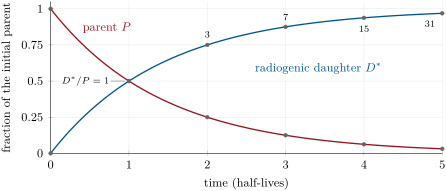
The parent and its radiogenic daughter in a closed system, as fractions of the initial number of parent atoms, against time counted in half-lives. Their sum stays equal to one; the ratio D∗/PD^*/P, printed at each whole half-life, doubles and adds one at each step.
在原文中阅读 →