书籍暂未推出简体中文版——当前显示英文版。
University Earth and Space Sciences — Year 1 · 本科一年级
25Radiometric Dating Methods
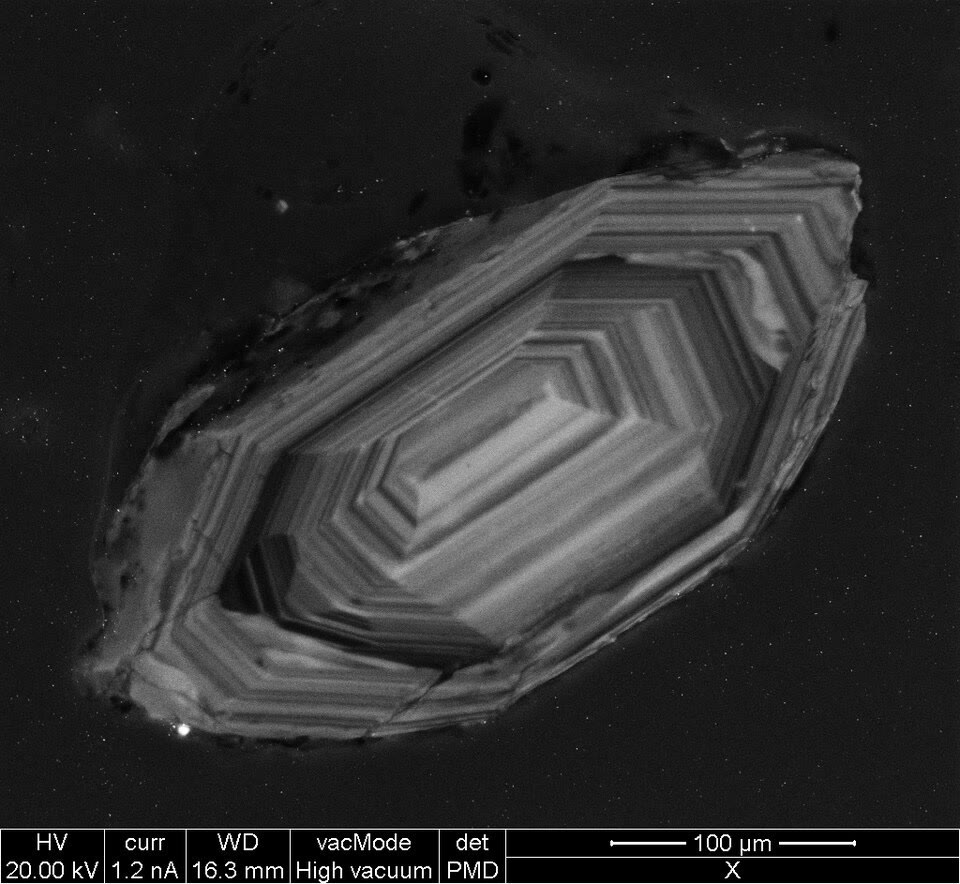
In 2001 a team working on detrital grains of zircon from the Jack Hills of Western Australia reported one that had crystallised million years ago. Later work confirmed the age of these grains: they are the oldest known material of any kind formed on the Earth, and they show that a crust had formed within about 160 million years of the birth of the Solar System. At the other end of the scale, argon ages have placed the extinction at the end of the Cretaceous, ago, within years of the impact thought to have caused it. Both numbers come from counting atoms: a radioactive parent that decays at a known rate, a daughter that accumulates. This chapter explains how such clocks are read, why each dates a different event, and how they hang the chart of Chapter 24 on a scale of years.
You already know
The physics volumes describe radioactive decay: the nuclei of a radioactive isotope decay at random, independently of temperature and pressure, so that the number left after a time follows , where is the decay constant; the half-life is . Isotopes of an element have the same number of protons and different numbers of neutrons; the chemistry volumes describe the mass spectrometer, which sorts ions by mass. In Book 2, grade 12, a rock or mineral that has exchanged no parent or daughter atoms with its surroundings is a closed system, and the minerals of the Varden granite, plotted on a rubidium–strontium isochron, gave an age of 310 million years. Biotite, muscovite and hornblende are the micas and the amphibole of Definition 7.10. An age between two dated levels can be interpolated (Proposition 24.8).
25.1 Decay systems
A clock needs two counts: what is left of the parent, and how much daughter it has made since the clock started.
Definition 25.1 (Parent isotope, radiogenic daughter)
In a decay system used for dating, the parent isotope is the radioactive isotope whose decay serves as the clock, and the daughter is the isotope its decay produces. The radiogenic daughter, written , is the part of the daughter made by the decay of the parent inside the sample since the clock started; the rest, , was there from the start. The number of atoms of the daughter measured today is .
Proposition 25.2 (Radiogenic growth and the age equation)
In a closed system that contains atoms of the parent today, the radiogenic daughter made in a time is
provided each decay gives one atom of the daughter. The age is then
Proof. By the decay law the parent numbered when the clock started. In a closed system every missing parent atom has become a daughter atom, so . Then ; taking logarithms gives the age. ∎
The age depends only on a ratio of two numbers of atoms, which is what a mass spectrometer measures best. The figure below shows the two counts in units of the half-life: after one half-life , after two , after three — in general after half-lives.
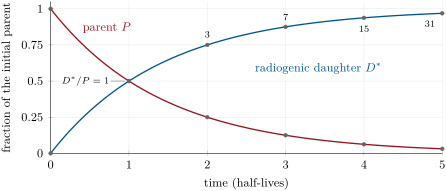
A clock reads well only within a window of ages. Long before one half-life the daughter is a tiny fraction of the parent; after many half-lives too little parent is left to measure. The table below lists the systems most used, with the material each is applied to.
| parent | daughter | half-life (years) | (per year) | dated material |
|---|---|---|---|---|
| wood, charcoal, bone, shell | ||||
| , | potassium-rich minerals: sanidine, biotite, hornblende | |||
| granites (whole rocks), micas | ||||
| rocks and their minerals (isochrons) | ||||
| zircon | ||||
| zircon |
Two sets of numbers are in use for the same nuclei, and an age must say which it used. Nuclear data tables give potassium-40 a half-life of years and send of its decays to argon; the constants conventionally used in geochronology give per year (a half-life of years) and send of the decays to argon. Radiocarbon ages, as Section 25.3 explains, are computed with a half-life of years that is known to be too short. The differences reach a few per cent, far more than the to which the best ages are now quoted (Section 25.5). The uncertainty of the decay constants of potassium-40 itself, a nucleus with two branches and a long half-life, limits the accuracy of its ages.
Proposition 25.3 (Precision of an age)
If the ratio is measured with the standard uncertainty , the age carries the uncertainty
Proof. For a small error , the age changes by . ∎
For a young sample, is small and : the absolute error of the age is set by how well a small amount of daughter can be measured. A long half-life (small ) magnifies it. That is why rubidium–strontium and uranium–lead serve for rocks older than about ten million years, while potassium–argon reaches rocks as young as about ten thousand years, and radiocarbon covers the last years.
25.2 Isochrons
The age equation needs , but the instrument measures , and is rarely zero: strontium-87 is present in every mineral that took in strontium when it formed. The isochron removes by measuring several samples that started with the same isotopic composition of the daughter element.
Definition 25.4 (Isochron, initial ratio)
Let be a stable isotope of the daughter element that no decay produces ( for strontium, for neodymium). An isochron is the straight line on which plot, in a graph of against , samples that formed at the same time with the same value of and have been closed systems since. That shared starting value is the initial ratio.
Theorem 25.5 (The isochron)
Samples that formed at the same time with the same initial ratio , and have been closed systems for a time , satisfy
Their points lie on a straight line of slope and intercept , and .
Proof. For each sample, by Proposition 25.2. The number of atoms of has not changed, since is stable, made by no decay, and the system is closed; dividing by it gives , with the same for all samples by hypothesis. ∎
When a granite crystallised, all its samples had the same and plotted on a horizontal line; each has since moved up in proportion to its , and the line has turned about its intercept. The samples need different values of to define the slope well: minerals with much and little rubidium, as in Book 2, or whole-rock samples taken from more and less evolved parts of one intrusion. A point off the line marks a sample that was not closed, or did not share the initial ratio. The initial ratio is itself a tracer: a magma from the mantle inherits a low , about , and one from melted continental crust a high one, about , because the crust is rich in rubidium and has made more strontium-87 over the ages.
Real points never fall exactly on a line. The usual estimate of the line is the one that makes the squared vertical distances of the points to it as small as possible.
Proposition 25.6 (The least-squares line)
Let , , be points with at least two different , of means and , and let
The line that minimises has
and passes through the centroid .
Proof. is a sum of squares, a polynomial of degree two in that tends to infinity in every direction, so it reaches its minimum where both partial derivatives vanish. gives , so : the line passes through the centroid. Substituting, , and . Since , may be replaced by in this sum, which gives . because the are not all equal. ∎
The scatter of the points about the line gives the uncertainty of the slope. With the residuals , the standard deviation of the scatter is — two degrees of freedom are used by the two parameters — and the standard uncertainties of the slope and of the intercept are
These two results of statistics are admitted here; the age then carries , by the argument of Proposition 25.3. They show what makes a good isochron: many points, spread widely in (a large ), with little scatter.
Method 25.7 (Fitting an isochron)
- Measure and in at least four samples of one body, chosen to spread as widely as possible.
- Plot them; set aside, with a reason, any point clearly off the trend.
- Compute , , , , then and .
- Compute the residuals, , and .
- The age is , with ; the initial ratio is .
Example 25.8 (An invented rhyolite)
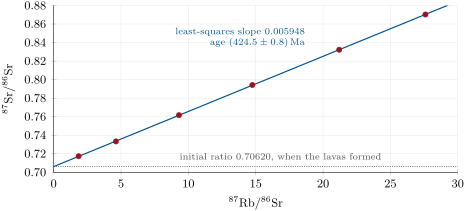
Six whole-rock samples of a series of rhyolite lavas (exercise data) give:
| 1.85 | 4.62 | 9.30 | 14.75 | 21.20 | 27.60 | |
| 0.71732 | 0.73332 | 0.76164 | 0.79420 | 0.83226 | 0.87028 |
Here , , and , so and . The residuals give , and . The age is , with : , initial ratio (figure below).
In the lab — Weighing isotopes
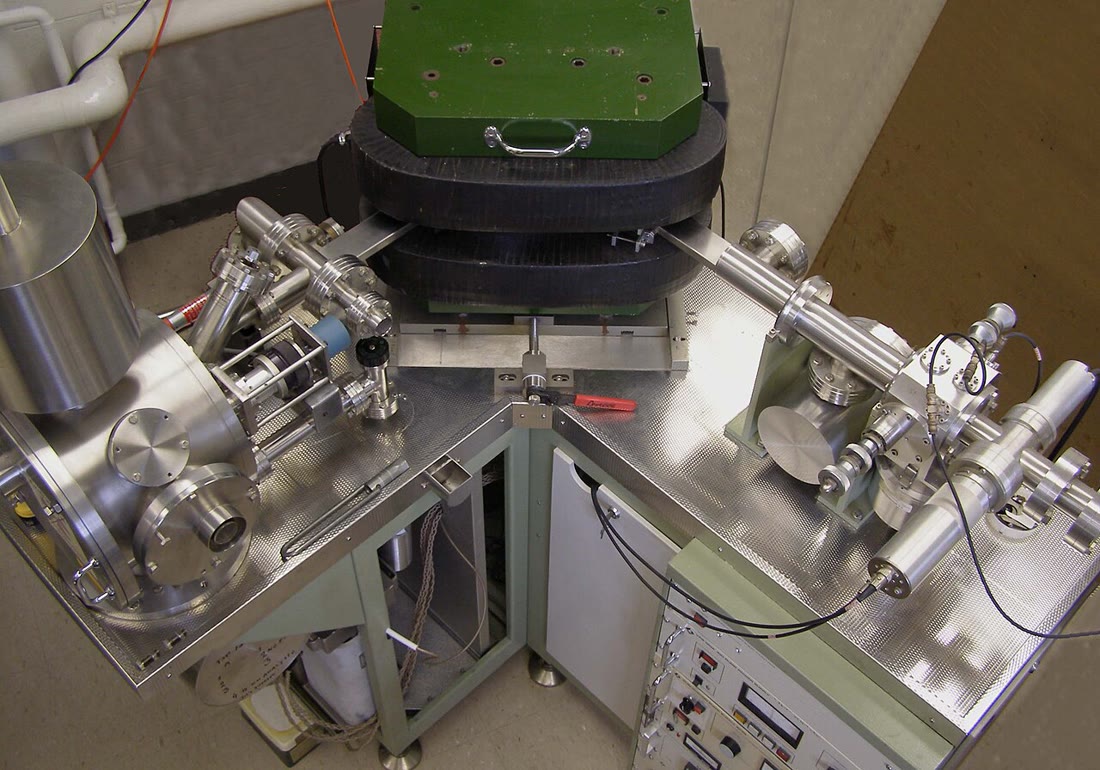
A thermal ionisation mass spectrometer (left) measures the isotope ratios of elements such as strontium. The element, separated from the dissolved sample by chemistry, is loaded on a metal filament in a vacuum; heated, it gives off ions, which are accelerated and bent by the field of the large electromagnet (the black coils at the centre), lighter ions more than heavier ones, so that each isotope reaches its own collector. Ratios of isotopes are what the instrument measures best, which is why methods built on ratios alone are the most precise. (Photograph: Radiogenic, CC0, via Wikimedia Commons.)
25.3 Potassium–argon, uranium–lead and radiocarbon
A parent with two daughters
Definition 25.9 (Branching decay)
A parent undergoes branching decay when its nuclei decay by two or more routes to different daughters. Each route has its own partial decay constant ; the parent decays with the total constant , and a fraction of the decays take route . Potassium-40 decays to calcium-40 with per year and to argon-40 with per year.
Proposition 25.10 (The potassium–argon age)
A mineral that has kept all the argon made in it, and contained none when it formed, contains after a time
where is the number of potassium-40 atoms today and .
Proof. The parent decays with the total constant , whatever the route, so by Proposition 25.2 the number of decays in the time is . Each decay takes the argon route with probability , independently of the others; over the very large number of decays the fraction that gave argon is . This gives ; solving for gives the age. ∎
The exponent holds the total constant and the factor in front the partial one: using in the exponent, as if argon were the only route, would give an age wildly wrong. The calcium branch carries nine-tenths of the decays but is useless for dating, because calcium-40 is the common isotope of an element abundant in rocks; argon, a noble gas, escapes from a melt, so that a crystal starts with almost none. Potassium-40 is of the atoms of potassium. The method needs the absolute amounts of both potassium and argon, measured separately. Argon from the air, present in every rock, is recognised by its argon-36 and subtracted with the atmospheric ratio .
The method fails in two ways. Excess argon makes ages too old: a lava that cools quickly can trap argon from the mantle in bubbles, and historic lavas usually give potassium–argon ages of 1 to 2 million years, an error that matters only for young rocks. Argon loss makes them too young: most minerals lose argon when heated above about , so that a later metamorphism resets the clock wholly or in part, and a partial loss gives an age between the two events that dates neither. Potassium-rich minerals are preferred: sanidine and biotite, then plagioclase or hornblende.
The argon–argon method measures only ratios. The sample is irradiated with fast neutrons in the core of a nuclear reactor, beside a standard mineral of known age; the reaction turns part of its potassium-39 into argon-39, which then stands for the potassium, and the standard gives the yield of the reaction. The two isotopes are measured together in the same gas. The sample can then be heated in steps, with a furnace or a laser; each step gives an age, and the ages are plotted against the cumulative fraction of argon-39 released, an age spectrum. Steps that agree within their errors form a plateau; a spectrum without one warns that the mineral has not stayed closed. The synchrony of the impact and the extinction at the end of the Cretaceous rests on argon–argon ages.
Two uranium clocks
Uranium has two long-lived isotopes, uranium-238 decaying to lead-206 and uranium-235 to lead-207, at different rates; today , one atom in 137.8. A mineral holding uranium thus carries two independent clocks, each with its own growth equation, and . If the two ages agree, they are said to be concordant, and the agreement is a test that the mineral stayed closed, which no single clock can provide. Disagreement comes mostly from lead lost from parts of the crystal damaged by the radiation of the uranium itself; a graph of the two ratios against each other, the concordia diagram, then recovers both the age of the crystal and that of the event that made it lose lead — a tool of the Year 3 volume.
Zircon, , is the mineral of choice: it takes uranium into its structure but almost no lead, so that nearly all its lead is radiogenic; it is hard, resists weathering and survives metamorphism, so that grains eroded from a rock keep its age in the sands derived from it. Apatite and sphene are used too, less often.
Radiocarbon
Carbon-14 is made continually in the upper atmosphere from nitrogen-14 struck by cosmic rays. It joins the carbon of the atmosphere; living organisms exchange carbon with the atmosphere and keep its proportion of carbon-14. At death the exchange stops and the carbon-14 decays back to nitrogen-14. Since the initial proportion is that of the atmosphere, the age follows from the decay law alone, without an isochron: , where is the activity of the sample’s carbon, that of living carbon and the mean life. Wood, charcoal, bone, teeth and shell are dated this way, up to some tens of thousands of years: about years at most.
Definition 25.11 (Radiocarbon age, calibration curve)
The (conventional) radiocarbon age of a sample is
where is the activity of the sample’s carbon and that of the reference standard; it uses the half-life of years (mean life years), normalises the activities for the isotopic fractionation of carbon (), and counts years before AD 1950 (BP, “before present”). A calibration curve gives the radiocarbon age of samples of known calendar age; read backwards, it converts a radiocarbon age into a range of calendar ages (cal BP).
The radiocarbon age is not an age in calendar years, for two reasons. The half-life of years, Libby’s value, kept by convention, is shorter than the true years, so radiocarbon ages run about short. More importantly, the proportion of carbon-14 in the atmosphere has not been constant. The calibration curve measures both effects together, on archives dated independently: tree rings back to about cal BP, and beyond, floating tree-ring sequences, lake and marine sediments, cave deposits and corals, to cal BP (figure below).
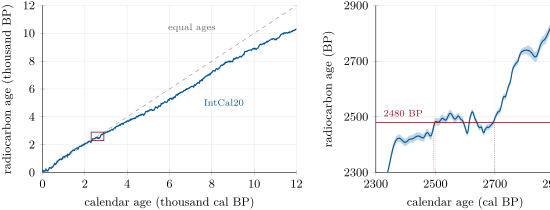
At cal BP the curve gives years BP; at cal BP, : radiocarbon ages there are years younger than calendar ages, far more than the of the half-life. The curve wiggles, and where it is flat a radiocarbon age matches a long range of calendar ages, however precise the measurement.
Figures as of 2020
The curve in use for the Northern Hemisphere is IntCal20, published in 2020. It replaced IntCal13, adding new data and extending the curve to cal BP, with separate curves for the Southern Hemisphere and for the surface ocean. Calibration curves are revised as new archives are measured, so a calendar age must name the curve that produced it.
25.4 Closure temperature
A mineral that crystallises from a magma at does not start its clock at once. While it is hot, atoms of the daughter — argon above all — diffuse through its lattice and escape; only when it has cooled enough does diffusion become too slow to matter, and the daughter begin to accumulate.
Definition 25.12 (Closure temperature, cooling age)
The closure temperature of a mineral for a decay system is the temperature below which the parent and daughter atoms no longer diffuse in or out of its lattice fast enough to matter, so that the mineral behaves as a closed system. A cooling age is an age measured in a mineral that formed above its closure temperature: it dates the moment the mineral cooled through that temperature, not the moment it formed.
Closure temperatures differ by mineral, because the lattices differ, and by element, because different atoms diffuse through one lattice at different rates (figure below). They are approximate: two tables give and for argon in biotite, and for argon in hornblende. Fission tracks, the trails of damage left in a crystal by the spontaneous fission of uranium nuclei, heal at even lower temperatures.
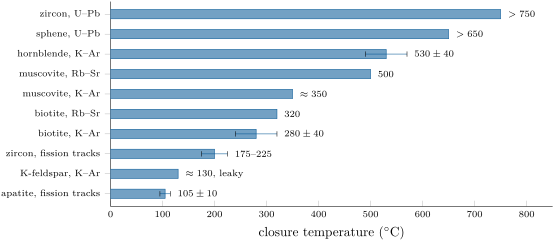
In a pluton that cooled slowly, the clocks therefore close one after another, from the hottest to the coolest: zircon first, near its crystallisation, then hornblende, then muscovite and biotite. The spread of their ages records the cooling.
Proposition 25.13 (Cooling rate between two closures)
If two minerals of one rock, of closure temperatures , give the cooling ages , the mean cooling rate between the two closures is
If the rock lay at a depth where the temperature rose with depth at a constant gradient below a surface at the temperature , it was at the depth when the clock closed.
Proof. The rock was at at the time and at at the time ; the mean rate of change of its temperature is the ratio of the two differences. With a linear geotherm (Definition 10.7), , which gives the depth. ∎
The depth gives a rate of exhumation once the time the rock reached the surface is known — as in the problem of this chapter. The method is crude: the closure temperatures are uncertain by tens of degrees, and the geotherm is assumed constant through time. Thermochronology, the detailed reconstruction of temperature–time paths from many clocks, is a subject of the Year 3 volume.
25.5 Dating sedimentary sequences
Most sedimentary rocks cannot be dated directly. Their grains are older than the rock: a detrital zircon, like the grain at the head of this chapter, dates the rock it was eroded from. Radiocarbon dates only young organic matter. The ages of the chart therefore come from rocks that crystallised at the moment they were deposited — volcanic ash and lava flows within the sequence — and from igneous rocks that cut it.
Definition 25.14 (Bracketing age)
A bracketing age is a limit placed on the age of a sedimentary level by dated rocks related to it by the principles of stratigraphy: a maximum age from a dated layer below it, or from the youngest detrital grain in it; a minimum age from a dated layer above it, or from an intrusion that cuts it. A level between a maximum and a minimum is bracketed.
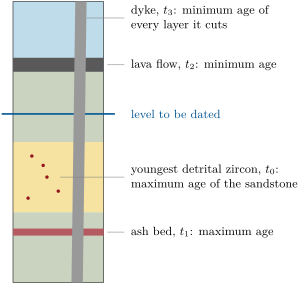
The best brackets are close and precise: two ash beds a few metres apart, dated on zircon to a few tens of thousands of years, with the level between them interpolated by Proposition 24.8. At Meishan, the GSSP of the base of the Triassic lies among five dated ash beds; the extinction is bracketed between and , and the base of the system is placed at (Section 24.4). Ash beds, carried by the wind across facies, are both time lines and clocks.
The chart is only as precise as the dated beds near each boundary. The base of the Triassic is known to , one part in ten thousand; the base of the Carboniferous to ; the base of the Devonian to . Where no dated bed lies near a boundary, its age is interpolated between distant ones, and its uncertainty grows accordingly. Each new ash bed dated near a boundary can move it, which is why the chart carries a version date.
25.6 Exercises
Exercise 25.1 ★
(a) A mineral contains three times as many radiogenic daughter atoms as parent atoms. How many half-lives old is it? (b) Compute after for rubidium-87 and for uranium-235, with the constants of Table 25.1. Which ratio is easier to measure precisely? (c) After how many half-lives is less than of the parent left?
Solution
Solution of Exercise 25.1.
(a) gives : two half-lives. (b) Rubidium-87: ; uranium-235: . The uranium ratio is about 80 times larger: a given absolute error of measurement is a far smaller part of it. (c) when : after about seven half-lives.
Exercise 25.2 ★
Which method of Table 25.1 would you use, and on what material, to date: (a) charcoal from a hearth about years old; (b) an ash bed thought to be about old, rich in sanidine and zircon; (c) a granite about old; (d) a shell about years old; (e) a limestone of the Jurassic with no volcanic layer?
Solution
Solution of Exercise 25.2.
(a) Radiocarbon on the charcoal. (b) Uranium–lead on the zircon, or argon–argon (potassium–argon) on the sanidine, a potassium-rich mineral. (c) Uranium–lead on zircon, which survives a long history; rubidium–strontium on whole rocks is possible; potassium–argon would risk ages lowered by argon lost in later heating. (d) Radiocarbon on the carbonate of the shell, near the limit of the method (about years). (e) None directly: its age is bracketed by dated volcanic rocks above and below, or found by correlating its fossils with a dated section (Chapter 24).
Exercise 25.3 ★
The carbon of a piece of wood has a quarter of the activity of the standard, after normalisation. (a) Compute its conventional radiocarbon age. (b) Compute its age with the half-life of years. (c) Why is neither of these its age in calendar years, and how is that age obtained?
Solution
Solution of Exercise 25.3.
(a) years BP. (b) The mean life is years: years. (c) Both assume that the proportion of carbon-14 in living carbon was the same then as in the standard; it was not. The calendar age is read from a calibration curve such as IntCal20, as a range of years cal BP.
Exercise 25.4 ★
A granite gives a uranium–lead age on zircon of , a potassium–argon age on hornblende of and one on biotite of . (a) Why are the three ages different, and in this order? (b) With the closure temperatures of the figure of Section 25.4, compute the mean cooling rate between the closures of hornblende and biotite. (c) What can be said of the cooling rate between the closure of zircon and that of hornblende?
Solution
Solution of Exercise 25.4.
(a) Each clock starts when its mineral cools below its closure temperature: zircon (above ) closes first, hornblende (about ) next, biotite (about ) last, so the ages decrease in that order as the granite cooled. (b) per million years. (c) Zircon closed above , so the granite cooled by at least in : at least per million years, a lower bound.
Exercise 25.5 ★★
Four whole-rock samples of a gneiss (exercise data) give , , , and , , , . (a) Fit the least-squares line by the method of Method 25.7. (b) Compute the age and the initial ratio. (c) Compute and the uncertainty of the age. (d) Does the initial ratio point to a source in the mantle or in the crust?
Solution
Solution of Exercise 25.5.
(a) , , , ; , . (b) ; initial ratio . (c) The residuals are , , and (in units of ): , and : . (d) is close to the mantle value and well below the crustal : a source mostly in the mantle.
Exercise 25.6 ★★
A sanidine from an ash bed contains potassium by mass and of radiogenic argon-40 per gram. (a) With the atomic weight of potassium, , and the abundance of potassium-40, compute the number of moles of potassium-40 per gram. (b) Compute the potassium–argon age. (c) If of the argon measured had been trapped when the ash fell rather than made by decay, by how much would the age be too old? Is this a concern here?
Solution
Solution of Exercise 25.6.
(a) of potassium-40 per gram. (b) ; ; . (c) The radiogenic argon would be nanomoles, giving : the measured age would be too old, ten times the years within which the impact and the extinction at the end of the Cretaceous are now shown to coincide. Excess argon is a concern mostly in young rocks and whole rocks; a mineral such as sanidine should not take in argon when it crystallises, and an argon–argon age spectrum would reveal it.
Exercise 25.7 ★★
The IntCal20 curve gives the radiocarbon ages years BP at cal BP, at cal BP and at cal BP. (a) A seed gives years BP. What is its calendar age? (b) Another gives years BP; with the right-hand panel of the figure of Section 25.3, give its range of calendar ages and explain why it is so wide. (c) By how many years, and in which direction, do radiocarbon ages differ from calendar ages at , and cal BP? Does the difference grow in proportion to the age?
Solution
Solution of Exercise 25.7.
(a) About cal BP: the curve passes through years BP there. (b) From about to cal BP, two hundred years: the curve is nearly flat between and cal BP, so that every calendar age in that interval has nearly the same radiocarbon age, and a more precise measurement would not narrow the range. (c) At cal BP the radiocarbon age is years older than the calendar age; at cal BP years younger (); at cal BP years younger (). The difference is not proportional to the age: it even changes sign. It cannot come from the half-life alone, which would give a constant .
Exercise 25.8 ★★
In a marine section, an ash bed at is dated and a lava flow at ; a dyke that cuts the whole section is dated . The youngest detrital zircon in a sandstone at is . A stage boundary is placed at . (a) Which of the four ages bracket the boundary, and which are of no use for it? (b) Interpolate its age and its uncertainty with Proposition 24.8. (c) What does the detrital zircon tell about the sandstone?
Solution
Solution of Exercise 25.8.
(a) The ash bed below () gives a maximum age, the lava flow above () a minimum: the boundary is bracketed between them. The dyke is also a minimum, but a weaker one, younger than the lava. The detrital zircon is a maximum only for the sandstone, and weaker than the ash bed, which lies below the sandstone. (b) ; ; : . (c) Its grains came from a rock at least old, eroded somewhere in the source area; it shows that the sandstone is younger than , which the ash bed below already proves more tightly.
Exercise 25.9 ★★
Two zircons of one granite give and (grain A), and and (grain B). (a) Compute the two ages of each grain. (b) Which grain is concordant? (c) Grain B has lost part of its lead recently. Show that both its ratios are of those of grain A, and explain why its two ages differ although the loss was the same for both isotopes.
Solution
Solution of Exercise 25.9.
(a) Grain A: and . Grain B: and . (b) Grain A is concordant. (c) and . The age is , not proportional to : for the small uranium-238 ratio and the age falls by nearly (to ); for the larger uranium-235 ratio the logarithm falls by less, and the age only to . Both are too young, and they disagree: the grain is discordant.
Exercise 25.10 ★★★
(a) Show that when the age equation reduces to , and that the relative error of this approximation is close to . (b) Compute the error for rubidium-87 at , for potassium-40 at and for uranium-238 at . (c) If is measured to , what is the uncertainty of a rubidium–strontium age of ?
Solution
Solution of Exercise 25.10.
(a) With , , so : the approximation overestimates the age by a relative error close to . (b) Rubidium-87 at : , error (); potassium-40 at : , error (; gives ); uranium-238 at : , error — the approximation and even its error estimate () fail. (c) , ; by Proposition 25.3, .
Exercise 25.11 ★★★
A biotite crystallised and closed ago. ago a brief heating made it lose a fraction of its argon, after which it was closed again. (a) Show that today
with and . (b) Compute the apparent potassium–argon age for , , and . (c) Why can a single potassium–argon age not tell a partial loss from a younger event?
Solution
Solution of Exercise 25.11.
(a) Let be today’s potassium-40. At the time before the present there were atoms, and the argon made between and was, by Proposition 25.10 applied to that interval, . A fraction of it remained. Since , the closed mineral has made more. Adding and multiplying by gives the expression. (b) The apparent age is : for , for , for and for . (c) Every age between and can be produced by some partial loss, and a single number cannot say whether it records a real event at that time or a mixture; an age spectrum, or other clocks in the same rock, are needed.
Exercise 25.12 ★★★
At cal BP the IntCal20 curve gives a radiocarbon age of years BP. (a) Recompute the age from the same activity ratio with the half-life of years. (b) How much of the years by which the radiocarbon age falls short of the calendar age does the half-life convention explain? (c) Assuming the rest comes from a higher proportion of carbon-14 in the atmosphere years ago, compute by how much, in per cent, it exceeded the proportion of the standard.
Solution
Solution of Exercise 25.12.
(a) The age is proportional to the mean life used: years. (b) years, about a seventh of the . (c) If the initial activity was , the true age is ; with , and : about more carbon-14 than in the standard.
25.7 Problem: Dating the Varden granite and its cover
Problem 25.1
Weekend problem — how four clocks date the crystallisation, the cooling and the unroofing of a granite
The granite of the Varden Hills, the series’ invented region, intrudes the schist basement and is overlain, above an unconformity, by the Triassic sandstone. Use the constants of Table 25.1, the closure temperatures of the figure of Section 25.4, the atomic weight of potassium and the abundance of potassium-40, of the atoms of potassium. All analyses are exercise data.
Part I — A whole-rock isochron. Six whole-rock samples give:
| 0.92 | 2.15 | 3.40 | 5.05 | 7.60 | 10.30 | |
| 0.71211 | 0.71718 | 0.72284 | 0.72986 | 0.74113 | 0.75261 |
- Plot the six samples. Do they lie on a straight line?
- Compute , , and , then the least-squares slope.
- Compute the intercept. What does it represent?
- Compute the age of the granite.
- Compute the residuals, , and the uncertainty of the age.
- Is the initial ratio closer to that of the mantle or of the continental crust? If the magma were a mixture of melts with and , equally rich in strontium, what share of its strontium came from the crust?
Part II — Potassium and argon. A biotite contains potassium by mass and of radiogenic argon-40 per gram; a hornblende and .
- Compute the number of atoms of potassium-40 in a gram of the biotite.
- Compute the potassium–argon age of the biotite.
- Compute that of the hornblende.
- What age would the biotite give if the branching were forgotten and all decays counted as argon? Why is calcium-40 not used instead?
- Why is excess argon, trapped when the minerals formed, of little concern here?
- Both ages are younger than the isochron age. Give two explanations, and say how an argon–argon age spectrum could tell them apart.
Part III — Cooling. A zircon of the granite gives and .
- Compute the two uranium–lead ages. Are they concordant?
- Assign to each age of Parts I to III the event it dates. Draw the temperature of the granite against time from the zircon to the biotite.
- Compute the mean cooling rate between the closures of hornblende and biotite.
- What can be said of the cooling rate between the closure of the zircon and that of the hornblende?
- With an uncertainty of on each of the two closure temperatures, independent, what range of cooling rates is possible?
- With the other table quoted in the chapter ( for hornblende, for biotite), what rate is found? What does this say of the result?
- Assume a geotherm of below a surface at . At what depth was the granite when the biotite closed?
Part IV — The unconformity. An ash bed above the base of the Triassic sandstone contains zircons with and . A second ash bed, above the base, is dated . Detrital zircons in the lowest metre of the sandstone give ages around .
- Compute the age of the lower ash bed.
- Where do the detrital zircons come from, and what do they say about the age of the sandstone?
- Compute the rate of accumulation of the sandstone between the ash beds, and the age of its base, assuming the same rate below the lower ash.
- How long is the gap in the record at the unconformity, from the crystallisation of the granite to the deposition of the sandstone?
- Compute the mean rate of erosion that brought the granite from the depth of question 19 to the surface. What assumption does this make about where the eroded granite lay?
- What is the cooling rate of the granite?
Solution
Solution of Problem 25.1.
- The points rise steadily with ; their deviations from a line are at most two units in the fourth decimal, against a range of in : they lie on a straight line within small scatter.
- , , , ; .
- : the of the granite when it crystallised, shared by all its parts.
- .
- The residuals are , , , , and (in units of ); , , : , and .
- is closer to the crustal than to the mantle’s . For a mixture, : about three quarters of the strontium came from melted crust.
- per gram, times : atoms.
- ; ; .
- , ratio , .
- , nine times too young, because only about one decay in ten gives argon. Calcium-40 is the common isotope of calcium, abundant in rocks: the little made by decay cannot be told from the calcium the minerals contained from the start.
- Excess argon shifts ages by amounts of the order of a million years, which matters for young rocks; here it would be well under of the age. And mica and amphibole crystals take in almost no argon when they form.
- Either the granite cooled slowly and the micas and amphibole closed after crystallisation (cooling ages), or a later heating drove out part of their argon. A flat plateau in an argon–argon age spectrum supports a cooling age; a spectrum without a plateau warns that the minerals lost argon. The order of the ages, hornblende before biotite as their closure temperatures predict, also points to cooling.
- and : concordant.
- Zircon , closure above : crystallisation; the whole-rock isochron, , also dates it, and agrees within its uncertainty; hornblende : cooling through about ; biotite : cooling through about . The graph falls from above at to at .
- per million years.
- per million years at least, since the zircon closed above : the cooling was at least as fast early on.
- The difference of temperatures, , gives per million years.
- per million years, inside the range of question 17: the uncertainty comes from the closure temperatures, not from the ages.
- .
- , and the same from the uranium-235 ratio: concordant.
- From the granite, eroded at the unconformity: their age is its crystallisation age. They show only that the sandstone is younger than : a maximum age, much weaker than the ash bed.
- per million years; the base is older than the lower ash: .
- From (isochron) or (zircon) to : about .
- in : per million years, per year. This assumes that the dated biotite came from just below the unconformity, so that all the rock above it in the granite and the schist was removed by the time the sand arrived, and that the geotherm stayed constant.
- The granite cooled at about per million years between the closures of hornblende and biotite.