
全部书籍

专业

应用 关于 Coach 登录 开始阅读

书籍暂未推出简体中文版——当前显示英文版。

Earth and Space Sciences · 术语表

什么是 Partial melting; decompression melting?

又称: partial melting · decompression melting

Definition 14.4 High School Earth and Space Sciences · 第 14 章 — Ocean Ridges and the Oceanic Lithosphere

Partial melting is the melting of only part of a rock: some of its minerals, or some of their components, melt, while the rest stays solid. Decompression melting is the partial melting of a rock that rises, and so is less and less squeezed, without being heated.
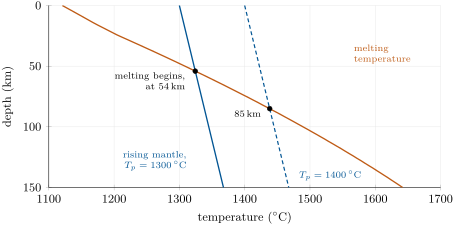
The temperature of mantle rock rising beneath a ridge (blue) and its melting temperature (orange), against depth. Rock with a potential temperature of 1300\, C starts to melt 54\, km down; rock 100\, C hotter (dashed) already at 85\, km. Melting temperature of dry peridotite from experiments (Hirschmann, 2000).
The temperature of mantle rock rising beneath a ridge (blue) and its melting temperature (orange), against depth. Rock with a potential temperature of 1300 ∘C1300\,{}^{\circ}\mathrm{C} starts to melt 54 km54\,\mathrm{km} down; rock 100 ∘C100\,{}^{\circ}\mathrm{C} hotter (dashed) already at 85 km85\,\mathrm{km}. Melting temperature of dry peridotite from experiments (Hirschmann, 2000).

示例

Example 14.6 (The depth of melting)

For a mantle of potential temperature 1300 ∘C1300\,{}^{\circ}\mathrm{C}, the rising rock is at 1300+0.45×54≈1324 ∘C1300 + 0.45 \times 54 \approx 1324\,{}^{\circ}\mathrm{C} when it reaches 54 km54\,\mathrm{km}, exactly its melting temperature at that depth: melting begins about 54 km54\,\mathrm{km} down. Above that depth it goes on melting as it rises.

在原文中阅读 →