
全部书籍

专业

应用 关于 Coach 登录 开始阅读

书籍暂未推出简体中文版——当前显示英文版。

Earth and Space Sciences · 术语表

什么是 Probabilistic seismic hazard analysis, ground-motion prediction equation, peak ground acceleration, hazard curve?

又称: peak ground acceleration · ground-motion prediction equation · probabilistic seismic hazard analysis · hazard curve

Definition 28.5 University Earth and Space Sciences — Year 2 · 第 28 章 — Geological Hazards and Risk

The peak ground acceleration (PGA) at a site is the largest absolute horizontal acceleration of the ground during an earthquake, usually expressed as a fraction of gg. A ground-motion prediction equation (GMPE) gives the probability distribution of a measure of shaking such as the PGA at a site — a median and a scatter — as a function of the magnitude, the distance to the source and the ground conditions. Probabilistic seismic hazard analysis (PSHA) combines all the earthquakes that can affect a site, with their rates and distances, with a GMPE, to give the annual rate at which each level of shaking is exceeded. The curve of that rate against the level is the site’s hazard curve.
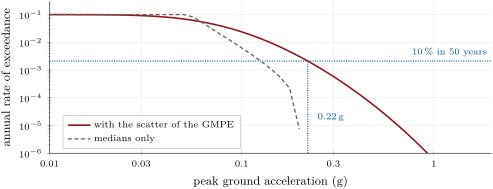
A hazard curve: the annual rate at which the PGA at a rock site exceeds each level, for one source zone at 15\, km (truncated Gutenberg–Richter recurrence, b = 1, magnitudes 5 to 7.5) and the GMPE of Boore, Joyner and Fumal. The dotted lines read the 10\,\%-in-50-years level. Without the scatter (dashed) the curve stops at the median motion of the largest earthquake.
A hazard curve: the annual rate at which the PGA at a rock site exceeds each level, for one source zone at 15 km15\,\mathrm{km} (truncated Gutenberg–Richter recurrence, b=1b = 1, magnitudes 5 to 7.5) and the GMPE of Boore, Joyner and Fumal. The dotted lines read the 10 %10\,\%-in-50-years level. Without the scatter (dashed) the curve stops at the median motion of the largest earthquake.
在原文中阅读 →