全部书籍

专业

应用 关于 Coach 登录 开始阅读

书籍暂未推出简体中文版——当前显示英文版。

Earth and Space Sciences · 术语表

什么是 Protoplanetary disc?

又称: protostellar disc

Definition 1.14 University Earth and Space Sciences — Year 2 · 第 1 章 — The Interstellar Medium and Star Formation

A protoplanetary disc (or protostellar disc) is the flattened disc of gas and dust in nearly Keplerian rotation around a young star, made of the matter of its parent core that kept too much angular momentum to fall onto the star; planets form in it.
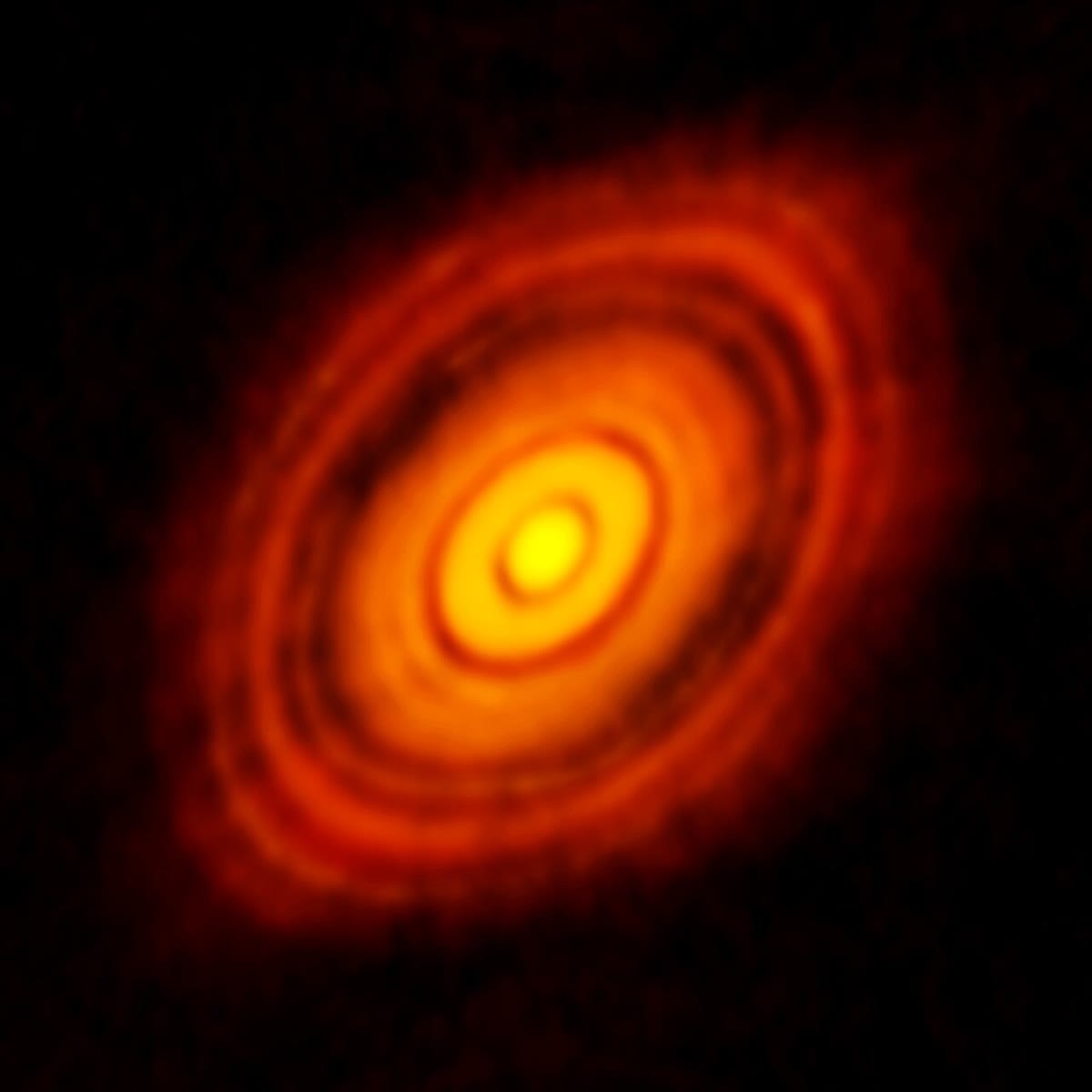
The disc of the young star HL Tauri, 140\, pc away in Taurus, imaged by the ALMA interferometer at a wavelength of about one millimetre, where cold dust shines. The disc, about 120\, au in radius and seen tilted by 47, shows bright and dark rings a few astronomical units wide; the system is at most one or two million years old, and the rings are read as the first signs of planets clearing their paths. ALMA (ESO/NAOJ/NRAO), CC BY 4.0.
The disc of the young star HL Tauri, 140 pc140\,\mathrm{pc} away in Taurus, imaged by the ALMA interferometer at a wavelength of about one millimetre, where cold dust shines. The disc, about 120 au120\,\mathrm{au} in radius and seen tilted by 47∘47{}^{\circ}, shows bright and dark rings a few astronomical units wide; the system is at most one or two million years old, and the rings are read as the first signs of planets clearing their paths. ALMA (ESO/NAOJ/NRAO), CC BY 4.0.
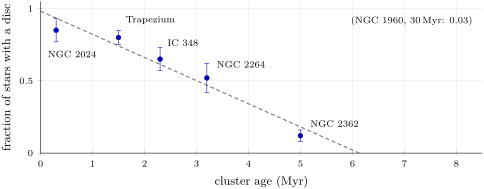
Fraction of the stars of young clusters that show the infrared excess of a disc, against the age of the cluster (with its error), from Haisch, Lada and Lada (2001). The dashed line is the least-squares straight line through the five youngest clusters: it reaches 0.5 at 3.0\, Myr and zero at 6.1\, Myr ().
Fraction of the stars of young clusters that show the infrared excess of a disc, against the age of the cluster (with its error), from Haisch, Lada and Lada (2001). The dashed line is the least-squares straight line through the five youngest clusters: it reaches 0.50.5 at 3.0 Myr3.0\,\mathrm{Myr} and zero at 6.1 Myr6.1\,\mathrm{Myr} (Exercise 1.12).
在原文中阅读 →
