University Earth and Space Sciences — Year 2 · Bachelor Year 2
1The Interstellar Medium and Star Formation
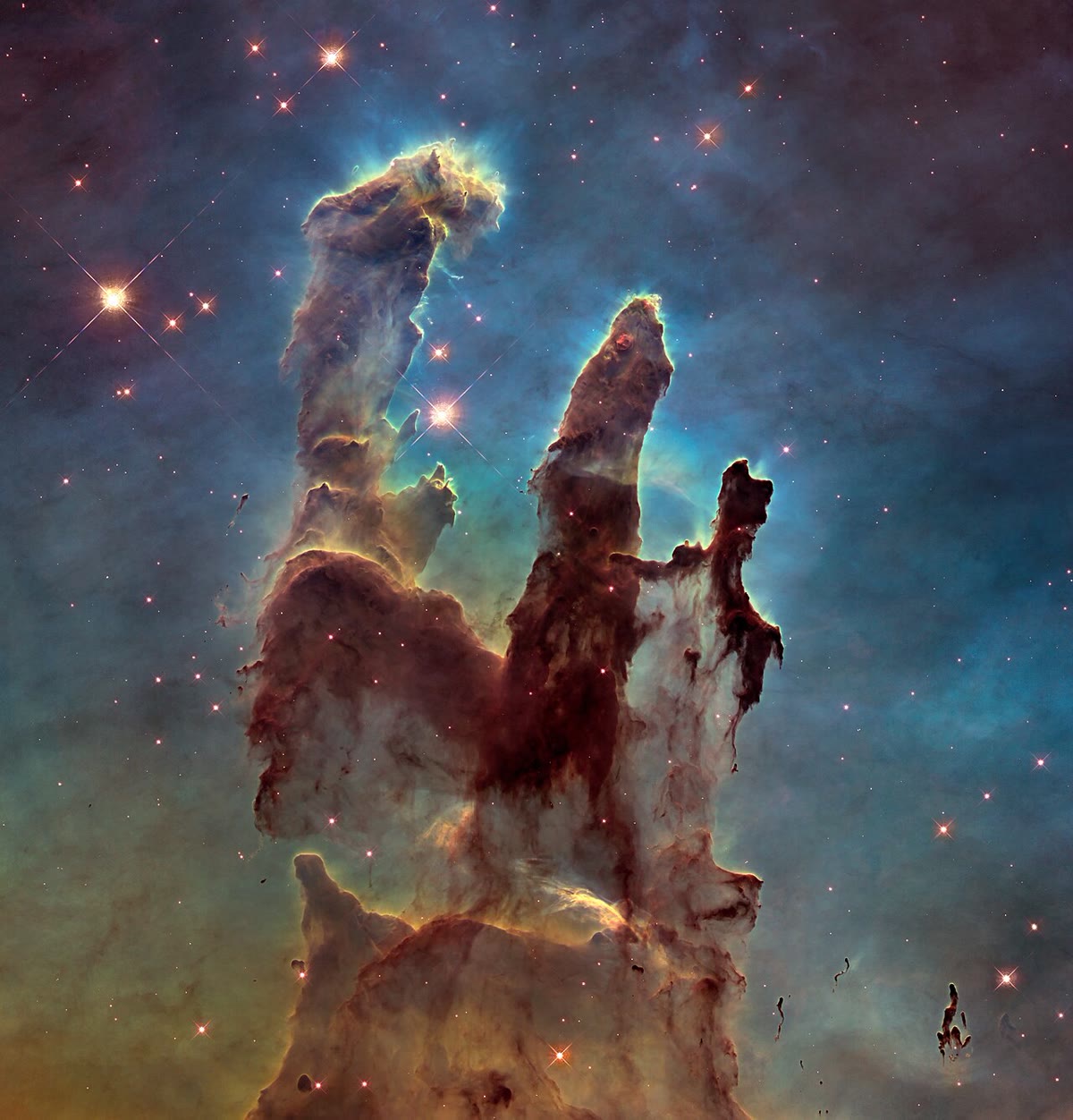
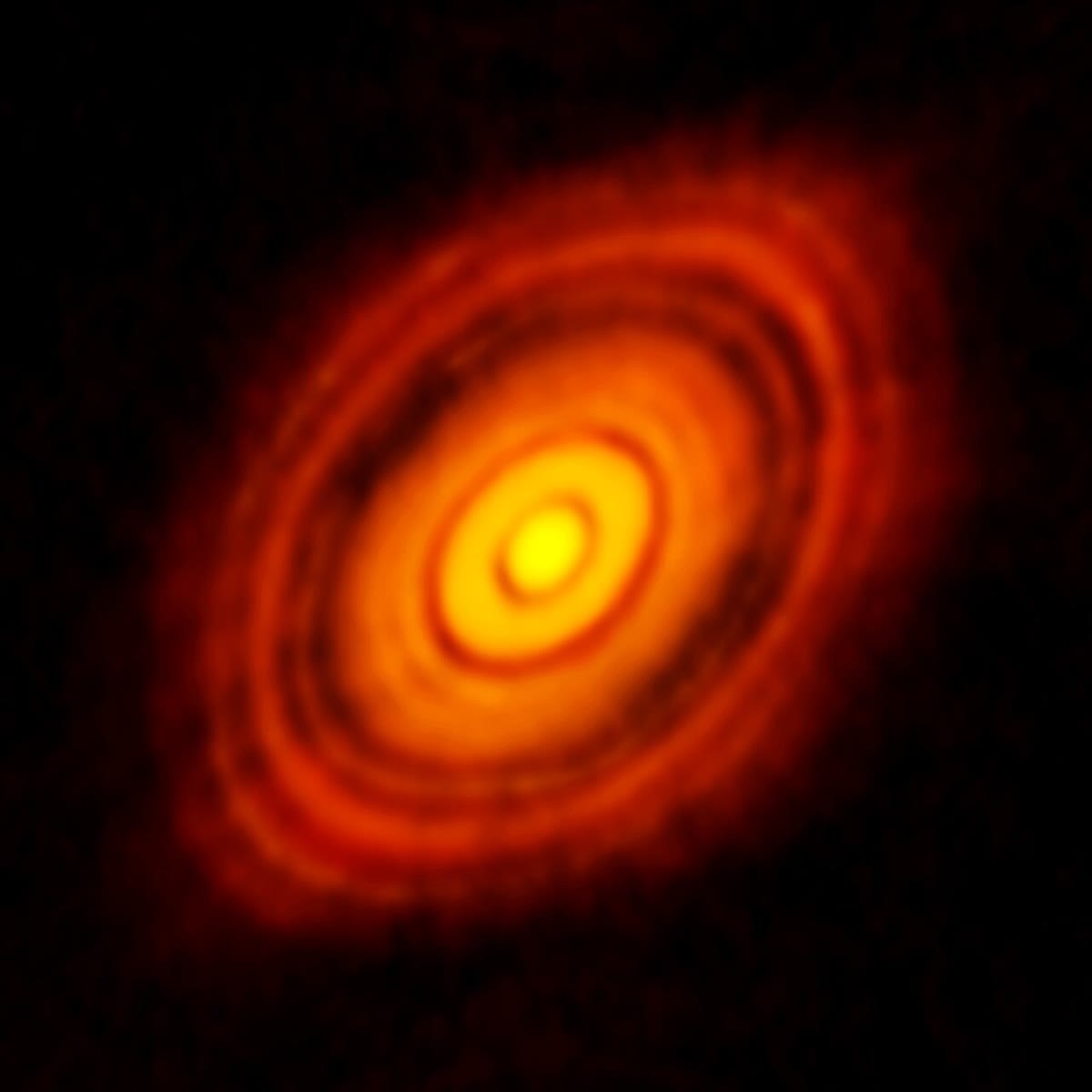
In the constellation of Taurus, about from the Sun, a dark patch blots out the stars behind it. Seen with a radio telescope tuned to the lines of carbon monoxide, the patch is a cloud of cold gas some twenty thousand times as massive as the Sun, laced with filaments; inside the densest knots, young stars are being born, and around one of them, HL Tauri, a disc of dust shows a pattern of bright and dark rings where planets may already be forming. The Sun, the Earth and every atom in the rocks of this book once lay in such a cloud. This chapter follows the matter of a planetary system from the thin gas between the stars to a disc around a newborn star: what the interstellar medium is made of, why a cloud supported by its own heat ever collapses, how long the collapse takes, how a star assembles its mass and why the matter that fails to fall into it ends in a disc.
You already know
A star on the main sequence shines by fusing hydrogen into helium in its core and holds itself up by its pressure against its own weight; its position in the Hertzsprung–Russell diagram is set by its mass (physics, University Year 3). A body on a closed orbit about a mass obeys Kepler’s third law, (physics, University Year 1). A black body of temperature emits per unit area (physics, University Year 2). In an ideal gas of particles the mean kinetic energy of translation is . The parsec, , is the distance unit of the Year 1 volume.
1.1 The matter between the stars
Space between the stars is not empty. Near the Sun it holds on average about one atom of hydrogen per cubic centimetre, a mass density of ; the air we breathe holds some times more molecules in the same volume (Exercise 1.1). Spread over the Galaxy, this thin matter still amounts to of the mass of the Galactic disc.
Definition 1.1 (Interstellar medium, interstellar dust)
The interstellar medium is the gas and dust that fill the space between the stars of a galaxy. Interstellar dust is the part of it in solid grains, from a few nanometres to about a micrometre across, made of silicates, carbon compounds and, in cold regions, ices.
Its composition is the one measured in the Sun and in meteorites: by mass, hydrogen, helium and heavier elements. Only of the mass is in dust, yet the dust holds most of some elements: the gas is poorer than the Sun in magnesium, silicon and iron by factors of 10 to 100, because those atoms are locked in the grains, while carbon, nitrogen and oxygen are depleted only by factors of 1.2 to 3. The grains are the first solids of a future planetary system; Chapter 2 follows them.
1.1.1 Five phases
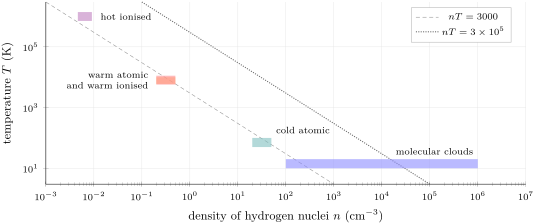
The gas is far from uniform. It comes in a few distinct states, or phases, each with its own range of temperature and density (table below). About half its mass is in clouds that fill only of the volume; the rest, warm or hot, fills the space between them.
| phase | temperature (K) | density () |
|---|---|---|
| molecular | 10–20 | – |
| cold atomic | 50–100 | 20–50 |
| warm atomic | 6000–10 000 | 0.2–0.5 |
| warm ionised | about 8000 | 0.2–0.5 |
| hot ionised | about | about 0.0065 |
The table hides a regularity. The pressure of an ideal gas is , so the product measures it. For the cold atomic gas is about (in ), for the warm atomic gas about , for the hot gas about : within a factor of a few, the three phases that share the space between the clouds are at the same pressure (figure below). Where a hot and a cold gas touch at equal pressure, neither pushes the other away; a gas that cools at constant pressure grows denser in proportion and drops from the warm phase into the cold one. The molecular clouds reach far higher pressures, up to thousands of times more in their dense parts: they are held together by their own gravity, not by the pressure of their surroundings.
Dust shows itself in three ways. It dims the light of the stars behind it, and dims blue light more than red, so that stars seen through it look redder than they are. It shines in the far infrared and at millimetre wavelengths, at the temperature of a few tens of kelvins to which starlight warms it. And it hides whatever lies inside a dense cloud from optical telescopes, which is why star formation is observed at radio and infrared wavelengths. The gas is traced by its lines: atomic hydrogen by its radio line at , molecular hydrogen, which hardly radiates when cold, by the lines of the molecules that come with it, carbon monoxide first among them.
1.2 Molecular clouds
The coldest and densest phase is where stars form.
Definition 1.2 (Molecular cloud, dense core)
A molecular cloud is a region of the interstellar medium dense and opaque enough for its hydrogen to be mostly in molecules, , shielded by dust from the ultraviolet light of the stars that would break them; its temperature is about to . A dense core is a compact condensation inside a molecular cloud, a few tenths of a parsec across or less, with densities of to particles per cubic centimetre, from which a single star or a small group of stars forms.
Clouds are organised in a hierarchy (table below). A dark cloud like Taurus holds clumps, and the clumps hold cores, each level denser, smaller and more quiet than the one above it: in a core the gas moves at a few tenths of a kilometre per second at most, the speed of sound in gas at . The region of Taurus mapped in carbon monoxide holds about solar masses of gas; only of it has turned into the young stars seen there, at a rate of about eight stars every hundred thousand years over the last three million years. Star formation is slow and wasteful.
| dark clouds | clumps | dense cores | |
|---|---|---|---|
| mass (solar masses) | – | 50–500 | 0.5–5 |
| size (pc) | 2–15 | 0.3–3 | 0.03–0.2 |
| mean density () | 50–500 | – | – |
| gas temperature (K) | about 10 | 10–20 | 8–12 |
| examples | Taurus, Musca | — | L1544, B68 |
Why are the clouds so cold? Gas loses energy by emitting photons that escape, and molecules are efficient emitters: a collision lifts a carbon monoxide molecule to a higher rotation level, the molecule falls back by emitting a photon at millimetre wavelength, and the photon leaves the cloud, taking the energy of the collision with it. Dust, warmed by the faint starlight that gets in, radiates in the far infrared. The heating, by cosmic rays and by starlight filtered through the dust, is weak; the balance settles near . In such gas the thermal pressure is small, and gravity can win.
1.3 Gravitational collapse
A cloud is a balance between two energies: the thermal energy of its gas, which pushes outward, and its gravitational energy, which pulls inward. The second grows faster with mass than the first; above a certain mass, gravity wins.
Proposition 1.3 (Gravitational energy of a uniform sphere)
A sphere of uniform density, of mass and radius , has the gravitational potential energy
Proof. Build the sphere shell by shell. When its radius is it has the mass ; bringing a shell of thickness , of mass , from infinity to its surface releases the energy , because a sphere attracts outside it as if its mass were at its centre (the shell theorem, physics). Hence
∎
A self-gravitating body in equilibrium obeys the virial theorem: averaged over time, twice its kinetic energy plus its gravitational energy is zero, (physics, University Year 3, where it is derived from the equations of motion). For a cloud at rest, is the thermal energy of its particles. If the gas expands; if gravity has no equilibrium to oppose it and the cloud contracts.
Proposition 1.4 (Jeans criterion)
A uniform, isothermal cloud of temperature and density , made of particles of mean mass , collapses under its own gravity if its mass exceeds the Jeans mass
or equivalently if its radius exceeds the Jeans length
This is the Jeans criterion.
Proof. The cloud holds particles, with the thermal energy . By Proposition 1.3, it collapses if , that is
Eliminate with , that is : , and raising both sides to the power gives . Eliminating instead, gives , that is . ∎
Definition 1.5 (Jeans mass, Jeans length)
The Jeans mass and the Jeans length of a gas of given temperature and density are the mass and the radius above which a uniform sphere of that gas collapses under its own gravity (Proposition 1.4).
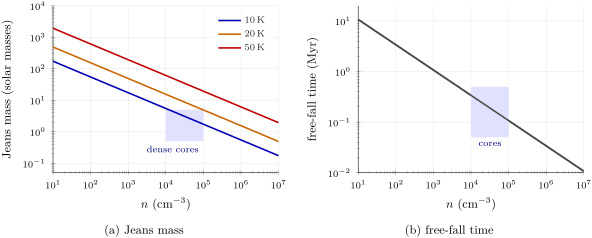
The Jeans mass grows as and falls as : cold, dense gas collapses most easily. In a molecular cloud the mean mass per particle is atomic mass units, molecular hydrogen with one helium atom for about every five molecules. At and particles per cubic centimetre, and solar masses, inside a Jeans length of : the mass and the size of a dense core. At the mean density of a dark cloud, particles per cubic centimetre, the Jeans mass is ten times larger, 55 solar masses, and a cloud of solar masses like Taurus contains hundreds of them (figure below).
A cloud that starts to collapse grows denser, and its Jeans mass falls as while it stays cold, which it does as long as it can radiate the heat of compression. Pieces of the cloud then become unstable on their own and collapse separately: the cloud fragments. This is why stars form in groups and why their masses are small compared with the clouds that make them. Fragmentation stops when the gas becomes too dense to let its radiation escape: the heat of compression is trapped, the temperature rises, and the Jeans mass stops falling.
How long does a collapse take? If pressure is negligible, each shell of the cloud falls freely towards the centre.
Proposition 1.6 (Free-fall time)
A uniform sphere of density , initially at rest and without pressure, collapses to its centre in the time
independent of its radius.
Proof. Consider a particle at rest at the distance from the centre, on the surface of the sphere. The shells inside it fall faster or with it, never behind, so the mass that attracts it stays the same all the way. Its path is a degenerate Kepler orbit: an ellipse flattened into a straight segment, with its far end at and the centre of attraction at its other end, so its semi-major axis is . Falling from the far end to the centre takes half a period; by Kepler’s third law
cancels: every shell of a uniform sphere arrives at the centre at the same moment. ∎
Definition 1.7 (Free-fall time)
The free-fall time of a gas of density is , the time a uniform sphere of that density would take to collapse under its own gravity alone.
For a dense core of particles per cubic centimetre the free-fall time is ; for a whole dark cloud of , . If every molecular cloud of the Galaxy collapsed in a free-fall time and turned into stars, the Galaxy would form stars far faster than it does: in Taurus, the gas actually turned into stars over the last three million years is about one per cent of the cloud. The clouds are held back, by turbulent motions and by magnetic fields that the ionised fraction of the gas drags along, and most of their gas is dispersed by the winds and light of the first massive stars before it can collapse: hence the low efficiency measured in Taurus.
History — James Jeans
James Jeans (1877–1946) published in 1902 the analysis of the stability of a gas under its own gravity from which the Jeans mass and length descend. He studied the growth of small density waves in an infinite uniform gas and found that waves longer than a critical length are not opposed by pressure but grow: the gas breaks into condensations of about that size. His critical length differs from the radius found above by a numerical factor only; the physics, gravity against thermal pressure, is the same.
1.4 Protostars
The collapse of a core is not uniform. The centre, slightly denser, falls first; a small, dense, hot object forms there and grows by swallowing the gas that keeps raining onto it.
Definition 1.8 (Protostar)
A protostar is a star in formation that is still gaining most of its mass by accretion of the gas of its parent core; it shines by the energy that the falling gas releases, not by nuclear fusion.
How fast does a protostar grow? A core near collapse holds about a Jeans mass and falls in about a free-fall time, so the mass arrives at a rate of order .
Proposition 1.9 (Accretion rate of a protostar)
Let be the isothermal speed of sound of the gas of a core. The ratio of the Jeans mass to the free-fall time does not depend on the density, and
a protostar grows at a rate of order , set by the temperature of its core alone.
Proof. With , and , so
in which has cancelled. The factor depends on the shape of the core; models of cores whose density falls off outward, as observed, give rates nearer to itself. ∎
At , and is solar masses per year: a star like the Sun assembles in about years, a time comparable to the free-fall time of its core. In a warmer core, at , the rate is times higher.

While it accretes, the protostar shines by the energy of the falling gas. Once the envelope is used up, it keeps shining, still without fusion, by contracting.
Proposition 1.10 (Contraction powers a young star)
A self-gravitating gas sphere in equilibrium that contracts slowly radiates half of the gravitational energy it releases and keeps the other half as heat: it grows hotter while it loses energy.
Proof. In equilibrium the virial theorem gives , so the total energy is . If the radius shrinks, decreases by some amount ; then changes by , which is the energy radiated away, and changes by : the thermal energy, and so the temperature, rise by the other half. ∎
Definition 1.11 (Kelvin–Helmholtz time scale)
The Kelvin–Helmholtz time scale of a star of mass , radius and luminosity is , the order of magnitude of the time for which contraction alone can supply its luminosity.
For the present Sun, : far shorter than its age, which is why the Sun must burn hydrogen. For a young star of one solar mass, twice the Sun’s radius and twice its luminosity, it is (Exercise 1.6). Contraction ends when the centre becomes hot enough for hydrogen fusion to supply the luminosity: the star arrives on the main sequence (recall).
Definition 1.12 (T Tauri star, bipolar outflow)
A T Tauri star is a young star of less than about two solar masses that has shed its envelope and become visible but has not yet reached the main sequence: it shines by contraction, varies in brightness, and is usually surrounded by a disc from which it still accretes. A bipolar outflow is a pair of fast jets or winds of gas ejected by a young star in opposite directions along the rotation axis of its disc.
Outflows carry away part of the angular momentum of the gas that the disc feeds to the star, and they clear the envelope along the axis; the star of HL Tauri, at the end of its protostellar stage, drives a highly collimated one.
1.5 Discs
A dense core turns, slowly: across a core the gas velocity changes by a few tenths of a kilometre per second per parsec. As the core collapses, its angular momentum is conserved, and the slow rotation becomes fast.
Proposition 1.13 (Centrifugal radius)
Gas of specific angular momentum (angular momentum per unit mass) falling towards a mass cannot reach the centre: it settles on a circular orbit of radius
Proof. Without friction the angular momentum of the falling gas is conserved, so at the distance its rotation speed is . The gas can circle at if gravity supplies exactly the centripetal acceleration, , that is at . Closer in, the centripetal acceleration needed, , exceeds the pull of gravity, and the gas cannot go further. ∎
Gas falling along the rotation axis has little angular momentum and goes straight to the star; gas falling in the equatorial plane keeps its rotation. Gas falling from opposite sides along different paths collides above and below the equatorial plane, loses its vertical motion, and collects into a thin rotating disc of radius about . For a core of turning once in some twenty million years, is a few hundred astronomical units (Exercise 1.11): the size of the observed discs.
Definition 1.14 (Protoplanetary disc)
A protoplanetary disc (or protostellar disc) is the flattened disc of gas and dust in nearly Keplerian rotation around a young star, made of the matter of its parent core that kept too much angular momentum to fall onto the star; planets form in it.
The disc is heated by the star. A grain at the distance absorbs starlight over its cross-section and radiates over its whole surface.
Proposition 1.15 (Temperature of a grain in starlight)
A small grain behaving as a black body, at the distance from a star of luminosity and in sunlight on one side only, settles at the temperature
which falls off as .
Proof. A spherical grain of radius intercepts the power and, at the temperature , radiates over its surface. At equilibrium the two are equal: ; cancels. ∎
At from a star like the Sun the grain is at ; at , where Jupiter orbits, at . Water ice condenses where the grains are colder than about (the condensation temperatures are those of Chapter 2), that is beyond about : the first sign of the boundary, the snow line, that separates rocky from icy planets. A real disc is opaque, and its midplane is shielded from direct starlight; the proposition gives the right order of magnitude and the right slope for the surface layers that the star sees.
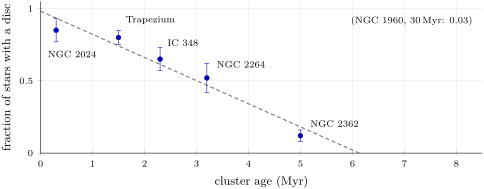
Discs do not last. Infrared excess, the glow of warm dust above what the star alone would emit, reveals whether a star still has a disc. Counting the stars with such an excess in clusters of different ages gives the fraction of stars that keep their disc as a function of time (figure below): most stars have one at birth, half have lost it by about three million years, and almost none keeps one beyond six. Gas giants, which must gather their gas from the disc, have to form within these few million years.
In the lab — Seeing through the dust with radio waves
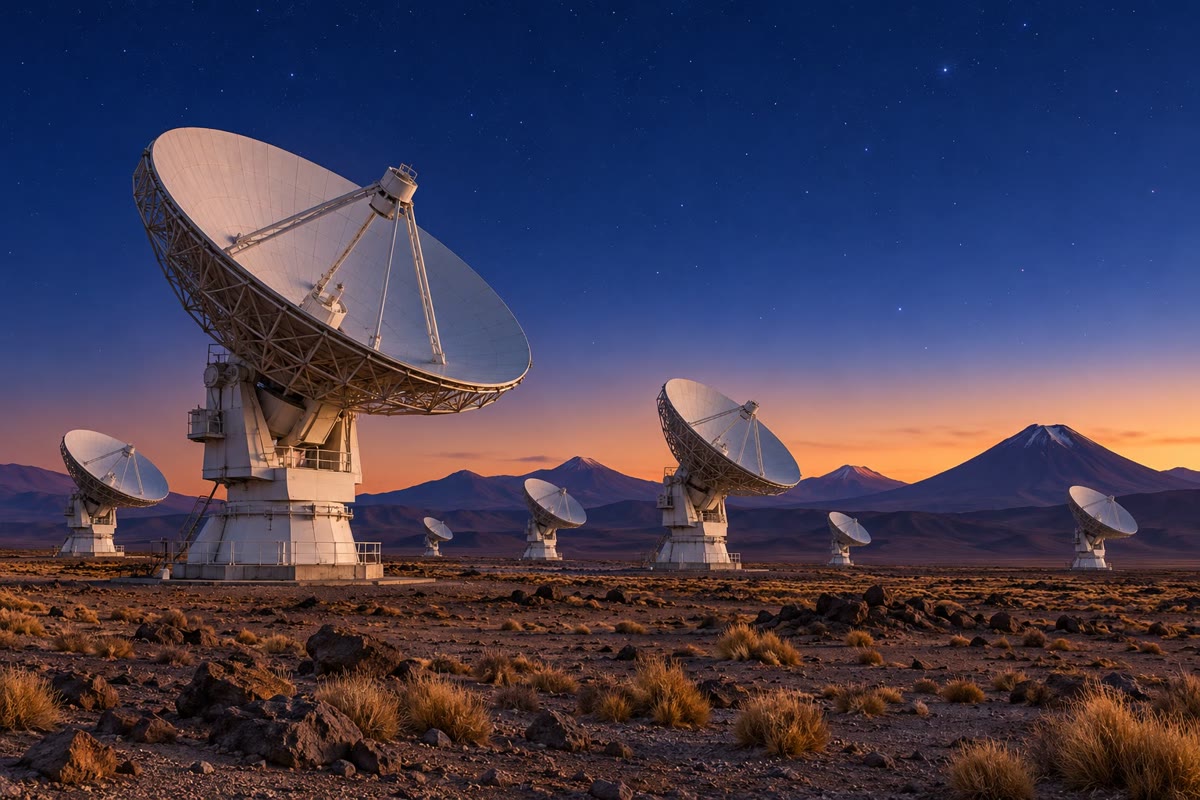
Cold gas and dust are invisible to optical telescopes but shine at millimetre wavelengths, where the atmosphere is transparent only above high, dry sites. A radio dish of the size of a house resolves little at such wavelengths, so astronomers combine many: in an interferometer each pair of antennas, separated by a baseline, measures one component of the brightness pattern of the sky, and a computer assembles the image from the hundreds of pairs that some thirty antennas make. The resolution is that of a single telescope as wide as the longest baseline: with antennas spread over , the HL Tauri disc was imaged in detail of a few astronomical units at . Operators move the antennas on transporters between configurations, and the correlator combines their signals in real time.
1.6 Exercises
Exercise 1.1 ★
The mean interstellar density near the Sun is . Taking the mass of a hydrogen atom as , compute the number of hydrogen atoms per cubic centimetre. Compare with the number of molecules per cubic centimetre in air at and ().
Solution
Solution of Exercise 1.1.
hydrogen atoms per cubic centimetre. In air, , that is molecules per cubic centimetre: about times more.
Exercise 1.2 ★
Using the value solar masses at and particles per cubic centimetre, and the scaling of with density, compute the Jeans mass at and particles per cubic centimetre. How many Jeans masses does the Taurus cloud, solar masses, contain?
Solution
Solution of Exercise 1.2.
: dividing by 100 multiplies by 10, so solar masses at particles per cubic centimetre. The cloud holds Jeans masses: it cannot be stable as a whole, and must fragment.
Exercise 1.3 ★
Compute the isothermal speed of sound of molecular gas (, ) at and at . How long does a sound wave take to cross a core of radius at , in millions of years?
Solution
Solution of Exercise 1.3.
at ; times more, , at . Crossing : , that is .
Exercise 1.4 ★
Compute the free-fall time of a dense core of particles per cubic centimetre and of a dark cloud of (). Which collapses faster, and by what factor?
Solution
Solution of Exercise 1.4.
with in . For particles per cubic centimetre, and ; for , is times smaller and times longer, . The dense core collapses 32 times faster.
Exercise 1.5 ★★
Show that can be written . At fixed temperature, by what factor must the density of a core rise to halve its Jeans mass? At fixed density, by what factor does the Jeans mass change if the core warms from to ?
Solution
Solution of Exercise 1.5.
With , , which gives the formula. Since , halving needs a density four times higher. Since , warming from to multiplies it by .
Exercise 1.6 ★★
A young star has the Sun’s mass, twice its radius and twice its luminosity (, , ). Compute its Kelvin–Helmholtz time in millions of years, and compare with the lifetimes of discs.
Solution
Solution of Exercise 1.6.
, that is . It is longer than the lifetime of most discs (half are gone after about ): the star is still contracting when its disc disappears.
Exercise 1.7 ★★
Compute the accretion rate of a protostar in a core at , in solar masses per year, and the time it takes to gather one solar mass. Same questions for a core at .
Solution
Solution of Exercise 1.7.
At , , that is solar masses per year, and one solar mass takes . At the rate is times higher, solar masses per year, and one solar mass takes .
Exercise 1.8 ★★
With Proposition 1.15 and , compute the distance from the Sun, in astronomical units, at which a grain reaches , near the temperature at which the common silicates condense (Chapter 2), and the temperature of a grain at Jupiter’s distance, .
Solution
Solution of Exercise 1.8.
with : at , , well inside the orbit of Mercury. At , .
Exercise 1.9 ★★
The gas of the HL Tauri disc rotates around a star of about solar masses. Compute the Keplerian speed and the orbital period at . If the system is one million years old, how many turns has the gas at made since the star formed?
Solution
Solution of Exercise 1.9.
, and years (equivalently years). In a million years the gas has made turns: the disc is old compared with its own rotation, which is why its rings are smooth circles.
Exercise 1.10 ★★★
Find the gravitational energy of a sphere of radius in which the density falls as , and compare it with that of a uniform sphere of the same mass and radius. Does concentrating the mass towards the centre make the cloud easier or harder to hold up by its thermal energy?
Solution
Solution of Exercise 1.10.
, and inside , . With ,
using . It is times the uniform value: the concentrated cloud is more tightly bound and needs more thermal energy to be held up; it collapses more easily.
Exercise 1.11 ★★★
A core of radius rotates as a solid body at the angular speed . Compute its rotation period, the specific angular momentum of gas at its equator, and the centrifugal radius of that gas around a star of one solar mass, in astronomical units. Why does gas from inside the core land closer to the star?
Solution
Solution of Exercise 1.11.
Period , about . With , , and . In solid rotation grows as the square of the distance from the axis: gas from inside the core has less angular momentum, and lands closer to the star.
Exercise 1.12 ★★★
The disc fractions of the five youngest clusters of the figure in the last section are , , , and at 0.3, 1.5, 2.3, 3.2 and . Fit a least-squares straight line by hand (compute the means, then and ). At what age does it reach one half, and zero? Why is a straight line a poor model beyond that age?
Solution
Solution of Exercise 1.12.
, ; , , so per million years and . The line reaches at and zero at , as in the figure. A fraction cannot fall below zero: older clusters, such as NGC 1960 at , keep a small fraction near zero that a straight line cannot describe.
1.7 Problem: A core in the Aldra cloud
Problem 1.1
Weekend problem — the mass and stability of a dense core read from a dust map, the birth of its protostar and the size of its disc
The Aldra cloud is an invented dark cloud. A millimetre map of its dust shows a round core of radius , with a mean column density of hydrogen molecules per square centimetre. A line of ammonia gives the gas temperature, , and a velocity gradient of per parsec across the core, read as solid rotation. Use , , , , , a year of , , , , ; the mass per hydrogen molecule, helium included, is , and the mean mass per particle .
Part I — Mass and density.
- Convert the radius of the core into metres.
- Compute the mass per square metre of the column, .
- Deduce the mass of the core, in kilograms and in solar masses.
- Compute its volume and its mean density.
- Compute the number of particles per cubic centimetre.
- Is this a dense core in the sense of the table of the second section?
Part II — Stability.
- Compute the Jeans mass of the core’s gas, in solar masses.
- How many Jeans masses does the core hold? Is it stable?
- Compute the Jeans length and compare it with the radius of the core.
- What would the Jeans mass be if the gas were at ? Would the core still collapse?
- Compute the free-fall time of the core, in thousands of years.
- Compare it with the time a sound wave takes to cross the core. Which process is faster, and what does that mean?
Part III — The protostar.
- Compute the speed of sound in the core.
- Compute the accretion rate , in solar masses per year.
- Compute the time needed to gather one solar mass at this rate.
- If a third of the core ends in stars, how many stars of one solar mass can it make?
- Once the envelope is gone, the star has one solar mass, three solar radii and four solar luminosities. Compute its Kelvin–Helmholtz time.
- Is it longer or shorter than the accretion time? What kind of star is it then?
Part IV — The disc.
- Convert the velocity gradient into an angular speed , in .
- Compute the specific angular momentum of gas at the equator of the core.
- Compute its centrifugal radius around a star of one solar mass, in astronomical units.
- Compute the temperature of a grain at and at from a star of one solar luminosity.
- Where is the snow line of this disc, if water ice survives below ?
- State the time needed to assemble the star of question 15, the key number of this problem, in thousands of years, and compare it with the free-fall time of question 11.
Solution
Solution of Problem 1.1.
1. .
2. , so .
3. , that is solar masses.
4. and .
5. , that is particles per cubic centimetre.
6. Yes: its density lies between and , its radius between 0.03 and ; its mass, 6.7 solar masses, is at the top of the range of cores.
7. solar masses.
8. Jeans masses: the core is unstable and collapses.
9. , smaller than the radius, : the same conclusion.
10. solar masses: about the core’s mass. At the core would be marginal; cold is what makes it collapse.
11. , about years.
12. , years: three times longer than the free fall. A pressure wave cannot cross the core before it has collapsed; pressure cannot react fast enough to stop the collapse.
13. (Exercise 1.3).
14. , solar masses per year.
15. years.
16. A third of 6.7 is : two stars of one solar mass.
17. , .
18. Longer, four times the accretion time: when accretion stops, the star is still contracting, shining without fusion; it is a T Tauri star, not yet on the main sequence.
19. .
20. .
21. , that is : larger than the HL Tauri disc, as expected for gas from the edge of the core.
22. at , and at .
23. , that is , as in the text.
24. The star of one solar mass takes thousand years to assemble, about four times the free-fall time of its core ( years): the outer gas reaches the protostar only gradually, inside out.