
All books

Professional

Apps About Coach Log in Start reading

Earth and Space Sciences · Glossary

What is Rayleigh wave, Love wave?

Also known as: Rayleigh wave · Love wave

Definition 1.7 University Earth and Space Sciences — Year 3 · Chapter 1 — Seismology and Earth Imaging

A Rayleigh wave is a surface wave whose particle motion lies in the vertical plane containing the direction of propagation: P and vertically polarised S motions coupled by the free surface, with an elliptical particle motion, retrograde at the surface of a uniform half-space, whose amplitude decays with depth over about a wavelength. A Love wave is a surface wave whose particle motion is horizontal and perpendicular to the direction of propagation: horizontally polarised S waves trapped in layers slower than the rock below them.
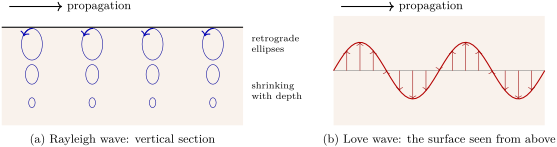
Particle motions of the two surface waves (schematic). (a) A Rayleigh wave moves the ground in the vertical plane of propagation, along ellipses that turn backwards at the top (retrograde) near the surface and shrink with depth. (b) A Love wave moves the ground horizontally, across the direction of propagation: the arrows show the displacement at one instant along a line of the surface.
Read in context →