
সব বই

পেশাদার

1 Markets I: The Ecosystem and Exchange-Traded Marketsবাজার অনলাইন 2 Markets II: Rates, FX and Creditবাজার অনলাইন 3 Markets III: Commodities, Energy and Cryptoবাজার অনলাইন 4 Quantitative Methodsপদ্ধতি অনলাইন 5 Derivatives and Volatilityডেরিভেটিভস অনলাইন 6 Rates, Credit, XVA and Riskসুদহার, ঋণ ও ঝুঁকি অনলাইন 7 Research Craft: Predictors, Backtests, Measurement, Portfoliosগবেষণা অনলাইন 8 Strategies I: Equities and Futuresকৌশল অনলাইন 9 Strategies II: Volatility, Relative Value, Macro and the Bank Desksকৌশল অনলাইন 10 Microstructure and Executionএক্সিকিউশন অনলাইন 11 Market Making and High-Frequency Tradingমার্কেট মেকিং অনলাইন 12 Machine Learning for Marketsমেশিন লার্নিং অনলাইন 13 Low-Latency Softwareপ্রযুক্তি অনলাইন 14 Networks, Hardware and Trading Infrastructureপ্রযুক্তি অনলাইন 15 Research, Data and Risk Platformsপ্রযুক্তি অনলাইন 16 The Desk and the Firmপ্রতিষ্ঠান অনলাইন 17 The Industry: Firms, Roles and Careersক্যারিয়ার অনলাইন 18 Interviews I: Maths, Probability and Speedক্যারিয়ার অনলাইন 19 Interviews II: Markets, Trading Games and the Final Roundক্যারিয়ার অনলাইন 20 Interviews III: Codeক্যারিয়ার অনলাইন
অ্যাপ পরিচিতি Coach সাইন ইন পড়া শুরু করো

বইগুলো এখনো বাংলা ভাষায় পাওয়া যায় না — ইংরেজি সংস্করণ দেখানো হচ্ছে।

Earth and Space Sciences · পরিভাষা

Reef, carbonate platform, ooid কী?

অন্য নাম: reef · carbonate platform · ooid

Definition 22.3 University Earth and Space Sciences — Year 1 · অধ্যায় 22 — Carbonate, Siliceous and Evaporite Sediments

A reef is a carbonate build-up whose framework of organisms, corals, algae or others, grown in place and bound and cemented together, stands above the surrounding sea floor and resists the waves. A carbonate platform is a thick body of shallow-water carbonate whose flat top lies close to sea level and which is bounded by a slope down to deeper water. An ooid is a round grain of sand size made of concentric layers of calcium carbonate grown around a nucleus as it rolled in agitated water; a rock made of ooids is an oolite.
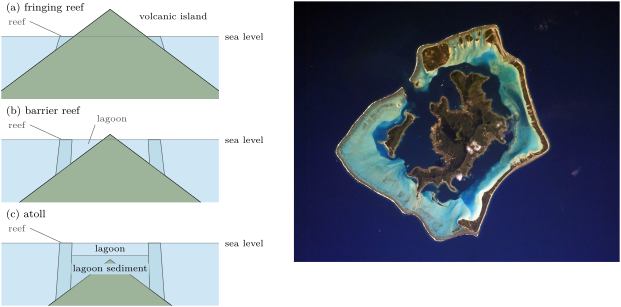
Left: the three kinds of coral reef in cross-section (schematic, vertical scale much exaggerated), drawn as Darwin explained them: (a) a reef fringing a volcanic island; (b) the island has sunk and the reef, growing upward, has become a barrier separated from the shore by a lagoon; (c) the island has sunk out of sight and the reef is an atoll around a lagoon floored with carbonate sediment. Right: Bora Bora, a volcanic island in a lagoon enclosed by a barrier reef with low islands on it, photographed by an astronaut from the International Space Station on 19 March 2003 (NASA, public domain, via Wikimedia Commons).
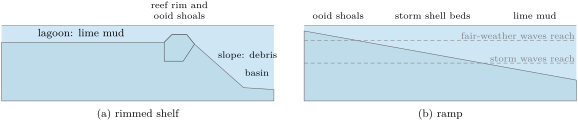
The two shapes of carbonate platform (schematic, slopes much exaggerated). (a) A rimmed shelf: a rim of reefs and ooid shoals breaks the waves, a quiet lagoon of lime mud lies behind it, and debris shed from the rim falls down the slope to the basin. (b) A ramp slopes gently from the shore to the basin, its sediments sorted by the depth the waves reach.
প্রসঙ্গসহ পড়ো →