সব বই

পেশাদার

1 Markets I: The Ecosystem and Exchange-Traded Marketsবাজার অনলাইন 2 Markets II: Rates, FX and Creditবাজার অনলাইন 3 Markets III: Commodities, Energy and Cryptoবাজার অনলাইন 4 Quantitative Methodsপদ্ধতি অনলাইন 5 Derivatives and Volatilityডেরিভেটিভস অনলাইন 6 Rates, Credit, XVA and Riskসুদহার, ঋণ ও ঝুঁকি অনলাইন 7 Research Craft: Predictors, Backtests, Measurement, Portfoliosগবেষণা অনলাইন 8 Strategies I: Equities and Futuresকৌশল অনলাইন 9 Strategies II: Volatility, Relative Value, Macro and the Bank Desksকৌশল অনলাইন 10 Microstructure and Executionএক্সিকিউশন অনলাইন 11 Market Making and High-Frequency Tradingমার্কেট মেকিং অনলাইন 12 Machine Learning for Marketsমেশিন লার্নিং অনলাইন 13 Low-Latency Softwareপ্রযুক্তি অনলাইন 14 Networks, Hardware and Trading Infrastructureপ্রযুক্তি অনলাইন 15 Research, Data and Risk Platformsপ্রযুক্তি অনলাইন 16 The Desk and the Firmপ্রতিষ্ঠান অনলাইন 17 The Industry: Firms, Roles and Careersক্যারিয়ার অনলাইন 18 Interviews I: Maths, Probability and Speedক্যারিয়ার অনলাইন 19 Interviews II: Markets, Trading Games and the Final Roundক্যারিয়ার অনলাইন 20 Interviews III: Codeক্যারিয়ার অনলাইন
অ্যাপ পরিচিতি Coach সাইন ইন পড়া শুরু করো

বইগুলো এখনো বাংলা ভাষায় পাওয়া যায় না — ইংরেজি সংস্করণ দেখানো হচ্ছে।

Earth and Space Sciences · পরিভাষা

Settling velocity কী?

Definition 20.4 University Earth and Space Sciences — Year 1 · অধ্যায় 20 — Erosion and Transport

The settling velocity wsw_s of a grain is the constant velocity at which it falls through still water, when the drag of the water balances its submerged weight, its weight minus the buoyancy of the water it displaces.
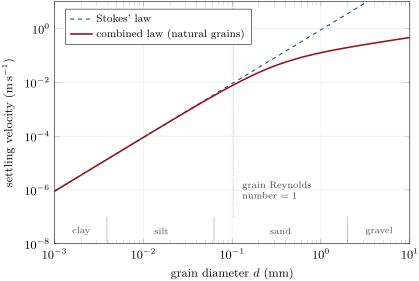

Settling velocity of quartz grains in water at 20\, C against their diameter, both on logarithmic scales: Stokes’ law and the combined law of natural grains, computed. On these scales Stokes’ law is a straight line of slope 2. The two agree for silt and clay; above about 0.1\, mm, where the grain Reynolds number passes 1, the drag of the wake slows the coarse grains. The ticks at the bottom mark the boundaries of the grain-size classes, at 3.9\, µ m (1/256 mm), 62.5\, µ m (1/16 mm) and 2\, mm.
Settling velocity of quartz grains in water at 20 ∘C20\,{}^{\circ}\mathrm{C} against their diameter, both on logarithmic scales: Stokes’ law and the combined law of natural grains, computed. On these scales Stokes’ law is a straight line of slope 2. The two agree for silt and clay; above about 0.1 mm0.1\,\mathrm{mm}, where the grain Reynolds number passes 1, the drag of the wake slows the coarse grains. The ticks at the bottom mark the boundaries of the grain-size classes, at 3.9 µm3.9\,\text{µ}\mathrm{m} (1/2561/256 mm), 62.5 µm62.5\,\text{µ}\mathrm{m} (1/161/16 mm) and 2 mm2\,\mathrm{mm}.
প্রসঙ্গসহ পড়ো →