
All books

Professional

Apps About Coach Log in Start reading

Earth and Space Sciences · Glossary

What is Snowball Earth; cap carbonate?

Also known as: snowball Earth · cap carbonate

Definition 18.14 University Earth and Space Sciences — Year 2 · Chapter 18 — The Precambrian Earth

A snowball Earth is a state of the Earth in which ice covers the oceans and the continents down to the equator, with grounded ice sheets reaching the sea at all latitudes, for millions of years. A cap carbonate is the layer of carbonate rock, typically a pale, finely laminated dolostone, that sharply overlies the glacial deposits of a snowball and records its sudden end.
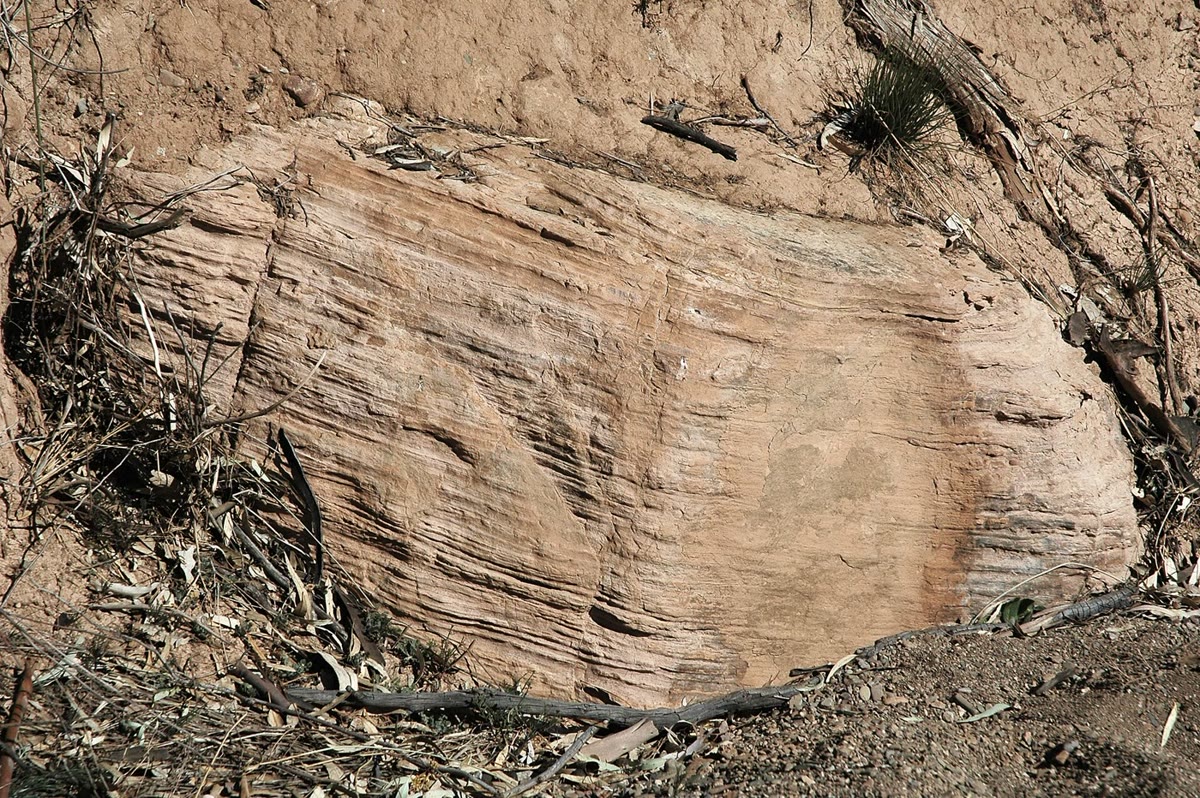
A cap carbonate: laminated dolostone of the Nuccaleena Formation, Flinders Ranges, South Australia, resting on the deposits of the Marinoan glaciation (the beds are tilted). Photograph James St. John, CC BY 2.0 (Wikimedia Commons).

Examples

Example 18.16 (How long to escape?)

The highest preferred estimate of today’s volcanic release is 0.26 Gt0.26\,\mathrm{Gt} of carbon dioxide a year. Estimates of the mixing ratio needed to end a Cryogenian snowball range from 0.01 to 0.1. With Ma=5.1×10¹⁸ kgM_{\text{a}} = 5.1 \times 10^{18}\,\mathrm{kg}, Mˉ=28.97 g mol−1\bar M = 28.97\,\mathrm{g}\,\mathrm{mol}^{-1} and MCO2=44.01 g mol−1M_{\mathrm{CO_2}} = 44.01\,\mathrm{g}\,\mathrm{mol}^{-1}, x=0.01x = 0.01 takes 0.010.99×1.519×5.1×1018 kg/0.26×1012 kg yr−1=0.30 Myr\frac{0.01}{0.99}\times1.519\times5.1 \times 10^{18}\,\mathrm{kg} / 0.26 \times 10^{12}\,\mathrm{kg}\,\mathrm{yr}^{-1} = 0.30\,\mathrm{Myr}, and x=0.1x = 0.1 takes 3.3 Myr3.3\,\mathrm{Myr}.

Read in context →