University Earth and Space Sciences — Year 2 · Bachelor Year 2
18The Precambrian Earth
The first shelly fossils appear in rocks about 540 million years old. Everything before them, from the birth of the Earth ago, is the Precambrian: seven-eighths of the planet’s history. In that time the Earth built the cores of its continents, filled its air with oxygen, and at least twice froze over from the poles to the equator, with ice sheets reaching the sea in the tropics. This chapter reads those four billion years in the rocks that survive from them, and puts numbers on three of their puzzles: why the oldest lavas were so hot, how a frozen planet can thaw, and how the young Earth stayed warm under a dim Sun.
You already know
From the school volumes: the age of the Earth; the eons on the geological time scale; the young Sun’s luminosity law and the faint young Sun problem; the primitive atmosphere; stromatolites, banded iron formations, the Great Oxidation Event and red beds; cratons; radiogenic heat in the past. From the Year 1 volume: zircon and its U–Pb ages, closure temperature; radiogenic heat production of the four isotopes; outgoing longwave radiation and the global mean insolation ; chronostratigraphic units. From earlier chapters: the mantle potential temperature and the adiabat (Chapter 7); the liquidus and fractional crystallisation of olivine (Chapter 8); granite types (Chapter 12); supercontinents (Chapter 15). Oxidation and reduction belong to the chemistry books, and the first eukaryotes and photosynthesis to the biology books.
18.1 Three eons before the fossils
Definition 18.1 (Hadean, Archean, Proterozoic)
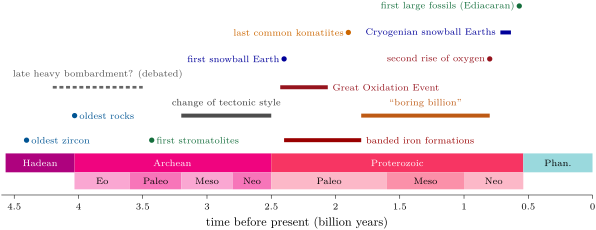
The time before the Phanerozoic is divided into three eons. The Hadean runs from the formation of the Earth, ago, to ; the Archean from to ; the Proterozoic from 2500 to , the base of the Cambrian. Together they are informally called the Precambrian.
The Archean is cut into four eras, the Eoarchean (4031 to ), Paleoarchean (3600 to 3200), Mesoarchean (3200 to 2800) and Neoarchean (2800 to 2500); the Proterozoic into three, the Paleoproterozoic (2500 to ), Mesoproterozoic (1600 to 1000) and Neoproterozoic (1000 to 538.8). Two Neoproterozoic periods matter below, the Cryogenian, 720 to , and the Ediacaran, 635 to .
The Hadean: minerals without rocks
No rock survives from the Hadean, only minerals. The oldest is a grain of zircon from the Jack Hills of Western Australia, old, washed out of an older rock and laid down in a conglomerate some three billion years ago. Its composition, and that of its neighbours, was read by its discoverers as evidence that a crust of continental type and liquid water already existed ago, some 160 million years after the Earth formed. The oldest dated rocks, the Acasta gneisses of north-western Canada, are 4.00 to old, close to the base of the Archean.
The young Earth was struck by large bodies, as Chapter 2 described. The last impact large enough to vaporise the whole ocean is estimated to have happened about ago. A later “late heavy bombardment”, a burst of impacts between about 4.2–4.0 and inferred from the ages of lunar rocks and of shocks in meteorites, has been proposed; many dispute that it was a distinct event at all, and either way it would probably not have sterilised the Earth.
18.2 The Archean crust
Greenstone belts and komatiites
The Archean crust that survives is made of two kinds of terrain, side by side: large bodies of grey, sodium-rich granitic gneiss, and narrower belts of altered volcanic and sedimentary rock.
Definition 18.2 (Greenstone belt; komatiite)
A greenstone belt is a belt of mafic and ultramafic volcanic rocks, with sediments, metamorphosed at low grade (the green comes from chlorite, actinolite and epidote), lying between bodies of granitoid in Archean and some Proterozoic terrains. A komatiite is an ultramafic lava, far richer in MgO than basalt, erupted as a liquid; its olivine typically grows in long, thin blades, the spinifex texture, as the top of the flow cools fast.
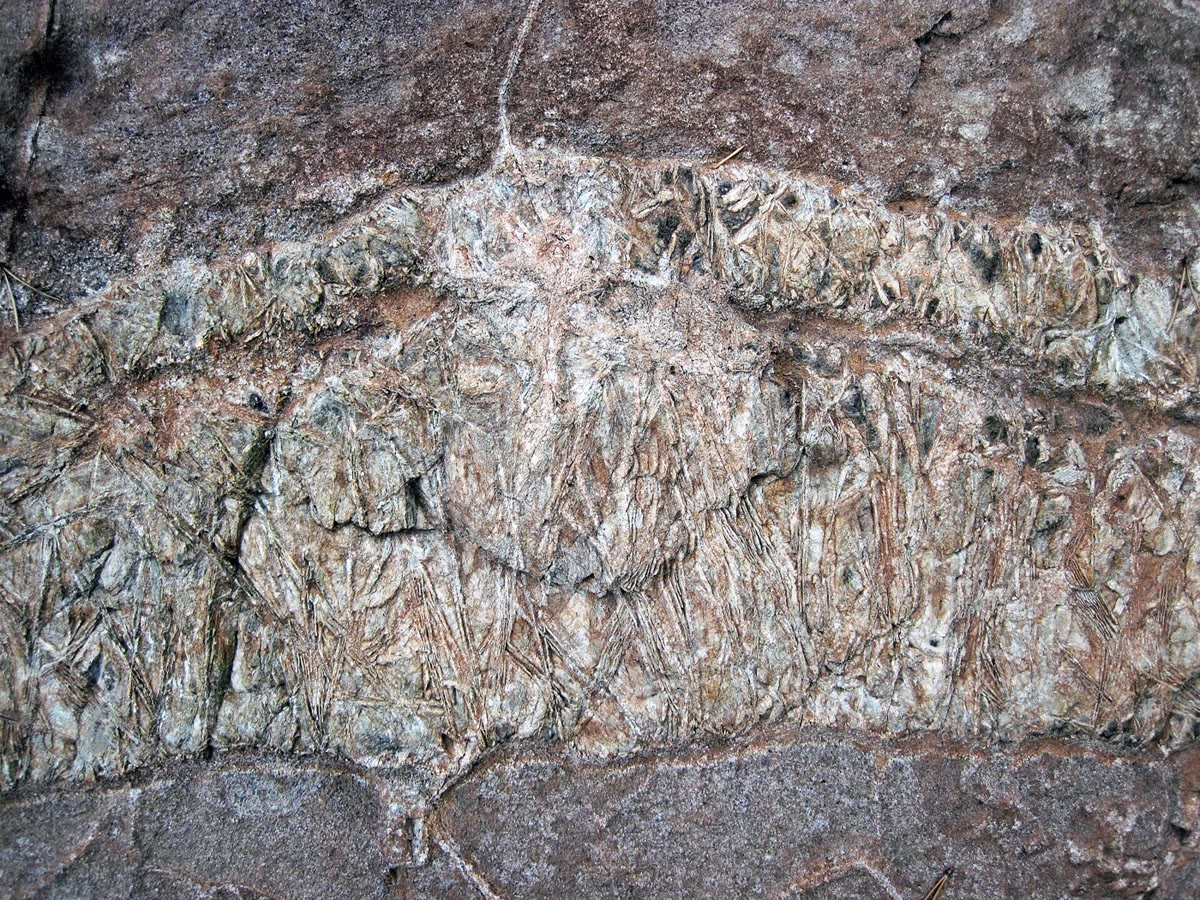
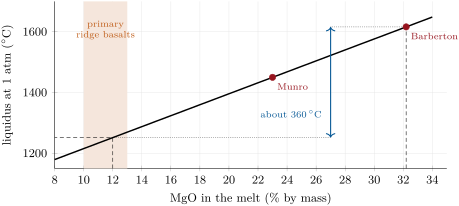
Komatiites contain up to MgO, against 10 to in the primary basalts of today’s ridges, and they are almost confined to the old Earth: the aluminium-depleted kind is found only in rocks older than , the aluminium-undepleted kind until about , and only a rare aluminium-enriched kind is as young as . A melt that rich in magnesium is very hot, and, as for the basalts of Chapter 8, the first mineral to crystallise from it is olivine, whose share in the liquid fixes the temperature.
Proposition 18.3 (The komatiite thermometer)
For a melt in equilibrium with olivine at atmospheric pressure, the liquidus temperature rises nearly linearly with the MgO content of the melt. Through two experiments and ,
Melting experiments on two komatiites, MgO at and at , give per per cent of MgO.
Proof. Olivine is a solid solution of forsterite and fayalite, much richer in magnesium than the melt it grows from. As the melt cools, olivine takes magnesium out of it, and the temperature at which the melt is just saturated in olivine falls with its MgO content. Experiments show that over the range of a given family of melts the fall is close to linear, so that the line through two experiments interpolates between them; . ∎
The coefficient is not special to komatiites. Glasses quenched from the lava of Kilauea, calibrated in the same way, change by for of MgO, that is per per cent. Extending the komatiite line down to a primary ridge basalt with MgO thus gives its liquidus within a few tens of degrees: . The hottest komatiite liquids were therefore some hotter than the melts that feed today’s ridges, and the figure below shows the line.
Hotter lava does not mean a mantle hotter by the same amount. Komatiites probably rose in plumes, as the hottest basalts of today do at Hawaii, where the potential temperature is up to about above the of the ambient mantle. And they formed by large degrees of melting, at greater depth. They are commonly thought to have formed in a mantle 200 to warmer than today’s; an alternative view holds that komatiites were wet magmas, formed at temperatures not much higher than the surrounding mantle. Either way, the Archean mantle was hotter, and the school volumes gave one reason: 3 billion years ago the four radioactive isotopes released more than twice today’s heat (Exercise 18.2).
TTG and the dome-and-keel pattern
The grey gneisses between the greenstone belts are not granites of the kind that Chapter 12 described.
Definition 18.4 (Tonalite–trondhjemite–granodiorite suite)
The tonalite–trondhjemite–granodiorite suite (TTG) is the family of sodium-rich, potassium-poor granitoids — tonalites, trondhjemites (tonalites poor in mafic minerals) and granodiorites — that makes up most of the Archean continental crust. Most of them formed by partial melting of hydrated basaltic crust.
Much of the volume of today’s continental crust had formed by the end of the Archean, largely as TTG. Some TTG carry trace-element signatures long read as melting at more than depth, a pressure not reached in younger continental crust, and these readings weigh in the debate on when plate tectonics began; a 2019 study argued that those signatures come instead from melts of the mantle, and that the common TTG formed at depths no greater than the of an ordinary continental crust today. Late in the Archean, between about 3.0 and , the granitoids of most cratons change from TTG to potassium-rich granites, the sign of a thicker crust being melted again.
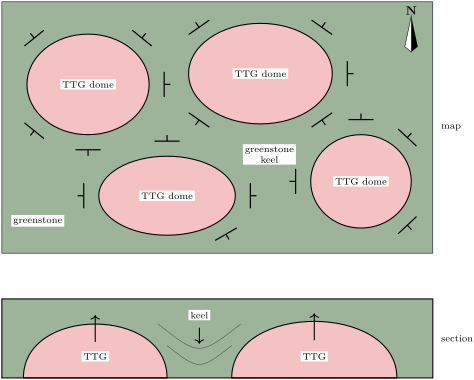
In the eastern Pilbara of Australia, in Zimbabwe and in southern India, the two terrains draw a striking pattern on the map. Rounded domes of granitoid are framed by synclinal keels of greenstone whose layers dip and face away from the domes. The domes are thought to have risen as diapirs, light granitic crust rising through a thick, dense pile of lavas that sank between them. In the Pilbara this doming went on for hundreds of millions of years and stopped about ago, after which the structures become linear, like those of younger orogens.
Cratons
Definition 18.5 (Craton)
A craton is a part of a continent that has stayed tectonically stable for more than a billion years: a core of Archean or Proterozoic crust, metamorphic and plutonic, sitting on a thick, cold and buoyant root of lithospheric mantle that reaches some deep.
The cratons stabilised mostly in the Mesoarchean and Neoarchean, and the signs of their stability are written in the rocks: broad sedimentary basins laid on them, such as the Transvaal Supergroup on the Kaapvaal craton (about 2640 to ) and the Mount Bruce Supergroup on the Pilbara (2775 to ); swarms of straight dykes that cut them as brittle plates; and their thick roots, acquired by the late Archean. Between 3.2 and the record also shows the oldest passive margins and foreland basins, belts of paired metamorphism, and palaeomagnetic evidence that cratons moved relative to each other. A review of 2018 reads these changes as the gradual onset of plate tectonics as it works today, while stressing that no single observation proves it; published estimates of that onset range from the Hadean to the Neoproterozoic.
In the field — Reading a greenstone belt
In a greenstone belt the first question a mapping geologist asks is which way was up when the rocks formed, since the layers are often vertical or overturned. Pillow lavas give the answer by their rounded tops and the pointed bases they push into the pillows below; graded beds by their fining upward; and komatiite flows by their zoning, a chilled and fractured top with spinifex blades growing downward into it, above a base rich in heaped olivine crystals. Facing directions mapped station by station draw the synclines of the keels. Zircons from felsic tuffs and from the TTG of the domes then give U–Pb ages, so that the geologist can tell which greenstones are older than the domes that now push through them.
18.3 Oxygen
An Archean air without oxygen
The primitive atmosphere of the school volumes was rich in nitrogen and carbon dioxide and poor in oxygen. Proxies and models now bound it more tightly. Before the oxygen at the surface was below a millionth of today’s; the carbon dioxide was perhaps 10 to 2500 times today’s and the methane 100 to times. Grains of uraninite and pyrite, which oxygen destroys, were carried by Archean rivers and laid down unaltered; at the survival of detrital uraninite caps oxygen at . The carbon cycle, recalled below, held the mean surface temperature between about 0 and .
Oxygen was being made: cyanobacteria release it by photosynthesis, and whiffs of it appear in some Archean rocks. But it was consumed as fast as it formed, by volcanic gases and by the iron dissolved in the sea.
Definition 18.6 (Banded iron formation)
A banded iron formation (BIF) is a chemical sediment of thin alternating layers of iron oxides — hematite, magnetite — and of chert. It precipitates from sea water that carries dissolved iron(II), when that iron is oxidised to insoluble iron(III); it therefore needs a deep ocean without oxygen, a supply of iron, and an oxidant where the iron is deposited.
Banded iron formations are most abundant from 2.4 to ; after that the deep ocean no longer carried enough dissolved iron, and they essentially vanish, to return briefly in the glacial deposits of the Cryogenian (below). They are a common ore of iron (Chapter 29).
The Great Oxidation Event
Definition 18.7 (Great Oxidation Event)
The Great Oxidation Event (GOE) is the interval, from about 2.4–2.3 to about , during which oxygen first accumulated durably in the atmosphere and the shallow ocean, rising from less than a millionth of its present level to perhaps a tenth.
The clearest marker is a signature of sulfur isotopes. In sediments older than the GOE, the isotopes of sulfur are sorted in a way that only photochemistry in an oxygen-free air produces; the signature disappears when oxygen arrives. Its physics and its full record belong to the Year 3 volume; here it serves as a clock. In three drill cores through the Transvaal Supergroup of South Africa the signature vanishes at , within 1 to : the rise itself was fast. Other records put the start of the event at 2.46 to , at the time of the first global glaciation, and show that oxygen did not rise steadily afterwards.
After the GOE, red beds appear, detrital pyrite and uraninite disappear from river sands, and soils keep their iron as oxides. But the deep ocean stayed anoxic for more than a billion years.
The “boring billion” and the second rise
The interval from about 1.8 to shows so little change in the carbon isotopes of marine carbonates that it is widely called the “boring billion”. Its oxygen is debated: early estimates gave 1 to of the present level, chromium isotopes suggest less than , perhaps . The deep ocean was anoxic. Over this interval the eukaryotes, as the biology books tell, appeared, diversified and grew in numbers. From about many records show a second, abrupt rise of oxygen, at the time of major developments in complex life; whether the oxygen triggered them or followed them is still argued. Large fossils of the Ediacaran appear from about . Meanwhile the supercontinents of Chapter 15 assembled and broke up: passive margins, a mark of break-up, are abundant around 2100 to , as Nuna assembled, and again from 650 to .
18.4 Ice to the equator
The ice–albedo feedback
Snow and ice reflect most of the sunlight they receive, open sea very little: about for the ocean, 50 to for bare sea ice, up to for snow-covered ice. An Earth that cools grows more ice, reflects more sunlight and cools further.
Definition 18.8 (Ice–albedo feedback)
The ice–albedo feedback is the amplification of a change of temperature by the change of snow and ice cover it causes: cooling extends the ice, which raises the planet’s albedo, reduces the sunlight absorbed and cools the planet further; warming works the other way. It is a positive feedback.
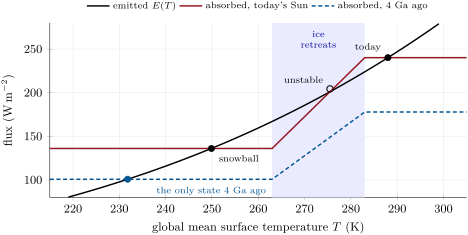
Its consequences are seen in the simplest climate model, a planet of one temperature and heat capacity per square metre. It absorbs , where is the sunlight at its distance and its albedo, and it loses the outgoing longwave radiation of the Year 1 volume, written : , the effective emissivity, measures how much of the surface’s emission escapes the greenhouse, and today it is . To include the feedback, the albedo is made a function of the temperature. This chapter chooses , today’s value, when ; , the value climate models give a globally frozen surface, when ; and a straight line in between. The two thresholds are a modelling choice, not measured quantities.
Proposition 18.9 (Equilibria of an energy-balance model)
In the model
the steady temperatures are the solutions of . A steady temperature is stable if and unstable if .
Proof. At a solution of the right-hand side vanishes, so stays put. Near it, put : to first order , whose solution decays when and grows when . ∎
always rises with . is flat where the albedo is fixed, so the frozen and the warm equilibria are stable; in the ramp between them rises, because warming melts ice, and if it rises faster than an equilibrium there is unstable. The figure below shows that with today’s sunlight the model has three equilibria.
Example 18.10 (Three climates under today’s Sun)
With , the warm equilibrium is by construction. A snowball has absorbed, so and , below : the frozen state also exists. Between them, in the ramp, again at , an unstable state: a planet slightly warmer warms to , one slightly colder freezes.
Proposition 18.11 (Tipping points)
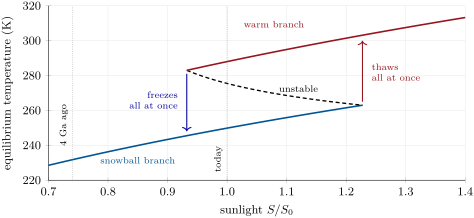
In this model the warm climate exists only if and the snowball only if , where
and being the ends of the ramp and , the albedos of the frozen and the warm planet. Between and both exist.
Proof. On the warm branch and the equilibrium is , which rises with ; it is a valid warm state only if , that is . Likewise the snowball equilibrium is valid only if it does not exceed , that is . ∎
With today’s emissivity, , of today’s sunlight, and , . The figure below draws the equilibria against the sunlight. Its fold makes a loop: a warm Earth whose sunlight or greenhouse weakens past the left fold freezes all at once, and a frozen Earth stays frozen until it is pushed past the right fold, far beyond the conditions in which it froze. This is the hysteresis that Hoffman and colleagues draw for the real Earth with more complete models, with the ice line advancing “uncontrollably to the equator” once it reaches the instability threshold.
The faint young Sun
Definition 18.12 (Faint young Sun problem)
The faint young Sun problem is the contradiction between the models of the Sun, which make it 25 to fainter ago, and the rocks, which show liquid water and an active water cycle through the Archean: with today’s atmosphere and albedo the early Earth should have been frozen.
The energy-balance model makes the problem sharper than the school volumes could. With Gough’s law, the sunlight ago was of today’s, below the at which the warm climate disappears: with today’s emissivity the only equilibrium is a snowball at . The law reaches only ago. For more than three quarters of its history, then, the Earth with today’s air could not have been warm, and once frozen it would have needed even more to thaw.
Example 18.13 (The greenhouse of the young Earth)
To keep under the Sun of ago with today’s albedo, the absorbed sunlight is , so the effective emissivity must fall to , against 0.616 today: the share of the surface’s emission trapped by the greenhouse must rise from 0.384 to 0.544.
The rocks say the greenhouse was indeed stronger. Carbon dioxide alone would have sufficed with 0.024 to of it ago and 0.004 to at , and methane, abundant in the anoxic air, helped. A thermostat kept it so: silicate weathering, which consumes carbon dioxide, slows when the climate cools and quickens when it warms, so the carbon dioxide of the air adjusts until the climate is temperate. The same thermostat explains how a snowball ends.
Snowball Earth
Glacial deposits of the Neoproterozoic — diamictites, striated pavements, stones dropped from floating ice into fine sediment — show grounded ice sheets reaching the sea at all latitudes, and palaeomagnetism, which the Year 3 volume treats, places several of them near the equator. The Sturtian glaciation, for instance, began at a palaeolatitude of N, in today’s Yukon.
Definition 18.14 (Snowball Earth; cap carbonate)
A snowball Earth is a state of the Earth in which ice covers the oceans and the continents down to the equator, with grounded ice sheets reaching the sea at all latitudes, for millions of years. A cap carbonate is the layer of carbonate rock, typically a pale, finely laminated dolostone, that sharply overlies the glacial deposits of a snowball and records its sudden end.
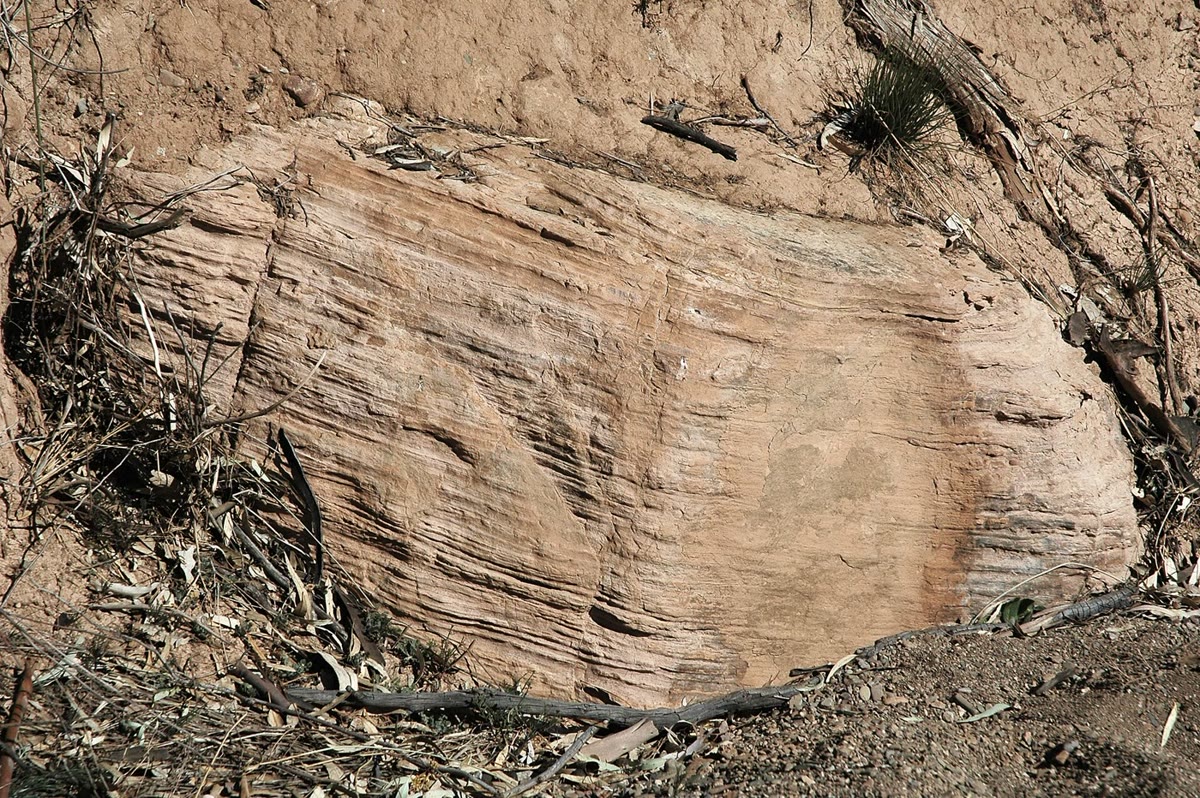
Two snowballs of the Cryogenian are now dated by uranium–lead ages on zircons from volcanic ash and by rhenium–osmium ages on organic-rich shales. The Sturtian began between 717.5 and and ended between 659.3 and : of ice, with the onset and the end synchronous across the world. The Marinoan began between 649.9 and , loosely dated, and ended between 636.0 and : at least . Each ends with a single cap carbonate, never with several. Iron formations, absent for a billion years, return in the Sturtian glacial deposits. At least one earlier snowball, in the Siderian around , came at the time of the GOE; between the two episodes, for some , almost no ice sheets are known.
History — From an odd hypothesis to a dated theory
In 1964 W. B. Harland drew attention to the evidence for a late Precambrian glaciation. In 1968 and 1969 M. I. Budyko, and W. D. Sellers with a similar model, found that the ice–albedo feedback could make the ice spread to the equator once it advanced far enough; a globally frozen Earth then seemed a state without return, and so one that had never happened. In 1981 J. Walker, P. Hays and J. Kasting described the thermostat of silicate weathering and noted that on a frozen Earth the carbon dioxide of volcanoes would accumulate until the ice melted: the state could end itself. In 1992 J. L. Kirschvink proposed that it had in fact happened, and named it the “Snowball Earth”; in 1998 P. F. Hoffman and colleagues published “A Neoproterozoic Snowball Earth”, and the panglacial epochs came to be called cryochrons. No Cryogenian glacial deposit had been dated radiometrically before 2004; the dates above are the work of the years since.
Volcanoes are the way out. On an Earth covered in ice, rain and rivers almost stop, silicate weathering with them, and the carbon dioxide that volcanoes release accumulates in the air until its greenhouse melts the ice.
Proposition 18.15 (Carbon dioxide build-up)
If carbon dioxide is released at a rate (mass per year) into an atmosphere of mass and mean molar mass , with no sink, the time needed to bring its volume mixing ratio from nearly zero to is
Proof. The atmosphere holds moles of other gases. Adding moles of carbon dioxide makes its mixing ratio , so , of mass ; at the rate this takes . ∎
Example 18.16 (How long to escape?)
The highest preferred estimate of today’s volcanic release is of carbon dioxide a year. Estimates of the mixing ratio needed to end a Cryogenian snowball range from 0.01 to 0.1. With , and , takes , and takes .
A column of pure carbon dioxide weighing over the whole Earth would take at the same rate, the figure Walker, Hays and Kasting gave. A few million years is long, but the Sturtian lasted . Either the threshold was higher, or the outgassing lower, or the frozen Earth still had sinks: the weathering of the young sea floor, which does not stop under ice, is one candidate. In the energy-balance model the escape needs the snowball’s effective emissivity to fall until its temperature reaches : under the Cryogenian Sun, of today’s, from 0.616 to 0.472, an extra trapping of some (Exercise 18.10).
When the ice finally opens at the equator, the feedback runs backwards: dark sea absorbs more sunlight, the ice retreats, and the models have the ice line racing to the poles in about . The Earth then finds itself with an enormous greenhouse on a dark surface, a hot aftermath. Weathering, very fast in that climate, pours calcium, magnesium and bicarbonate into the sea, where the cap carbonates precipitate while the meltwater floods the shelves; it takes some ten million years to draw the carbon dioxide back down. The ice sheets and the cap carbonates, the iron formations and the synchronous ages are why most geologists now accept that the Cryogenian snowballs happened, although how hard they were — whether a belt of open water survived at the equator, as “waterbelt” models propose — is still argued.
Exercises
Data for the exercises, unless stated otherwise: ; ; today’s albedo 0.294 and mean surface temperature ; snowball albedo 0.6; ramp from to ; effective emissivity today 0.616; Gough’s law for a time before present, ; komatiite liquidus at MgO, slope per per cent; half-lives , , , .
Exercise 18.1 ★
(a) How long did the Hadean, the Archean and the Proterozoic last? (b) What fraction of the age of the Earth do the three together make? (c) How old was the Earth when the oldest known zircon crystallised, and when the oldest rocks formed?
Solution
Solution of Exercise 18.1.
(a) Hadean ; Archean ; Proterozoic . (b) : about seven eighths. (c) for the zircon; for the oldest rocks.
Exercise 18.2 ★
Today the bulk silicate Earth releases, per kilogram, from , from , from and from (). (a) Find each contribution ago, and the total. (b) By what factor has the heat production fallen since? (c) Which isotope leads today, and which led then?
Solution
Solution of Exercise 18.2.
(a) The factors with and are 1.593 (), 19.18 (), 1.160 () and 5.292 (): the contributions were 3.053, 1.573, 2.424 and , in all, against today. (b) . (c) Thorium-232 leads today; potassium-40 led then.
Exercise 18.3 ★
Use the komatiite thermometer. (a) What is the liquidus of a komatiite with MgO? (b) What MgO content corresponds to ? (c) A spinifex-textured flow has a whole-rock MgO of . Why should its liquidus not be read from the line?
Solution
Solution of Exercise 18.3.
(a) . (b) . (c) A whole-rock analysis is not the composition of a liquid: a komatiite flow can contain olivine crystals heaped up from the liquid, which add MgO. Its lies beyond the of the richest komatiite liquids, and beyond the experiments on which the line rests.
Exercise 18.4 ★
Put the following in order and give their approximate ages: the Great Oxidation Event, the first stromatolites, the end of the Marinoan glaciation, the last common komatiites, the oldest rocks, the second rise of oxygen, the first Ediacaran fossils, the end of the dome-and-keel structures of the Pilbara.
Solution
Solution of Exercise 18.4.
Oldest rocks, ; first stromatolites, ; end of the Pilbara domes, ; Great Oxidation Event, about 2.4 to ; last common komatiites, ; second rise of oxygen, about ; end of the Marinoan, ; first Ediacaran fossils, about .
Exercise 18.5 ★★
(a) Check that the effective emissivity of today’s Earth is 0.616. (b) Find the snowball equilibrium under today’s Sun. (c) Show that the middle equilibrium, , satisfies to within . (d) Find the slopes of and there, and conclude that it is unstable.
Solution
Solution of Exercise 18.5.
(a) absorbed and , so . (b) , , . (c) At the albedo is : and . (d) , : , so the equilibrium is unstable (Proposition 18.9).
Exercise 18.6 ★★
(a) Using Gough’s law, find the sunlight ago and ago as fractions of today’s. (b) In the model, is a warm climate possible at each date with today’s emissivity? (c) Hoffman and colleagues write that the Siderian Sun was about dimmer than the Cryogenian Sun. Check.
Solution
Solution of Exercise 18.6.
(a) ; . (b) The warm state needs at least 0.932 of today’s sunlight: impossible ago, possible ago. (c) : dimmer, close to the quoted, which comes from a different solar model.
Exercise 18.7 ★★
The Sturtian lasted from to (middles of the dated intervals), the Marinoan from to . (a) Find their durations and the interglacial between them. (b) What fraction of the Cryogenian period, 720 to , did ice cover the Earth, on these figures? (c) Why is the duration of the Marinoan only a rough figure?
Solution
Solution of Exercise 18.7.
(a) Sturtian ; Marinoan ; interglacial . (b) : about four fifths of the period. (c) Its onset is only bracketed between 649.9 and : on these bounds the Marinoan lasted between about 3 and .
Exercise 18.8 ★★
(a) How long does it take volcanoes, at a year with no sink, to bring the air to a carbon dioxide mixing ratio of 0.05? (b) How many times the of 1750 is that? (c) If half of the release were taken up by the weathering of the sea floor, how long would it take?
Solution
Solution of Exercise 18.8.
(a) . (b) times. (c) Twice as long, .
Exercise 18.9 ★★
A Neoproterozoic diamictite contains striated stones, some of which lie in finely laminated mud that is bent down beneath them. (a) What does the bending tell? (b) Its palaeolatitude is . Why does this matter for the snowball hypothesis? (c) It is directly overlain by a pink laminated dolostone a few metres thick. What is it, and what does it record?
Solution
Solution of Exercise 18.9.
(a) The stones fell into soft mud and bent its laminae down: they are dropstones, released by floating ice. (b) Ice reaching the sea from the equator is the expected trace of a snowball, and very hard to obtain if only the polar regions are frozen. (c) A cap carbonate: it records the sudden end of the glaciation, with intense weathering and the flooding of the shelves by the meltwater.
Exercise 18.10 ★★★
Under the Cryogenian Sun, . (a) Show that in the model the warm state still exists, barely, but that a snowball also exists. (b) Find the snowball’s temperature with today’s emissivity. (c) Find the emissivity at which the snowball reaches and thaws. (d) Convert the change of emissivity into an extra trapping of longwave radiation at , in .
Solution
Solution of Exercise 18.10.
(a) , the warm tipping point: the warm equilibrium, , lies just above ; and , so the snowball also exists. (b) . (c) . (d) , and .
Exercise 18.11 ★★★
(a) Using the tipping points of Proposition 18.11, show that the width of the hysteresis loop, , does not depend on the emissivity, and compute it. (b) What would make the loop narrower? (c) Why can a snowball thaw only far from the conditions in which it froze?
Solution
Solution of Exercise 18.11.
(a) : the emissivity cancels. . (b) A smaller contrast of albedo between ice and open water, such as darker, dusty ice, or a wider ramp of temperature. (c) A snowball reflects so much sunlight that it stays cold under any sunlight or greenhouse at which a warm Earth would freeze; to thaw it the forcing must exceed that of freezing by the full width of the loop.
Exercise 18.12 ★★★
Derive the time constant of the energy-balance model near the warm equilibrium, , and evaluate it for an ocean mixed layer deep, of density and specific heat . What happens to as the sunlight approaches the left tipping point, in this model and in a model whose albedo varies smoothly with temperature?
Solution
Solution of Exercise 18.12.
Near , , so with . At the warm equilibrium and ; , so , about . In this model the warm equilibrium keeps until it reaches , so stays near two years up to the tipping point, then the state vanishes. With a smoothly varying albedo, grows as the equilibrium approaches the fold, where : grows without bound, a slowing down that announces the tipping point.
Problem 18.1
Weekend problem — A hotter young Earth
This problem follows the young Earth from its interior to its air. Use the data of the exercises; the bulk silicate Earth holds of uranium, of thorium and of potassium by mass, and its isotopes release (), (), () and () per kilogram of isotope. By mass, uranium is and , and potassium . Round to three significant figures.
Part I — Heat from inside.
- Find the heat released today by each isotope per kilogram of bulk silicate Earth, in .
- Find the total.
- Find the decay constant of each isotope, in .
- Find each contribution ago, when the komatiites of Pyke Hill erupted.
- Find the total then, and the ratio to today’s.
- Which isotope gave most heat then? Why does it give so little today?
Part II — The Sun of the Archean.
- With Gough’s law, find the sunlight ago as a fraction of today’s, and in .
- Find the warm equilibrium at that sunlight with today’s emissivity. Is it a valid warm state of the model?
- Find the snowball equilibrium at that sunlight.
- What effective emissivity would keep the Earth at with the warm albedo?
- Carbon dioxide alone could have done it at 0.004 to at . In an atmosphere of about , how many times the of 1750 is that?
- Name the process that kept the carbon dioxide at such a level for hundreds of millions of years.
Part III — A snowball and its end.
- The first snowball, ago: find the sunlight then as a fraction of today’s. Is the warm state of the model still possible with today’s emissivity?
- At of carbon dioxide a year, how long does it take to reach a mixing ratio of 0.1?
- If the threshold under the dimmer Siderian Sun was twice as high, 0.2, how long?
- Which rock records the end of a snowball, and how?
- Why do the iron formations of the Sturtian need an ocean without oxygen under the ice?
Part IV — The komatiite thermometer.
- Check the slope of the komatiite line from the two experiments.
- A komatiite liquid of Pyke Hill had MgO. Find its liquidus.
- Find the liquidus of the Barberton komatiite, MgO.
- Find the liquidus of a primary ridge basalt with MgO.
- With the Kilauea slope, per per cent, instead, how hot would the basalt be, starting from the Barberton point? How much does the choice of slope matter?
- Why is the temperature difference between the two lavas larger than the difference of potential temperature between the Archean and today’s mantle?
- To sum up: how much hotter was the hottest Archean komatiite lava than a primary basalt of today’s ridges?
Solution
Solution of Problem 18.1.
1. (); (); (); (). 2. . 3. : 0.155, 0.985, 0.0495 and . 4. Factors 1.52, 14.3, 1.14 and 4.48: 2.91, 1.17, 2.39 and . 5. , 2.07 times today’s. 6. Potassium-40. Its half-life, , is short: more than two half-lives have passed since, and more than three quarters of the of that time has decayed. 7. ; . 8. , below : not a valid warm state; the Earth would freeze. 9. . 10. . 11. to times. 12. The silicate-weathering thermostat: weathering slows in a cold climate, letting volcanic carbon dioxide accumulate, and quickens in a warm one. 13. 0.826 of today’s, below 0.932: no warm state; the Earth with today’s air would be a snowball. 14. . 15. . 16. The cap carbonate, a laminated dolostone sharply overlying the glacial deposits, precipitated from a sea fed by intense weathering in the hot aftermath and flooded by meltwater. 17. Iron(II) stays dissolved only in water without oxygen: the iron accumulates in the anoxic ocean under the ice and precipitates as iron(III) where oxygen arrives, for instance with meltwater. 18. per per cent. 19. . 20. , the measured point. 21. . 22. : lower, a tenth of the difference between the lavas; the conclusion does not depend on the choice. 23. Komatiites came from plumes, hotter than the ambient mantle, and from large degrees of melting deep down; a lava’s temperature is not the potential temperature of its source. The mantle as a whole was warmer by 200 to . 24. The hottest komatiite lava was about hotter than a primary basalt of today’s ridges.