All books

Professional

Apps About Coach Log in Start reading

Earth and Space Sciences · Glossary

What is Spectral signature?

Definition 25.1 University Earth and Space Sciences — Year 3 · Chapter 25 — Remote Sensing and GIS

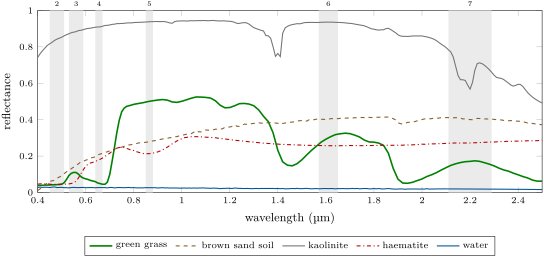
The spectral signature of a material is its reflectance as a function of wavelength, R(λ)R(\lambda), the fraction of the incident radiation it reflects. Over the thermal infrared, where surfaces emit rather than reflect, the signature is the emissivity ε(λ)\varepsilon(\lambda); for an opaque sample ε=1−R\varepsilon = 1 - R.

Laboratory reflectance spectra of five surfaces (ECOSTRESS Spectral Library, reproduced through the courtesy of the Jet Propulsion Laboratory, California Institute of Technology), with the six reflective bands 2 to 7 of the Landsat 8 and 9 imager shaded. Green grass is dark in the visible, brightest in the near infrared; kaolinite is bright everywhere but for a narrow absorption at 2.2\, µ m; haematite absorbs the blue and green and reflects the red; water reflects a few percent at every wavelength.
Laboratory reflectance spectra of five surfaces (ECOSTRESS Spectral Library, reproduced through the courtesy of the Jet Propulsion Laboratory, California Institute of Technology), with the six reflective bands 2 to 7 of the Landsat 8 and 9 imager shaded. Green grass is dark in the visible, brightest in the near infrared; kaolinite is bright everywhere but for a narrow absorption at 2.2 µm2.2\,\text{µ}\mathrm{m}; haematite absorbs the blue and green and reflects the red; water reflects a few percent at every wavelength.
Read in context →