
全部书籍

专业

应用 关于 Coach 登录 开始阅读

书籍暂未推出简体中文版——当前显示英文版。

Earth and Space Sciences · 术语表

什么是 Static stability; temperature inversion?

又称: static stability · stable stratification · unstable stratification · neutral stratification · temperature inversion

Definition 26.9 University Earth and Space Sciences — Year 1 · 第 26 章 — Structure of the Atmosphere and the Ocean

The static stability of a layer at rest is its response to a small vertical displacement of a parcel. The layer has a stable stratification if the displaced parcel is pushed back towards its level, an unstable stratification if it is pushed further away, and a neutral stratification if no force acts on it. A temperature inversion is a layer in which the temperature increases with height.
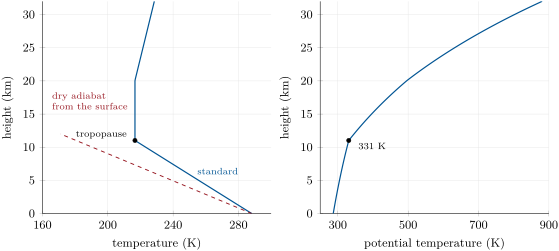
The 1976 standard atmosphere to 32\, km. Left: temperature, with the dry adiabat that a parcel lifted from the surface would follow (dashed). The standard cools more slowly than the adiabat, so it is stable everywhere. Right: potential temperature, which rises with height throughout, gently in the troposphere and steeply above the tropopause (dot).
The 1976 standard atmosphere to 32 km32\,\mathrm{km}. Left: temperature, with the dry adiabat that a parcel lifted from the surface would follow (dashed). The standard cools more slowly than the adiabat, so it is stable everywhere. Right: potential temperature, which rises with height throughout, gently in the troposphere and steeply above the tropopause (dot).
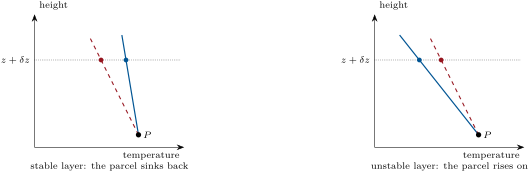
The parcel method. Solid blue: the sounding; dashed red: the dry adiabat through P. A parcel starts at P at the temperature of the air around it and is lifted to z + z along the dry adiabat (red dot); the sounding gives the temperature of the air there (blue dot). Left: the sounding cools more slowly than the adiabat; the parcel arrives colder, hence denser, than its surroundings and sinks back. Right: the sounding cools faster than the adiabat; the parcel arrives warmer and keeps rising.
The parcel method. Solid blue: the sounding; dashed red: the dry adiabat through PP. A parcel starts at PP at the temperature of the air around it and is lifted to z+δzz + \delta z along the dry adiabat (red dot); the sounding gives the temperature of the air there (blue dot). Left: the sounding cools more slowly than the adiabat; the parcel arrives colder, hence denser, than its surroundings and sinks back. Right: the sounding cools faster than the adiabat; the parcel arrives warmer and keeps rising.
在原文中阅读 →