
全部书籍

专业

应用 关于 Coach 登录 开始阅读

书籍暂未推出简体中文版——当前显示英文版。

Earth and Space Sciences · 术语表

什么是 Terrestrial and giant planets?

又称: terrestrial planet · giant planet · gas giant · ice giant

Definition 3.4 University Earth and Space Sciences — Year 1 · 第 3 章 — Comparative Planetology

A terrestrial planet is a planet made mostly of silicate rock and iron, with a solid surface: Mercury, Venus, the Earth and Mars. A giant planet is a planet many times more massive than the Earth, made mostly of light elements and their compounds and without a solid surface. A gas giant is a giant planet made mostly of hydrogen and helium: Jupiter and Saturn. An ice giant is a giant planet made mostly of the compounds astronomers call ices — water, methane and ammonia — under an envelope of hydrogen and helium: Uranus and Neptune.
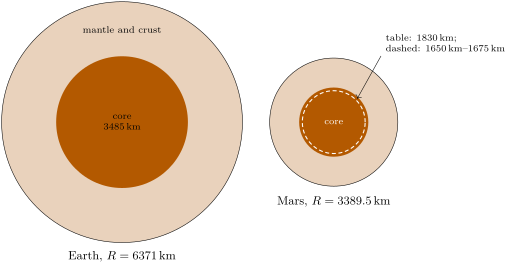
The Earth and Mars to scale, with their cores. For Mars, the solid edge is the core radius of the planetary table and the dashed circle the smaller radius indicated by recent seismic results. Both cores are iron-rich; the Earth’s has a solid inner part, not drawn.
在原文中阅读 →