书籍暂未推出简体中文版——当前显示英文版。
University Earth and Space Sciences — Year 1 · 本科一年级
3Comparative Planetology
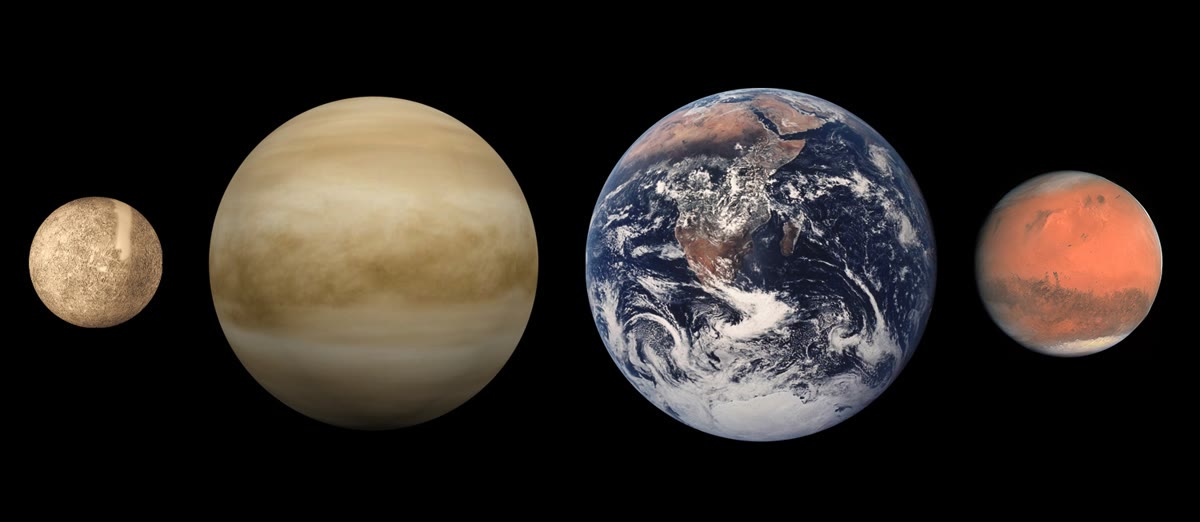
Venus and the Earth are nearly twins: Venus has of the Earth’s radius and of its mass. Yet the Earth has oceans, a nitrogen–oxygen atmosphere and moving plates, while Venus hides under clouds a surface at , hotter than any kitchen oven, crushed by a carbon-dioxide atmosphere at . Mars, half the Earth’s size, has a thin cold atmosphere, giant volcanoes and canyons, but no moving plates. Further out, Jupiter and Saturn are mostly hydrogen and helium; Uranus and Neptune mostly the ices of water, methane and ammonia. Comparing the planets is the only way to test what we think we know about the Earth: why its interior is layered, why its climate is mild, why it alone has plate tectonics. This chapter weighs and measures the planets, reads their interiors from their densities and the way their mass is distributed, compares their temperatures and atmospheres, and ends with the moons and small bodies that keep the record of the Solar System’s youth.
You already know
The planets go round the Sun on ellipses, and the square of a satellite’s period is proportional to the cube of its semi-major axis (Kepler’s third law, in the physics books’ Year 1 volume, where the moment of inertia of a solid is also defined; a uniform sphere has ). A black body radiates per unit area (Year 2). The Solar System and its rocky and giant planets were described in Book 1 (grade 6); the albedo and the equilibrium temperature of a planet were met in Book 2 (grade 10), and the greenhouse effect in Book 1 (grade 9).
3.1 Weighing and measuring the planets
A planet’s radius is measured from its angular diameter and its distance, or, for a planet visited by spacecraft, from radar and laser altimetry. Its mass is harder: it is felt only through the gravity the planet exerts on something else.
Method 3.1 (A planet’s mass from a satellite’s orbit)
For a satellite of negligible mass on a near-circular orbit of radius (semi-major axis) and sidereal period round a planet of mass :
- convert to metres and to seconds;
- Kepler’s third law gives : this product is what the orbit measures, and to much better precision than itself;
- divide by to obtain .
A planet without a moon (Mercury, Venus) is weighed in the same way from the orbit, or the deflection, of a spacecraft that passes it.
Example 3.2
Io, the innermost large moon of Jupiter, orbits at in days, that is . Then
which agrees with the tabulated mass of Jupiter, , to . Io’s own mass, of Jupiter’s, is negligible; the small excess comes from Jupiter’s equatorial bulge, which pulls a close moon slightly harder than a sphere of the same mass would.
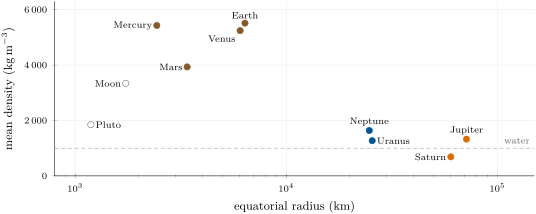
With the mass and the radius comes the mean density , the first clue to what a planet is made of. The densities of the planets fall into two groups (see the figure below): Mercury, Venus, the Earth and Mars lie between about and , denser than any common rock; the four outer planets lie between and , near the density of water, Saturn even below it.
The mean density alone cannot tell a planet made of one dense material from a planet with a very dense centre and a lighter envelope. A second number does: how the mass is distributed between centre and surface.
Definition 3.3 (Moment-of-inertia factor)
The moment-of-inertia factor of a planet is the number
where is its moment of inertia about its rotation axis, its mass and its mean radius. A uniform sphere has ; a planet whose density increases toward the centre has , the smaller the more the mass is concentrated.
The moment of inertia is measured from the slow precession of the rotation axis under the pull of the Sun, together with the flattening of the planet’s gravity field. The values are revealing: the Moon, , is nearly uniform; Mars, , and the Earth, , are clearly layered; Jupiter, , and Saturn, , have most of their mass packed toward their centres.
3.2 What the planets are made of
Definition 3.4 (Terrestrial and giant planets)
A terrestrial planet is a planet made mostly of silicate rock and iron, with a solid surface: Mercury, Venus, the Earth and Mars. A giant planet is a planet many times more massive than the Earth, made mostly of light elements and their compounds and without a solid surface. A gas giant is a giant planet made mostly of hydrogen and helium: Jupiter and Saturn. An ice giant is a giant planet made mostly of the compounds astronomers call ices — water, methane and ammonia — under an envelope of hydrogen and helium: Uranus and Neptune.
The atmospheres the probes and telescopes measure confirm the division. Jupiter’s is hydrogen and helium by volume, Saturn’s and ; for Uranus, at least of the mass is a hot dense fluid of water, methane and ammonia above a small rocky core. A gas giant’s mean density stays low although its centre is strongly compressed, because hydrogen is the lightest element; an ice giant is denser than Saturn because its ices are heavier than hydrogen.
The terrestrial planets are layered as the Earth is: an iron-rich core under a silicate mantle and a thin crust. The simplest model that uses both measured numbers, the mean density and the moment-of-inertia factor, has two layers.
Proposition 3.5 (The two-layer planet)
Model a planet of radius as a core of radius and uniform density inside a mantle of uniform density . Its mean density and its moment-of-inertia factor are
Given , and an assumed mantle density , the relative core radius follows:
Proof. The planet is a uniform sphere of density and radius plus a sphere of radius with the excess density . Masses add: , and dividing by the volume gives . Moments of inertia about the same axis add too; a uniform sphere of density and radius has , so . Dividing by gives . Finally the two equations read and ; dividing the second by the first gives , and the first gives . ∎
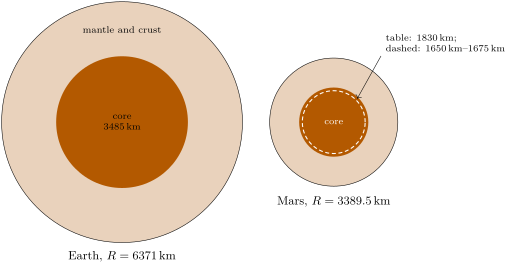
The model has three unknowns and two data, so one of them, the mantle density, must be assumed from what rocks of the right composition weigh under pressure. The answer is sensitive to that choice when is close to , because is then a small difference of large numbers (Exercise 3.10 and the problem). The model also ignores the compression of the mantle by its own weight, which in a planet as large as the Earth raises the density of the deep mantle well above that of surface rocks; for the Earth, seismology does far better (Chapter 9). Seismometers placed on Mars have now done the same for that planet: where the planetary table gives a core radius of , recent results indicate only to .
3.3 Atmospheres and surfaces
A planet’s temperature is set first by the sunlight it absorbs. The irradiance at its distance from the Sun falls as (Proposition 2.11): at the Earth, at Venus, at Mars, at Jupiter. Part of it is reflected straight back.
Definition 3.6 (Bond albedo)
The Bond albedo of a planet is the fraction of the total power of the sunlight falling on it that it reflects and scatters back to space, over all wavelengths and all directions.
Fresh snow and bright clouds reflect much, dark rock and open sea little. Venus, wrapped in bright clouds, has ; the Earth ; Mars ; the Moon, dark grey rock, .
Definition 3.7 (Equilibrium temperature)
The equilibrium temperature of a planet is the uniform temperature at which a black body of the planet’s size would radiate to space exactly the power the planet absorbs from the Sun.
Proposition 3.8 (Equilibrium temperature)
A planet of Bond albedo receiving the irradiance has
Proof. The planet intercepts the sunlight falling on its cross-section, a disc of area , and absorbs the fraction : it absorbs . A black body (Stefan–Boltzmann law, admitted from the physics books’ Year 2 volume) at uniform temperature radiates from each square metre of its whole surface, . Equating the two powers, , and the factor 4 is the ratio of the sphere’s area to its cross-section. ∎
With the values above, is for the Earth, for Venus, for Mars and for the Moon. Venus, though nearer the Sun, comes out colder than the Earth: its clouds reflect three quarters of the sunlight. The figure below sets these values beside the measured mean surface temperatures. The differences are the greenhouse effect, which the next paragraphs and the climate chapters (Chapter 27) make quantitative: about for the Earth, about for Venus, only about for Mars.
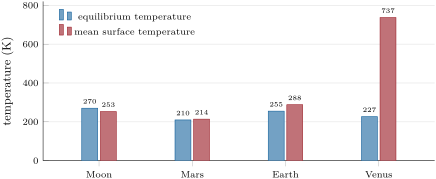
The Moon’s mean temperature, about , falls below its equilibrium temperature. This is no paradox: without an atmosphere or an ocean to carry heat, the day side is very hot and the night side very cold, and since emission grows as , a body with uneven temperatures radiates the absorbed power with a lower mean temperature than a uniform one (Exercise 3.11).
An atmosphere does two things: it lets most of the sunlight through and it absorbs part of the infrared the ground emits, re-emitting some of it downward. How much it warms the surface depends on how much absorbing gas lies above each square metre. The surface pressure measures exactly that: for a column of mass per square metre. Venus’s atmosphere, at , is carbon dioxide; Mars’s, at only on average, is carbon dioxide too, but it holds about sixty times less gas above each square metre than the Earth’s, and very little water vapour. Both planets have carbon-dioxide atmospheres; only one of them has a thick one.
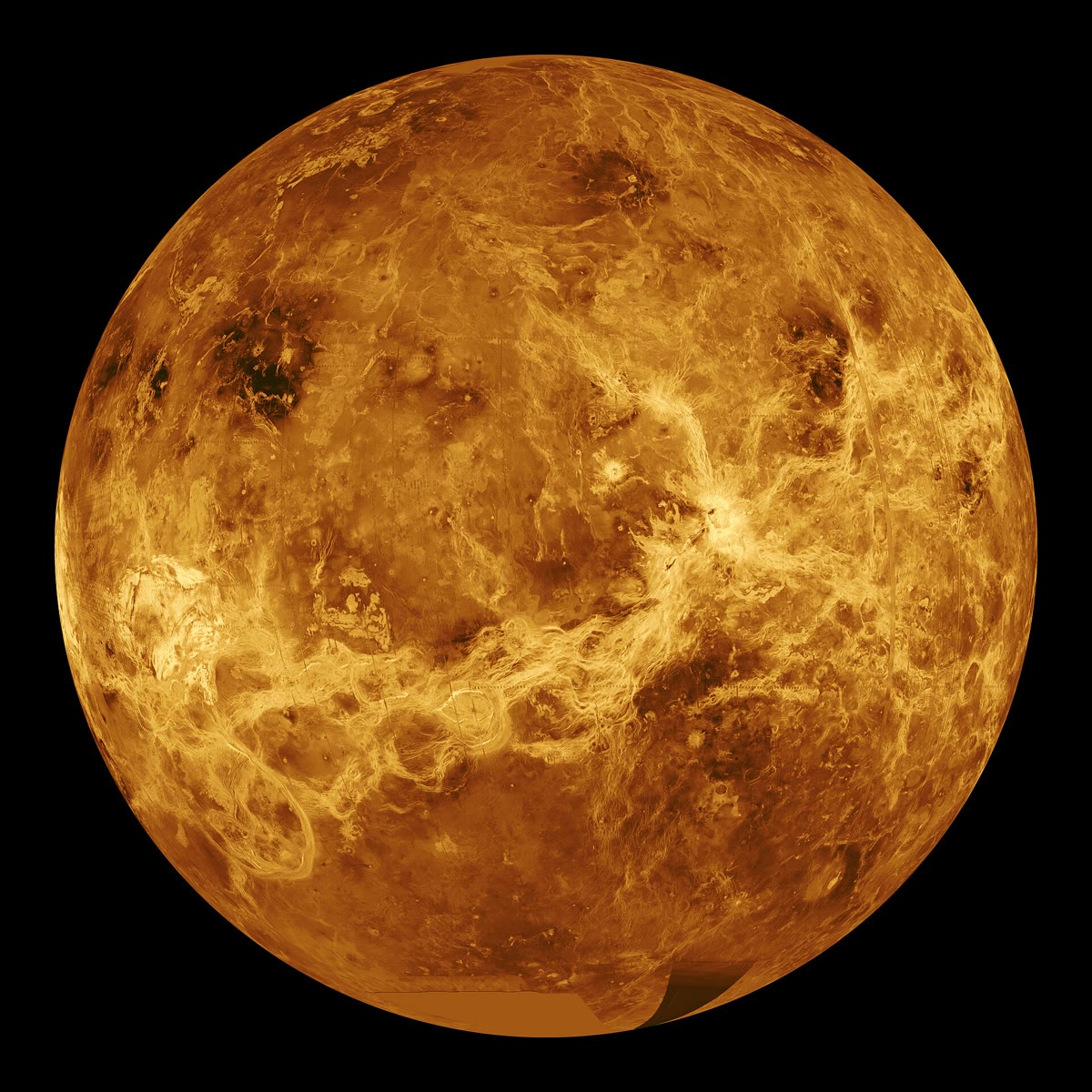
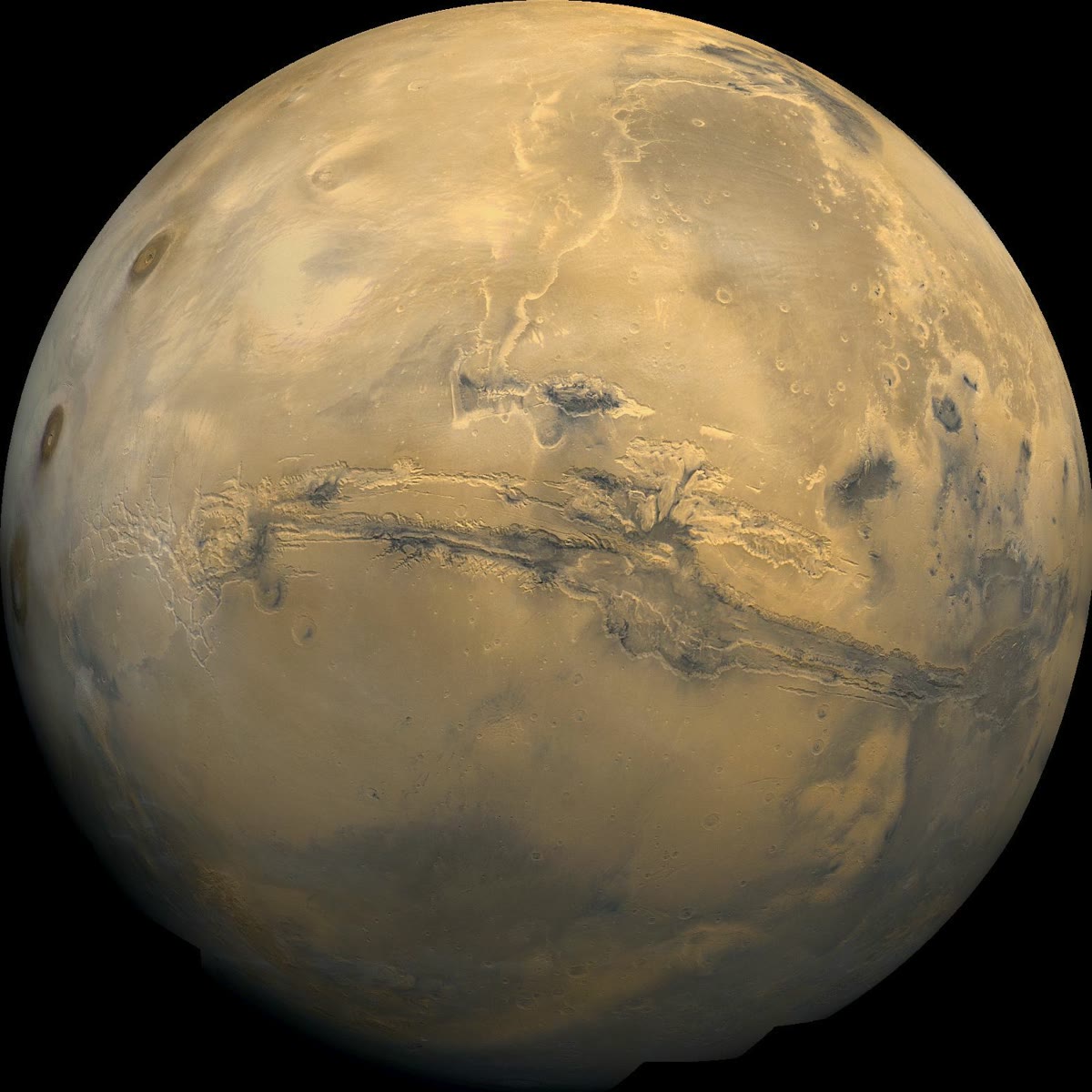
The surfaces carry the record of what shaped them. Impact craters accumulate on any surface exposed to space, so a heavily cratered surface, like most of the Moon’s or Mercury’s, is old, and a surface with few craters has been renewed: by lava flows, by erosion, or by the plates that carry the Earth’s ocean floor back into the mantle. Volcanic plains and volcanoes are found on all the terrestrial planets. Faults, rifts and folded belts show that the lithospheres of Venus and Mars have been deformed; but of all the planets, only the Earth shows today a lithosphere broken into plates that move as rigid blocks, with ridges where they are made and trenches where they sink. Why the Earth alone has plate tectonics is still discussed; the presence of water, which weakens rocks, is one of the reasons put forward.
3.4 Moons and small bodies
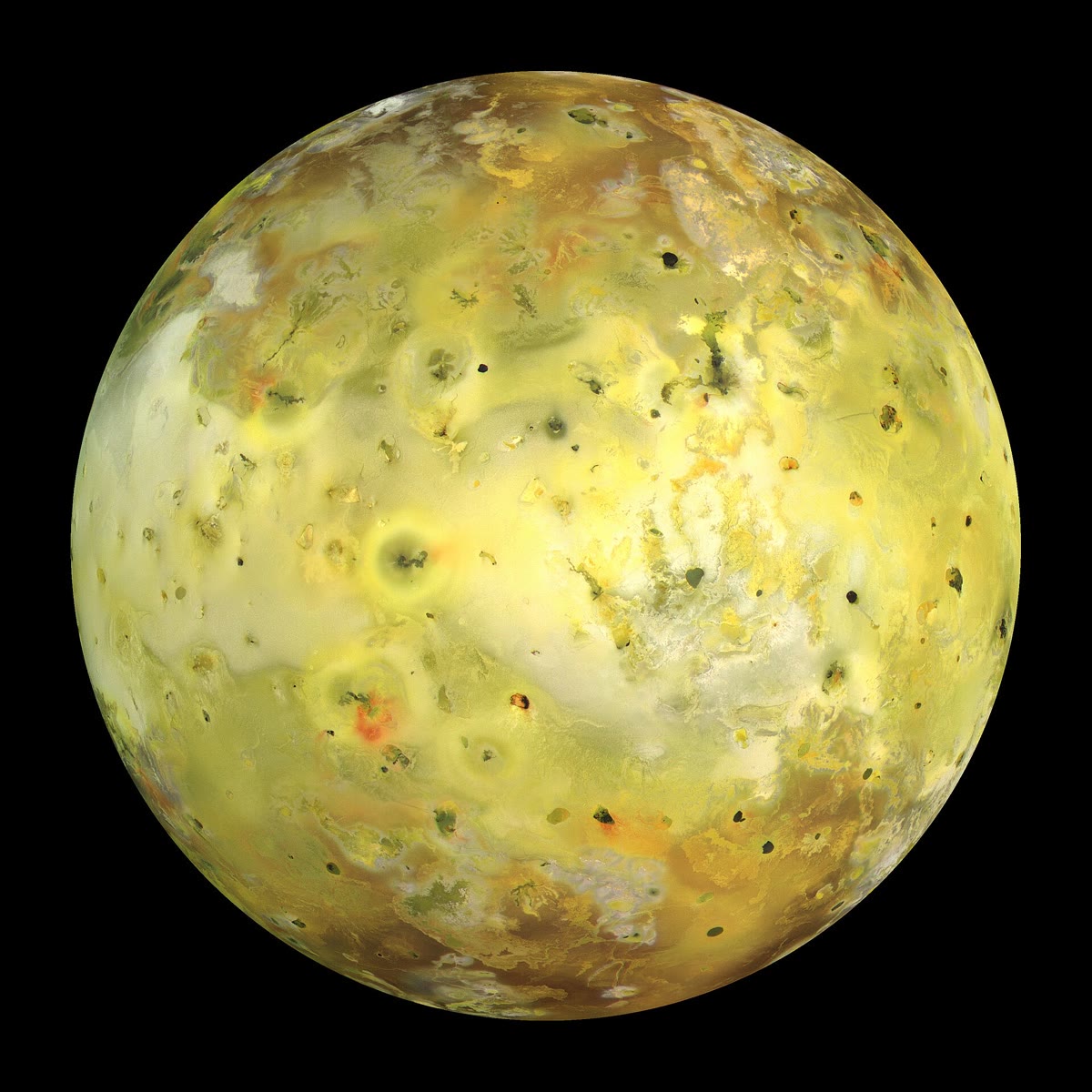
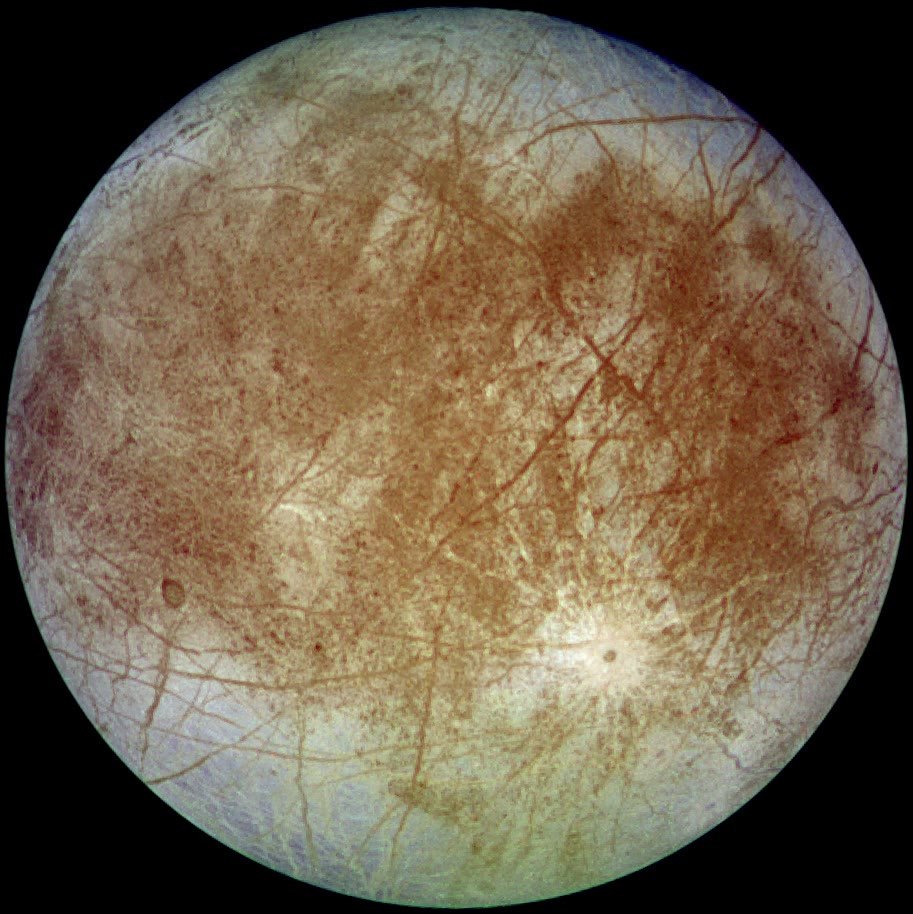
The Moon, a quarter of the Earth’s diameter, is large for a satellite. Its density, , close to that of the Earth’s mantle rocks, and its moment-of-inertia factor, close to , show that it has at most a small iron core. The giant planets have systems of moons that are worlds in themselves (see the photographs below). Io, the innermost of Jupiter’s four large moons, is the most volcanically active world in the Solar System, with hundreds of volcanoes, heated by the tides Jupiter raises in it; volcanism resurfaces it faster than impacts can mark it with large craters. Europa, of density , is rock under a crust of ice, and there is strong evidence for a salty ocean beneath that crust. Ganymede and Callisto, of densities and , are made of rock and ice in comparable amounts. Titan, Saturn’s largest moon, is the only moon with a dense atmosphere, mostly nitrogen with a little methane, and the only world besides the Earth with rivers, lakes and seas on its surface — of liquid methane and ethane; it too probably hides an ocean of water.
Definition 3.9 (Asteroid, comet, trans-Neptunian object)
An asteroid is a small rocky or metallic body that orbits the Sun, too small to be a planet and without the gas and dust envelope of a comet; most orbit between Mars and Jupiter. A comet is a small body of ice and dust that, when its orbit brings it near the Sun, releases gas and dust that form a glowing envelope round it and tails pointing away from the Sun. A trans-Neptunian object is a body of the Solar System whose orbit lies, on average, beyond that of Neptune.
The trans-Neptunian objects of the Kuiper Belt, a disc-shaped zone beyond Neptune, are icy and rocky bodies left from the formation of the planets; Pluto, classed as a dwarf planet since 2006, is one of them. The asteroids are the debris of a region where no planet formed. Pieces of asteroids, and a few of the Moon and Mars, fall on the Earth as meteorites. They are the only samples of other worlds in our hands besides those brought back by spacecraft, and some of them have changed little since the Solar System formed; their classes, and what they say about the composition of the Earth and the age of the Solar System, are the subject of the Year 2 volume.
3.5 Exercises
Exercise 3.1 ★
Jupiter has a mass of and a mean radius of . Compute its mean density and compare it with that of water, .
Solution
Solution of Exercise 3.1.
and , only 1.33 times the density of water, although Jupiter is 318 times more massive than the Earth: it is made mostly of the lightest elements.
Exercise 3.2 ★
Using the figure of densities and radii, classify Mercury, Saturn, Uranus and Venus as terrestrial planets, gas giants or ice giants, and justify each choice by its radius and density.
Solution
Solution of Exercise 3.2.
Mercury (radius , ) and Venus (, ) are small and denser than rock: terrestrial planets, of rock and iron. Saturn (, ) is huge and lighter than water: a gas giant, mostly hydrogen and helium. Uranus (, ) is a giant but far smaller than Saturn and nearly twice as dense: an ice giant, whose water, methane and ammonia are heavier than hydrogen.
Exercise 3.3 ★
Venus receives and has a Bond albedo of 0.77. Compute its equilibrium temperature. Why is it lower than the Earth’s, although Venus is nearer the Sun?
Solution
Solution of Exercise 3.3.
. Venus receives 1.9 times more sunlight than the Earth but its clouds reflect of it: it absorbs only against for the Earth.
Exercise 3.4 ★
Rank the Moon (), Mars (0.366), the Earth (0.3308), Jupiter (0.254) and Saturn (0.210) from the most uniform to the most centrally concentrated. What would be for a planet whose whole mass sat in a point at its centre?
Solution
Solution of Exercise 3.4.
From the most uniform to the most concentrated: the Moon, Mars, the Earth, Jupiter, Saturn. A point mass at the centre has , hence .
Exercise 3.5 ★★
Titan orbits Saturn at in days. Compute the mass of Saturn and compare it with the tabulated .
Solution
Solution of Exercise 3.5.
; ; , within of .
Exercise 3.6 ★★
The Earth receives at from the Sun. Compute the irradiance at Mars () and at Jupiter (), and compare with the tabulated and .
Solution
Solution of Exercise 3.6.
at Mars and at Jupiter, in agreement with the tables (the small difference at Mars comes from the rounding of the mean distances).
Exercise 3.7 ★★
Show that, for a given albedo, varies as . Compute for Jupiter (, ). If Jupiter were found to radiate more power than it absorbs from the Sun, what would that imply about its interior?
Solution
Solution of Exercise 3.7.
and , so . For Jupiter, . A planet radiating more than it absorbs must have an internal source of heat: Jupiter would be releasing heat stored since its formation, or produced as it slowly contracts.
Exercise 3.8 ★★
Compute the greenhouse warming of Venus (), the Earth (, ) and Mars (). Express each as a fraction of .
Solution
Solution of Exercise 3.8.
Venus: , of . The Earth: , , . Mars: , .
Exercise 3.9 ★★
For a uniform sphere, show that by integrating the moments of inertia of thin spherical shells (a shell of radius and mass has ). What value does a hollow shell of radius have?
Solution
Solution of Exercise 3.9.
With : , and , so . A hollow shell has all its mass at : , .
Exercise 3.10 ★★★
Mercury has , and a radius of . With a mantle density of , use the two-layer model to find its core radius, its core density and the fraction of its mass in the core. What is remarkable about Mercury?
Solution
Solution of Exercise 3.10.
; , , core radius . and . The core holds of the mass. Mercury’s core reaches of its radius, against for the Earth: Mercury is mostly core, with a thin rocky mantle.
Exercise 3.11 ★★★
Model an airless body whose day hemisphere is at the uniform temperature and night hemisphere at , radiating together the absorbed power. (a) Show that if , the mean temperature is at most , with equality only when . (b) For the Moon, ; take . Compute and the mean temperature.
Solution
Solution of Exercise 3.11.
(a) The function is convex, so , with equality only if . (b) , , and the mean temperature is , below .
Exercise 3.12 ★★★
Venus has a radius of , a surface gravity of and a surface pressure of . Compute the mass of its atmosphere, compare it with the Earth’s, , and with the mass of Venus, . What does the comparison suggest about where the Earth’s carbon dioxide is kept?
Solution
Solution of Exercise 3.12.
: 93 times the mass of the Earth’s atmosphere, and of the mass of Venus. The Earth holds a comparable amount of carbon, not in its air but in carbonate rocks (limestones) and in the ocean, where liquid water allowed it to be stored.
3.6 Problem: Weighing and sounding Mars
Problem 3.1
Weekend problem — the mass of Mars from its moon, its density and temperature, and the size of its core
Phobos, the larger moon of Mars, orbits at a mean distance of from the centre of Mars in days. Mars has a mean radius of , a rotation period of , a moment-of-inertia factor , a Bond albedo of 0.250 and a mean surface pressure of ; it receives from the Sun, and its mean surface temperature is about . Phobos has a mass of . Take and .
Part I — Weighing Mars.
- Convert the period of Phobos to seconds.
- Compute for Mars.
- Deduce the mass of Mars.
- Is it right to neglect the mass of Phobos?
- Compute the orbital speed of Phobos.
- Compare the period of Phobos with the rotation of Mars. In which direction does Phobos cross the sky of Mars?
Part II — Density and gravity.
- Compute the volume of Mars.
- Compute its mean density, rounded to .
- Compare it with the Earth’s, . Give two reasons why the Earth is denser.
- Compute the gravity at the surface of Mars.
- Compute the escape velocity from the surface of Mars.
Part III — Temperature and atmosphere.
- Compute the equilibrium temperature of Mars.
- Compare it with the mean surface temperature. How large is the greenhouse warming?
- Compute the mass of the atmosphere above each square metre of Mars, and compare it with the Earth’s (, ).
- Compute the total mass of the atmosphere of Mars.
- Mars’s atmosphere is carbon dioxide, yet its greenhouse warming is small. Suggest why.
Part IV — The core of Mars.
- What would be if Mars were uniform? What does the measured value tell?
- Write the mean density of a two-layer Mars in terms of the relative core radius , the mantle density and the core density .
- Write its moment-of-inertia factor in the same terms.
- Show that .
- With the mean density of question 8 and , compute and the core density.
- What fraction of the mass of Mars is in its core?
- Repeat question 21 with and . What do you conclude about the precision of the model?
- Give the radius of the core of Mars from the model with , and compare it with the value of the planetary table, , and with the recent seismic result, to .
Solution
Solution of Problem 3.1.
1. .
2. .
3. , within of the tabulated .
4. : Phobos is negligible.
5. , about .
6. , 3.2 times shorter than the rotation of Mars: Phobos goes round faster than the ground turns beneath it, so it overtakes the rotation. Seen from Mars, it rises in the west and sets in the east.
7. .
8. , that is .
9. . The Earth, larger and more massive, compresses its own interior more strongly; and its iron core is a larger share of the planet.
10. , of the Earth’s.
11. .
12. .
13. : a weak greenhouse warming.
14. ; for the Earth , 61 times more.
15. .
16. Above each square metre there is sixty times less gas than on the Earth, so the infrared absorption, although by carbon dioxide, is weak; and the air of Mars holds very little water vapour, the other major absorber.
17. A uniform Mars would have ; the measured 0.366 shows that its density increases toward the centre: Mars has a dense core.
18. .
19. .
20. From 18 and 19, and ; dividing gives .
21. ; , . and .
22. , that is of the mass.
23. With : , , core radius , . With : , , , . A change of in the assumed mantle density moves the core radius by several hundred kilometres: the mean density and alone cannot fix the core of Mars precisely, which is why seismometers were sent there.
24. : the radius of the core of Mars from the model is about , within the recent seismic range of to and well below the of the planetary table — an agreement that question 23 shows to be partly luck in the choice of .