
All books

Professional

Apps About Coach Log in Start reading

Earth and Space Sciences · Glossary

What is Transient crater, simple crater, complex crater, ejecta blanket?

Also known as: transient crater · simple crater · complex crater · ejecta blanket

Definition 26.3 University Earth and Space Sciences — Year 3 · Chapter 26 — Planetary Interiors and Surfaces

The transient crater is the bowl-shaped cavity opened by the excavation flow at the moment it stops growing; its depth is about a third of its diameter. A simple crater is a bowl with a raised rim, the transient crater barely modified: its steep walls slump inwards into a lens of breccia. A complex crater is a larger crater whose transient bowl collapsed: the floor rose into a central uplift, the rim slid inwards along terraces, and the floor is flat. The ejecta blanket is the sheet of excavated rock thrown out beyond the rim and deposited around the crater.
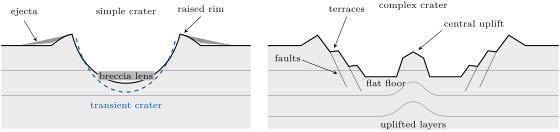
Cross-sections of a simple and a complex crater in layered rock (not to scale). Left: the bowl of a simple crater keeps the shape of the transient crater (dashed), partly filled by a lens of breccia, under a raised rim and a blanket of ejecta. Right: in a complex crater the transient bowl has collapsed; the deep layers have risen under a central uplift, and the rim has slid inwards along faults into terraces.
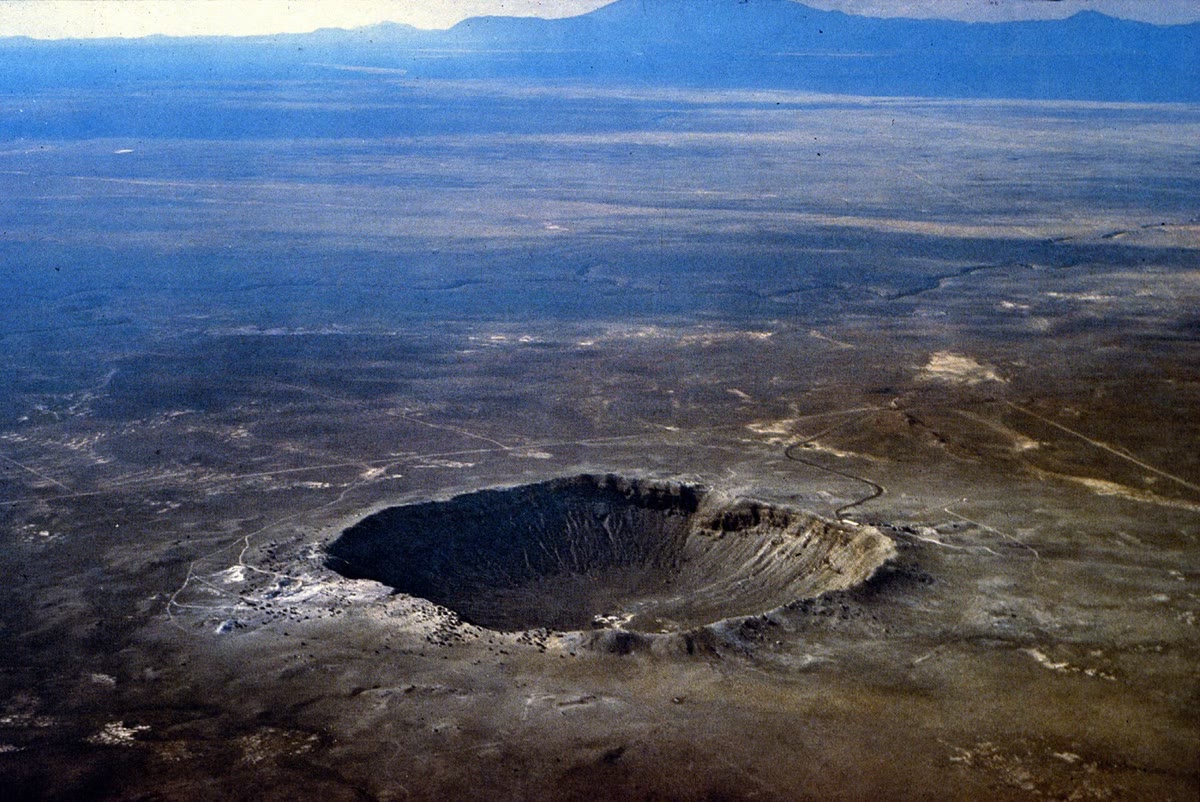
Barringer Meteor Crater, Arizona, a simple crater 1.2\, km across, formed about 50,000 years ago by an iron meteorite some 30\, m across; the rim stands above the plateau and the ejecta blanket spreads around it. Aerial photograph, USGS/D. Roddy, public domain.
Barringer Meteor Crater, Arizona, a simple crater 1.2 km1.2\,\mathrm{km} across, formed about 50,000 years ago by an iron meteorite some 30 m30\,\mathrm{m} across; the rim stands above the plateau and the ejecta blanket spreads around it. Aerial photograph, USGS/D. Roddy, public domain.
Read in context →