
সব বই

পেশাদার

1 Markets I: The Ecosystem and Exchange-Traded Marketsবাজার অনলাইন 2 Markets II: Rates, FX and Creditবাজার অনলাইন 3 Markets III: Commodities, Energy and Cryptoবাজার অনলাইন 4 Quantitative Methodsপদ্ধতি অনলাইন 5 Derivatives and Volatilityডেরিভেটিভস অনলাইন 6 Rates, Credit, XVA and Riskসুদহার, ঋণ ও ঝুঁকি অনলাইন 7 Research Craft: Predictors, Backtests, Measurement, Portfoliosগবেষণা অনলাইন 8 Strategies I: Equities and Futuresকৌশল অনলাইন 9 Strategies II: Volatility, Relative Value, Macro and the Bank Desksকৌশল অনলাইন 10 Microstructure and Executionএক্সিকিউশন অনলাইন 11 Market Making and High-Frequency Tradingমার্কেট মেকিং অনলাইন 12 Machine Learning for Marketsমেশিন লার্নিং অনলাইন 13 Low-Latency Softwareপ্রযুক্তি অনলাইন 14 Networks, Hardware and Trading Infrastructureপ্রযুক্তি অনলাইন 15 Research, Data and Risk Platformsপ্রযুক্তি অনলাইন 16 The Desk and the Firmপ্রতিষ্ঠান অনলাইন 17 The Industry: Firms, Roles and Careersক্যারিয়ার অনলাইন 18 Interviews I: Maths, Probability and Speedক্যারিয়ার অনলাইন 19 Interviews II: Markets, Trading Games and the Final Roundক্যারিয়ার অনলাইন 20 Interviews III: Codeক্যারিয়ার অনলাইন
অ্যাপ পরিচিতি Coach সাইন ইন পড়া শুরু করো

বইগুলো এখনো বাংলা ভাষায় পাওয়া যায় না — ইংরেজি সংস্করণ দেখানো হচ্ছে।

Earth and Space Sciences · পরিভাষা

Trap কী?

অন্য নাম: trap (oil and gas)

Definition 18.8 High School Earth and Space Sciences · অধ্যায় 18 — The Geology of Coal, Oil and Gas

A trap is an arrangement of reservoir rock and seal that holds oil and gas in place, closing the way up on every side.
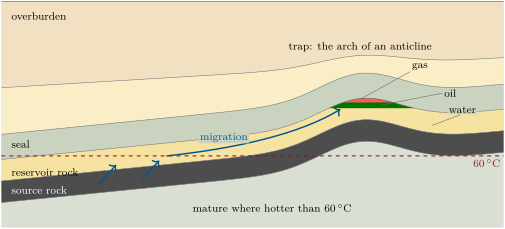
A petroleum system (a drawing, not to scale). The source rock, deep on the left, lies below the 60 C isotherm and makes oil; oil and gas move out of it into the sandstone above and creep up along it, under the mudstone seal, to the arch of an anticline. There they gather by density: gas at the top, oil beneath, water below. The overburden rocks on top bury the source rock deep enough to mature it.
A petroleum system (a drawing, not to scale). The source rock, deep on the left, lies below the 60∘C60{}^{\circ}\mathrm{C} isotherm and makes oil; oil and gas move out of it into the sandstone above and creep up along it, under the mudstone seal, to the arch of an anticline. There they gather by density: gas at the top, oil beneath, water below. The overburden rocks on top bury the source rock deep enough to mature it.
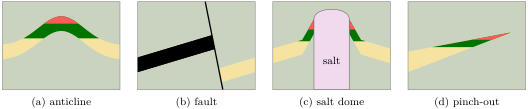
Four kinds of trap (drawings, not to scale): reservoir sandstone in yellow, sealing mudstone in grey-green, oil in green, gas in red. (a) The arch of an anticline. (b) A tilted reservoir cut by a fault, against a mudstone on the other side. (c) Layers bent up against a rising salt dome. (d) A sandstone that thins out up-slope within mudstone, a trap made by a change in the rocks themselves.

উদাহরণ

Example 18.9 (A trap in an anticline)

A seismic survey maps the top of a sandstone sealed by mudstone. It forms an arch whose crest lies 1800 m1800\,\mathrm{m} below the surface. Around the crest, the deepest contour line that still closes all the way round lies at 2050 m2050\,\mathrm{m}; below it, the sandstone opens to the side. A well at the crest finds gas down to 1880 m1880\,\mathrm{m}. How tall a column of oil and gas can the trap hold, and how thick is the oil?

Solution. Oil and gas fill the arch from the crest downwards; any that sinks below the last closed contour spills out to the side, at the spill point, and migrates on. The column is at most 2050−1800=250 m2050 - 1800 = 250\,\mathrm{m} tall. If the trap is full, gas fills the top 1880−1800=80 m1880 - 1800 = 80\,\mathrm{m} and oil the next 2050−1880=170 m2050 - 1880 = 170\,\mathrm{m}, with water below.

প্রসঙ্গসহ পড়ো →