
全部书籍

专业

应用 关于 Coach 登录 开始阅读

书籍暂未推出简体中文版——当前显示英文版。

Earth and Space Sciences · 术语表

什么是 Tuning thickness?

Definition 2.6 University Earth and Space Sciences — Year 3 · 第 2 章 — Exploration Seismology

The tuning thickness of a bed is the thickness at which the reflections from its top and base, of opposite signs, interfere most constructively, so that the composite amplitude is greatest. Thinner beds are not resolved: their top and base can no longer be picked separately, and the amplitude decreases in proportion to the thickness.
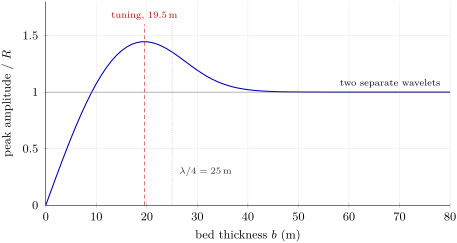
The wedge model (computed): a bed of 3000\, m\, s-1 with reflection coefficients +R at its top and -R at its base, imaged with a 30\, Hz Ricker wavelet. The peak amplitude of the composite reflection, relative to a single reflection of coefficient R, rises linearly from zero for very thin beds, peaks at the tuning thickness and settles to the level of two separate wavelets for thick beds.
The wedge model (computed): a bed of 3000 m s−13000\,\mathrm{m}\,\mathrm{s}^{-1} with reflection coefficients +R+R at its top and −R-R at its base, imaged with a 30 Hz30\,\mathrm{Hz} Ricker wavelet. The peak amplitude of the composite reflection, relative to a single reflection of coefficient RR, rises linearly from zero for very thin beds, peaks at the tuning thickness and settles to the level of two separate wavelets for thick beds.
在原文中阅读 →