
সব বই

পেশাদার

1 Markets I: The Ecosystem and Exchange-Traded Marketsবাজার অনলাইন 2 Markets II: Rates, FX and Creditবাজার অনলাইন 3 Markets III: Commodities, Energy and Cryptoবাজার অনলাইন 4 Quantitative Methodsপদ্ধতি অনলাইন 5 Derivatives and Volatilityডেরিভেটিভস অনলাইন 6 Rates, Credit, XVA and Riskসুদহার, ঋণ ও ঝুঁকি অনলাইন 7 Research Craft: Predictors, Backtests, Measurement, Portfoliosগবেষণা অনলাইন 8 Strategies I: Equities and Futuresকৌশল অনলাইন 9 Strategies II: Volatility, Relative Value, Macro and the Bank Desksকৌশল অনলাইন 10 Microstructure and Executionএক্সিকিউশন অনলাইন 11 Market Making and High-Frequency Tradingমার্কেট মেকিং অনলাইন 12 Machine Learning for Marketsমেশিন লার্নিং অনলাইন 13 Low-Latency Softwareপ্রযুক্তি অনলাইন 14 Networks, Hardware and Trading Infrastructureপ্রযুক্তি অনলাইন 15 Research, Data and Risk Platformsপ্রযুক্তি অনলাইন 16 The Desk and the Firmপ্রতিষ্ঠান অনলাইন 17 The Industry: Firms, Roles and Careersক্যারিয়ার অনলাইন 18 Interviews I: Maths, Probability and Speedক্যারিয়ার অনলাইন 19 Interviews II: Markets, Trading Games and the Final Roundক্যারিয়ার অনলাইন 20 Interviews III: Codeক্যারিয়ার অনলাইন
অ্যাপ পরিচিতি Coach সাইন ইন পড়া শুরু করো

বইগুলো এখনো বাংলা ভাষায় পাওয়া যায় না — ইংরেজি সংস্করণ দেখানো হচ্ছে।

Economics · পরিভাষা

Alternating-offers bargaining model কী?

Definition 12.11 University Economics — Year 2 · অধ্যায় 12 — Dynamic Games

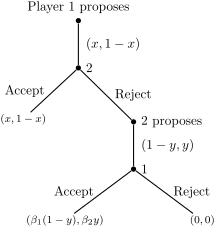
In the alternating-offers bargaining model two players divide a pie of size 1. In round 1 player 1 proposes a division and player 2 accepts or rejects it; after a rejection, player 2 proposes in round 2 and player 1 responds, and so on. A share ss agreed in round tt is worth βi t−1s\beta_i^{\,t-1} s to player ii, with 0<βi<10 < \beta_i < 1. Bargaining may end after a fixed number of rounds, with nothing for either player, or go on without limit.
Alternating offers with two rounds. Player 1 proposes a division, which player 2 accepts or rejects; after a rejection player 2 proposes and player 1 responds. Payoffs are valued in round 1: a share received in round 2 is discounted by each player’s _i. Backward induction: in round 2 player 2 offers y = 1, which player 1 accepts (or is indifferent about); so in round 1 player 2 accepts any 1 - x _2, and player 1 offers x = 1 - _2.
Alternating offers with two rounds. Player 1 proposes a division, which player 2 accepts or rejects; after a rejection player 2 proposes and player 1 responds. Payoffs are valued in round 1: a share received in round 2 is discounted by each player’s βi\beta_i. Backward induction: in round 2 player 2 offers y=1y = 1, which player 1 accepts (or is indifferent about); so in round 1 player 2 accepts any 1−x≥β21 - x \ge \beta_2, and player 1 offers x=1−β2x = 1 - \beta_2.
প্রসঙ্গসহ পড়ো →