 Coach
A country’s consumption-equivalent welfare relative to a reference country is the factor by which consumption in the reference country, at every date and for everyone, would have to be multiplied to give a person there the same expected lifetime utility as being born in the country compared, with its consumption, leisure, mortality and inequality. More generally, a person’s equivalent income is the income that, under reference values of the things other than income, gives them the same welfare as their actual situation.
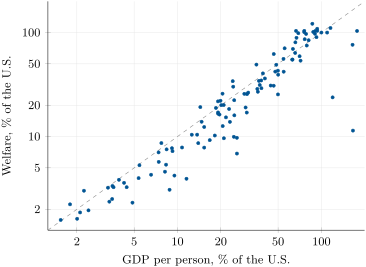
| GDP | Welfare | Terms of | ||||
| % of U.S. | % of U.S. | life | consumption | leisure | inequality | |
| France | 76.1 | 103.8 | 0.246 | 0.201 | 0.143 | |
| Germany | 87.8 | 101.4 | 0.154 | 0.115 | 0.132 | |
| Japan | 63.4 | 69.6 | 0.306 | 0.123 | ||
| Brazil | 24.8 | 16.0 | ||||
| China | 25.9 | 9.7 | 0.056 | |||
| India | 10.8 | 7.9 | 0.168 | |||