
جميع الكتب

مهني

1 Markets I: The Ecosystem and Exchange-Traded Marketsالأسواق عبر الإنترنت 2 Markets II: Rates, FX and Creditالأسواق عبر الإنترنت 3 Markets III: Commodities, Energy and Cryptoالأسواق عبر الإنترنت 4 Quantitative Methodsالأساليب عبر الإنترنت 5 Derivatives and Volatilityالمشتقات عبر الإنترنت 6 Rates, Credit, XVA and Riskالفائدة والائتمان والمخاطر عبر الإنترنت 7 Research Craft: Predictors, Backtests, Measurement, Portfoliosالبحث عبر الإنترنت 8 Strategies I: Equities and Futuresالاستراتيجيات عبر الإنترنت 9 Strategies II: Volatility, Relative Value, Macro and the Bank Desksالاستراتيجيات عبر الإنترنت 10 Microstructure and Executionالتنفيذ عبر الإنترنت 11 Market Making and High-Frequency Tradingصناعة السوق عبر الإنترنت 12 Machine Learning for Marketsتعلم الآلة عبر الإنترنت 13 Low-Latency Softwareالتكنولوجيا عبر الإنترنت 14 Networks, Hardware and Trading Infrastructureالتكنولوجيا عبر الإنترنت 15 Research, Data and Risk Platformsالتكنولوجيا عبر الإنترنت 16 The Desk and the Firmالشركة عبر الإنترنت 17 The Industry: Firms, Roles and Careersالمسارات المهنية عبر الإنترنت 18 Interviews I: Maths, Probability and Speedالمسارات المهنية عبر الإنترنت 19 Interviews II: Markets, Trading Games and the Final Roundالمسارات المهنية عبر الإنترنت 20 Interviews III: Codeالمسارات المهنية عبر الإنترنت
التطبيقات حول المدرب تسجيل الدخول ابدأ القراءة

Economics · المسرد

ما معنى Consumption-equivalent welfare; equivalent income؟

Definition 36.5 University Economics — Year 3 · الفصل 36 — Income, Wellbeing and What Economics Measures

A country’s consumption-equivalent welfare relative to a reference country is the factor λ\lambda by which consumption in the reference country, at every date and for everyone, would have to be multiplied to give a person there the same expected lifetime utility as being born in the country compared, with its consumption, leisure, mortality and inequality. More generally, a person’s equivalent income is the income that, under reference values of the things other than income, gives them the same welfare as their actual situation.
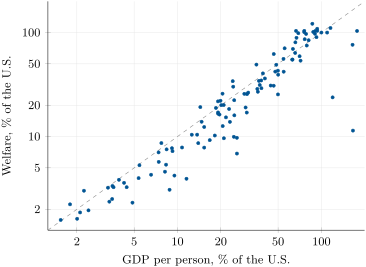
Consumption-equivalent welfare against GDP per person, both as a share of the United States, 2019, 115 countries (logarithmic scales), with the line of equality.
Consumption-equivalent welfare against GDP per person, both as a share of the United States, 2019, 115 countries (logarithmic scales), with the line of equality. Source: Penn World Table 11.0 (GDP, consumption share, hours, employment); World Bank, World Development Indicators (life expectancy; Gini index, latest 2010–2019); author’s calculation
GDPWelfareTerms of ln⁡λ\ln\lambda
% of U.S.% of U.S.lifeconsumptionleisureinequality
France76.1103.80.246−0.552-0.5520.2010.143
Germany87.8101.40.154−0.388-0.3880.1150.132
Japan63.469.60.306−0.768-0.768−0.024-0.0240.123
Brazil24.816.0−0.124-0.124−1.455-1.455−0.024-0.024−0.229-0.229
China†^\dagger25.99.7−0.029-0.029−1.872-1.872−0.484-0.4840.056
India†^\dagger10.87.9−0.279-0.279−2.283-2.283−0.151-0.1510.168
†^\dagger Gini index from a consumption survey; the others, and the United States (41.9), from income surveys.
اقرأ في الفصل →