
সব বই

পেশাদার

1 Markets I: The Ecosystem and Exchange-Traded Marketsবাজার অনলাইন 2 Markets II: Rates, FX and Creditবাজার অনলাইন 3 Markets III: Commodities, Energy and Cryptoবাজার অনলাইন 4 Quantitative Methodsপদ্ধতি অনলাইন 5 Derivatives and Volatilityডেরিভেটিভস অনলাইন 6 Rates, Credit, XVA and Riskসুদহার, ঋণ ও ঝুঁকি অনলাইন 7 Research Craft: Predictors, Backtests, Measurement, Portfoliosগবেষণা অনলাইন 8 Strategies I: Equities and Futuresকৌশল অনলাইন 9 Strategies II: Volatility, Relative Value, Macro and the Bank Desksকৌশল অনলাইন 10 Microstructure and Executionএক্সিকিউশন অনলাইন 11 Market Making and High-Frequency Tradingমার্কেট মেকিং অনলাইন 12 Machine Learning for Marketsমেশিন লার্নিং অনলাইন 13 Low-Latency Softwareপ্রযুক্তি অনলাইন 14 Networks, Hardware and Trading Infrastructureপ্রযুক্তি অনলাইন 15 Research, Data and Risk Platformsপ্রযুক্তি অনলাইন 16 The Desk and the Firmপ্রতিষ্ঠান অনলাইন 17 The Industry: Firms, Roles and Careersক্যারিয়ার অনলাইন 18 Interviews I: Maths, Probability and Speedক্যারিয়ার অনলাইন 19 Interviews II: Markets, Trading Games and the Final Roundক্যারিয়ার অনলাইন 20 Interviews III: Codeক্যারিয়ার অনলাইন
অ্যাপ পরিচিতি Coach সাইন ইন পড়া শুরু করো

বইগুলো এখনো বাংলা ভাষায় পাওয়া যায় না — ইংরেজি সংস্করণ দেখানো হচ্ছে।

Economics · পরিভাষা

Consumption-equivalent welfare; equivalent income কী?

Definition 36.5 University Economics — Year 3 · অধ্যায় 36 — Income, Wellbeing and What Economics Measures

A country’s consumption-equivalent welfare relative to a reference country is the factor λ\lambda by which consumption in the reference country, at every date and for everyone, would have to be multiplied to give a person there the same expected lifetime utility as being born in the country compared, with its consumption, leisure, mortality and inequality. More generally, a person’s equivalent income is the income that, under reference values of the things other than income, gives them the same welfare as their actual situation.
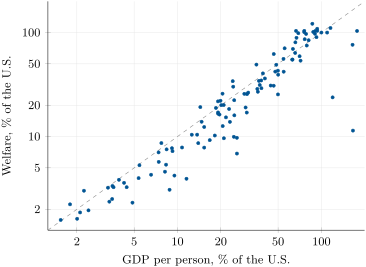
Consumption-equivalent welfare against GDP per person, both as a share of the United States, 2019, 115 countries (logarithmic scales), with the line of equality.
Consumption-equivalent welfare against GDP per person, both as a share of the United States, 2019, 115 countries (logarithmic scales), with the line of equality. Source: Penn World Table 11.0 (GDP, consumption share, hours, employment); World Bank, World Development Indicators (life expectancy; Gini index, latest 2010–2019); author’s calculation
GDPWelfareTerms of ln⁡λ\ln\lambda
% of U.S.% of U.S.lifeconsumptionleisureinequality
France76.1103.80.246−0.552-0.5520.2010.143
Germany87.8101.40.154−0.388-0.3880.1150.132
Japan63.469.60.306−0.768-0.768−0.024-0.0240.123
Brazil24.816.0−0.124-0.124−1.455-1.455−0.024-0.024−0.229-0.229
China†^\dagger25.99.7−0.029-0.029−1.872-1.872−0.484-0.4840.056
India†^\dagger10.87.9−0.279-0.279−2.283-2.283−0.151-0.1510.168
†^\dagger Gini index from a consumption survey; the others, and the United States (41.9), from income surveys.
প্রসঙ্গসহ পড়ো →