Physics · Glossary

What is Coil and solenoid?

Also known as: coil · solenoid

Definition 15.9 High School Physics · Chapter 15 — Magnetism and Magnetic Fields

Winding the wire concentrates its field. A flat coil (NN turns in a disc) behaves like a thin magnet, one face north, the other south; a solenoid — a long cylindrical winding, nn turns per metre — like a bar magnet.

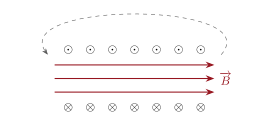
A solenoid cut lengthwise (/: the turns crossing the page): inside, a uniform B = _0 n I along the axis; outside, a weak, spread-out return field (dashed).
A solenoid cut lengthwise (\odot/\otimes: the turns crossing the page): inside, a uniform B=μ0nIB = \mu_0 n I along the axis; outside, a weak, spread-out return field (dashed).

Examples

Example 15.13 (Solenoid numbers)

At 1010 turns per centimetre (n=1000m1n = 1000\,\mathrm{m}^{-1}) and I=5.0AI = 5.0\,\mathrm{A}: B=1.26×106×1000×5.06.3mTB = 1.26 \times 10^{-6} \times 1000 \times 5.0 \approx 6.3\,\mathrm{mT} — a hundred Earth fields, adjustable by a knob.

Read in context →