Coach
CoachA lens is a transparent medium bounded by two surfaces, at least one curved. Thicker at the center than at the edge, it is converging: parallel rays are bent toward each other; thicker at the edge, diverging: they spread apart. A thin lens has negligible thickness: we draw a segment with outward (converging) or inward (diverging) arrowheads. Its center is the optical center; the perpendicular line through , the principal axis.
Examples
Example 10.4 (Reading a prescription)
A lens with has D: converging. A D prescription means : diverging, focal length .
Example 10.10 (The formula at work)
An object stands in front of a converging lens with : , so
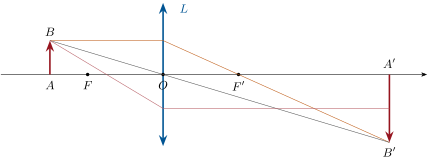
a real image behind the lens, inverted, half-size — exactly what the three rays draw.
Example 10.12 (The vergence of your eye)
The retina sits at . Distant object (): D. Near point (): D. Reading costs about D: the eye is a D lens with a built-in D fine tune.