High School Physics · Grades 10–12
15Magnetism and Magnetic Fields
Sailors steered by magnetized needles for a thousand years before anyone knew why they point north. The answer came in 1820, when a current made a compass twitch: magnetism is made by moving charges. This chapter maps the magnetic field — of magnets, of the Earth, of currents — then closes the loop: the field pushes back on currents, which is how every electric motor turns.
15.1 Magnets and the magnetic field
Definition 15.1 (Magnet and poles)
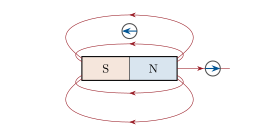
A magnet attracts iron and, hung by a thread, turns to face north. Its action concentrates at two magnetic poles, north (the end that seeks geographic north) and south: like poles repel, unlike attract. Sawing a magnet in half yields two complete magnets — no experiment has ever isolated a pole.
Definition 15.2 (Magnetic field)
A magnet modifies the space around it (Chapter 14): it creates everywhere a magnetic field . A compass reads its direction (the needle aligns with , north end forward); a Hall probe measures its magnitude, in teslas ().
Definition 15.3 (Magnetic field lines)
Magnetic field lines are curves tangent to , crowding where the field is strong. Outside a magnet they run from north pole to south; unlike electric field lines they have no ends: each closes through the magnet’s body.
15.2 The Earth is a magnet
Definition 15.4 (The Earth’s magnetic field)
Currents in the Earth’s molten iron core make the planet a giant magnet: at the surface , and a free needle aligns with the field’s horizontal component — this is the compass. The geomagnetic poles are not the geographic ones; the angle between compass north and true north is the declination, corrected on every bearing.
Example 15.5 (Correcting a bearing)
Where the declination is west, a ship steering “compass north” for drifts west of its track: to sail true north, steer east of the needle.
15.3 The magnetic field of a current
Remark 15.6 (Oersted, 1820)
During a lecture in 1820, Hans Christian Oersted saw a compass needle swing when he closed a circuit nearby: electricity and magnetism were one subject — currents create magnetic fields.
Proposition 15.7 (Field of a straight wire)
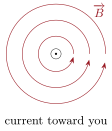
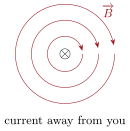
A long straight wire carrying a current creates a field whose lines are circles centered on the wire, in planes perpendicular to it. At distance from the wire,
Proof. Admitted at this level. ∎
Example 15.8 (A wire is a weak magnet)
At from a wire carrying : — six Earth fields, from a current that would trip a household breaker. Strong fields need a better geometry.
Definition 15.9 (Coil and solenoid)
Winding the wire concentrates its field. A flat coil ( turns in a disc) behaves like a thin magnet, one face north, the other south; a solenoid — a long cylindrical winding, turns per metre — like a bar magnet.
Proposition 15.10 (Field inside a solenoid)
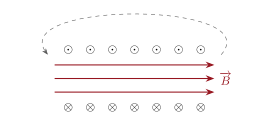
Inside a long solenoid, away from the ends, the field is uniform: parallel to the axis and the same at every interior point, of magnitude , independent of the bore’s width. Outside, the field is weak.
Proof. Admitted at this level. ∎
Remark 15.11
Both formulas are derived honestly in the Year 1 volume, from the law relating a field’s circulation to the current it encircles. Note what matters: , turns per metre — wind tighter, not longer.
Method 15.12 (The right hand, twice)
Example 15.13 (Solenoid numbers)
At turns per centimetre () and : — a hundred Earth fields, adjustable by a knob.
15.4 Electromagnets
Definition 15.14 (Electromagnet)
An electromagnet is a solenoid wound on a soft iron core: the iron magnetizes in the coil’s field and multiplies it, typically by to . Unlike a permanent magnet, it switches off with the current.
Remark 15.15 (Three machines)
The scrapyard crane lifts a car with an electromagnet and — the whole point — drops it by opening a switch. A relay’s small electromagnet pulls a contact closed: a weak current switches a strong one (Chapter 12). An MRI scanner holds a uniform around the patient with a superconducting solenoid.
Orders of magnitude, from the galaxy to a dead star:
| interstellar space | |
| the Earth’s surface field | |
| a fridge magnet | |
| a neodymium magnet, at its pole | |
| an MRI solenoid | |
| surface of a neutron star |
15.5 The Laplace force
Proposition 15.16 (Laplace force)
A straight wire of length , carrying a current in a uniform field perpendicular to the wire, feels the Laplace force of magnitude , perpendicular to both wire and : flat right hand, thumb along the current, straight fingers along — the palm pushes along . A wire parallel to the field feels no force.
Proof. Admitted at this level. ∎
Remark 15.17 (The jumping rail)
The Year 1 volume derives this from the magnetic force on each moving charge. In the laboratory: a copper rod rests across two horizontal rails between the poles of a magnet (field into the page in the figure); close the switch, and the rod shoots along the rails. Reverse the current, or flip the magnet: it shoots the other way.
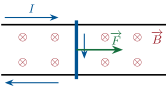
Example 15.18 (Laplace numbers)
A rod of length carrying across : — the weight of , on a wire weighing a few grams.
Remark 15.19 (The DC motor)
Bend the wire into a loop in the field: the two sides perpendicular to carry opposite currents, so their Laplace forces are opposite — a pair that spins the loop. Half a turn later the pair would spin it back, so a rotating switch (the commutator) reverses the current every half-turn. Every fan and drill is this loop, multiplied.
15.6 Exercises
Exercise 15.1 ★
A bar magnet is sawn in half between its poles. What poles does each piece carry? Brought back together, do the freshly cut faces attract or repel? Can any cutting scheme isolate the north pole?
Solution
Solution of Exercise 15.1.
Each piece is a complete magnet with a north and a south pole: a new pole appears on each cut face. The fresh faces are an N and an S, so they attract — the pieces try to reassemble. No scheme isolates a pole: every cut creates a pair.
Exercise 15.2 ★
True or false, with one reason each: (a) two magnetic field lines cross where the field is strong; (b) outside a magnet, field lines run from north pole to south pole; (c) every magnetic field line is a closed loop; (d) a needle settles perpendicular to the line through it.
Exercise 15.3 ★
Compute the field from a straight wire carrying . How many times the Earth’s is that?
Exercise 15.4 ★
A solenoid of turns wound over carries . Compute , then inside; what does become if the current doubles?
Solution
Solution of Exercise 15.4.
; . : doubling the current gives .
Exercise 15.5 ★
A wire segment of length carries perpendicular to a field. Compute the Laplace force; the weight of what mass equals it?
Exercise 15.6 ★★
Where a hiker stands, the declination is west. She walks “north by compass”: how far, and to which side of true north, does she drift? What heading would have walked her true north?
Solution
Solution of Exercise 15.6.
1. Her track points west of true north: to the west.
2. Steer east of the needle’s north.
Exercise 15.7 ★★
At what distance from a straight wire carrying does its field equal the Earth’s ? What does this say about trusting a compass near live cables?
Solution
Solution of Exercise 15.7.
. Within a decimetre of such a cable the compass reads the wire, not the planet — keep it away from live conductors.
Exercise 15.8 ★★
Design a solenoid producing with : compute the required , then the turn count for a coil.
Solution
Solution of Exercise 15.8.
; over , turns.
Exercise 15.9 ★★
In the rail experiment, the rod (mass , length between the rails) carries in a perpendicular field. Compute the Laplace force, then the rod’s initial acceleration; compare with .
Solution
Solution of Exercise 15.9.
; — about : the rod genuinely jumps.
Exercise 15.10 ★★
A horizontal wire of mass and length sits in a horizontal field perpendicular to it. What current makes the Laplace force balance the wire’s weight, so that it levitates? Which way must the force point?
Solution
Solution of Exercise 15.10.
Balance: , so . The force must point up; with horizontal and perpendicular to the wire, the flat right hand (palm up) fixes the required current direction.
Exercise 15.11 ★★
Give the direction of the Laplace force (or say it vanishes): (a) current to the right of the page, into the page; (b) current toward the top of the page, out of the page; (c) current parallel to . Use the flat right hand.
Exercise 15.12 ★★★
A horizontal wire runs geographic north–south, above a compass; the Earth’s horizontal component there is . The wire carries : compute its field at the compass, give its direction, then the needle’s deflection (fields add as vectors).
Solution
Solution of Exercise 15.12.
1. ; the lines circle the wire, so directly below it the field is horizontal, perpendicular to the wire: east–west.
2. The needle follows the vector sum: , so away from north.
Exercise 15.13 ★★★
A scrapyard electromagnet is a coil of turns over , resistance , on a supply; its iron core multiplies the bare field by . Compute the current, the bare-coil field, the field with the core, and the power the coil dissipates (Chapter 12). Why does the scrap fall the instant the switch opens?
Solution
Solution of Exercise 15.13.
1. ; ; ; with the core, .
2. .
3. No current, no field — and soft iron does not stay magnetized: the load releases instantly, by design.
Exercise 15.14 ★★★
A motor’s rectangular loop has turns carrying ; its two sides of length are perpendicular to a field . Compute the force on each of these sides; why are the two forces opposite, and what do they do to the loop? Why do the other two sides sometimes feel no force? Why must the current be reversed every half-turn?
Solution
Solution of Exercise 15.14.
1. on each side. The current runs opposite ways in the two sides, so the forces are opposite: a couple that rotates the loop.
2. When parallel to , a wire feels no Laplace force.
3. After half a turn the couple would reverse and undo the rotation; the commutator flips the current each half-turn so the loop keeps spinning one way.
Exercise 15.15 ★★★
How close to a cable carrying would you have to be for its field to reach ? Compare with the cable’s millimetre radius, and conclude why tesla-strength fields are built from solenoids, not single wires. Then: a neutron star’s surface field of is how many powers of ten above the Earth’s?
15.7 Problem: The compass, the crane and the MRI
Problem 15.1
Weekend problem — three magnets at work: a compass crossing an ocean, an electromagnet lifting a car, and an MRI solenoid — one field, spanning ten powers of ten, doing three jobs
The same vector steers a sailboat with , lifts scrap iron with , and images a knee with — three machines for this chapter’s three formulas.
Part I — The compass. At the ship’s position, the Earth’s field has horizontal component and vertical component ; the declination is west.
- Why does a compass needle point (magnetic) north at all?
- Compute the total field’s magnitude and its angle with the horizontal.
- Steering “compass north” for , how far west of the true-north track does the ship end up?
- Steel cargo deflects the needle a further west: same question.
- Near the geomagnetic pole a compass is useless: which component is to blame, and why?
Part II — The crane. The scrapyard electromagnet is a solenoid of turns wound over , of resistance , fed by a supply; its iron core multiplies the bare field by .
- Compute , the turn density.
- Compute the current in the coil (Chapter 12).
- Compute the bare-coil field .
- Compute the field with the core; compare with neodymium’s .
- Compute the power dissipated in the coil, then the energy for a lifting shift.
- A permanent magnet this strong exists. Why an electromagnet anyway?
Part III — The winch motor. The crane’s winch is a DC motor: a rectangular loop of turns, sides of length perpendicular to , carrying .
- Compute the Laplace force on each side bundle perpendicular to .
- The two forces are equal and opposite, yet their effect does not cancel. What do they produce, and why must they be opposite?
- What force acts on the other two sides, when parallel to ?
- After half a turn, the same forces would undo the rotation. What does the commutator do, and when?
- Give three separate design changes that each double the force pair.
Part IV — The MRI. The scanner’s solenoid holds a uniform with a current .
- How many times the Earth’s field is ?
- Compute the turn density needed without any iron core.
- If the winding had resistance , what power would it dissipate? What property of the actual winding avoids this, at the price of extreme cold?
- Punchline: place the ship’s, the crane’s and the MRI’s fields on the powers-of-ten ladder from interstellar space () to a neutron star (); what changed between the machines — the physics, or the amperes?
Solution
Solution of Problem 15.1.
1. The needle is itself a small magnet; the Earth’s field aligns it, north end along the horizontal component of , i.e. toward magnetic north.
2. , tilted below the horizontal.
3. The track runs west of true north: west.
4. Errors add: , so — five kilometres for ten degrees.
5. The horizontal component: near the pole the field is almost vertical, the horizontal part shrinks toward zero, and the needle has nothing left to align with.
6. .
7. .
8. .
9. — twice the field at a neodymium pole, over a far larger face.
10. ; in : .
11. Because it lets go: open the switch, the field dies, the car drops exactly where wanted. A permanent magnet grips forever.
12. .
13. A couple: applied on opposite sides of the axis, the two opposite forces both turn the loop the same way. Equal parallel forces would only push the loop sideways, not spin it.
14. None: a wire parallel to the field feels no Laplace force.
15. It reverses the current in the loop at each half-turn, just as the couple would change sign — so the torque always drives the same rotation.
16. Double , or double , or double : the force pair is proportional to each.
17. : thirty thousand Earths.
18. — and every one of those turns carries .
19. — a neighbourhood’s worth of heating. The real winding is superconducting: zero resistance, zero dissipation, provided it is kept a few degrees above absolute zero.
20. Compass , crane , MRI : the ship sits five rungs below the two machines, which share a decade — between interstellar and neutron-star . Nothing changed but the amperes (and the turns, iron and superconductor that multiply them): one field, three jobs.