
Physics · Glossary

What is Polarisation and bound charges?

Definition 22.1 University Physics — Year 3 · Chapter 22 — Electromagnetism in Matter

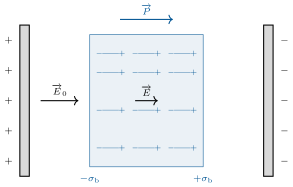
A dielectric is an insulator whose molecules acquire (or already own) electric dipole moments. The material’s response is summarised by the polarisation P\vect P: the dipole moment per unit volume, P=np\vect P = n\langle\vect p\rangle for nn molecules per unit volume. A polarised block carries bound charges — not free to leave, but perfectly real: a surface density σb=Pn\sigma_{\text{b}} = \vect P\cdot\vect n where the polarisation meets the surface, and a volume density ρb=P\rho_{\text{b}} = -\nabla\cdot\vect P wherever it is non-uniform. A uniformly polarised slab is exactly equivalent to two sheets of charge ±P\pm P on its faces: all its interior dipole heads and tails cancel.
A dielectric slab between charged plates. The field aligns molecular dipoles; their interior charges cancel pairwise, leaving bound sheets _ b on the faces — which oppose the free charge and shrink the interior field from E_0 to E = E_0/ _ r.
A dielectric slab between charged plates. The field aligns molecular dipoles; their interior charges cancel pairwise, leaving bound sheets σb\mp\sigma_{\text{b}} on the faces — which oppose the free charge and shrink the interior field from E0\vect E_0 to E=E0/εr\vect E = \vect E_0/\varepsilon_{\text{r}}.
Read in context →