All books

Professional

Apps About Coach Log in Start reading

Quantitative Finance · Glossary

What is Aim portfolio, multi-period optimisation?

Also known as: multi-period optimisation · aim portfolio

Definition 26.6 Research Craft: Predictors, Backtests, Measurement, Portfolios · Chapter 26 — Portfolio Construction II

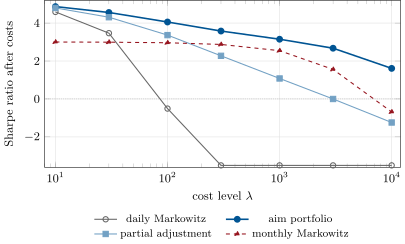
Multi-period optimisation chooses trades by planning a sequence of future books under forecasts of returns, risks and costs, and executes the first (Boyd and co-authors). With quadratic costs λ2Δx⊤ΣΔx\frac\lambda2\Delta x^\top\Sigma\Delta x and signals whose predictive power decays at rates ϕk\phi_k, Gârleanu and Pedersen show that the optimal book trades each period a fraction a/λa/\lambda of the way from the current book to the aim portfolio (γΣ)−1∑kBkfk/(1+ϕka/γ)(\gamma\Sigma)^{-1}\sum_k B_k f_k/(1 + \phi_k a/\gamma), which weights slow signals more than fast ones, with aa the positive root of a2(1−ρ)+a(γ(1−ρ)+λρ)−γλ(1−ρ)=0a^2(1-\rho) + a(\gamma(1-\rho) + \lambda\rho) - \gamma\lambda(1-\rho) = 0 and ρ\rho the discount rate.

Sharpe ratio after quadratic costs against the cost level, for four trading rules on the three planted signals; values below -3.5 are drawn at -3.5. Data: rs_allocation.multiperiod.
Figure 26.2. Sharpe ratio after quadratic costs against the cost level, for four trading rules on the three planted signals; values below −3.5-3.5 are drawn at −3.5-3.5. Data: rs_allocation.multiperiod.
Read in context →