جميع الكتب

مهني

1 Markets I: The Ecosystem and Exchange-Traded Marketsالأسواق عبر الإنترنت 2 Markets II: Rates, FX and Creditالأسواق عبر الإنترنت 3 Markets III: Commodities, Energy and Cryptoالأسواق عبر الإنترنت 4 Quantitative Methodsالأساليب عبر الإنترنت 5 Derivatives and Volatilityالمشتقات عبر الإنترنت 6 Rates, Credit, XVA and Riskالفائدة والائتمان والمخاطر عبر الإنترنت 7 Research Craft: Predictors, Backtests, Measurement, Portfoliosالبحث عبر الإنترنت 8 Strategies I: Equities and Futuresالاستراتيجيات عبر الإنترنت 9 Strategies II: Volatility, Relative Value, Macro and the Bank Desksالاستراتيجيات عبر الإنترنت 10 Microstructure and Executionالتنفيذ عبر الإنترنت 11 Market Making and High-Frequency Tradingصناعة السوق عبر الإنترنت 12 Machine Learning for Marketsتعلم الآلة عبر الإنترنت 13 Low-Latency Softwareالتكنولوجيا عبر الإنترنت 14 Networks, Hardware and Trading Infrastructureالتكنولوجيا عبر الإنترنت 15 Research, Data and Risk Platformsالتكنولوجيا عبر الإنترنت 16 The Desk and the Firmالشركة عبر الإنترنت 17 The Industry: Firms, Roles and Careersالمسارات المهنية عبر الإنترنت 18 The Interview Bookالمسارات المهنية عبر الإنترنت
التطبيقات حول المدرب تسجيل الدخول ابدأ القراءة

Quantitative Finance · المسرد

ما معنى Average cost, realised and unrealised P&L؟

يُعرف أيضًا باسم: average cost · realised P\&L · unrealised P\&L

Definition 7.6 Markets I: The Ecosystem and Exchange-Traded Markets · الفصل 7 — P&L and the Accounting of a Position

Under the average cost convention an open position carries the quantity-weighted average price pˉ\bar p of the fills that built it. A fill that reduces the position by nn units at price pp realises ±n(p−pˉ)\pm n(p - \bar p) (plus for a long, minus for a short) and leaves pˉ\bar p unchanged; a fill that increases it updates pˉ\bar p; a fill that flips it closes the old position entirely and opens the remainder at pp. The realised P&L is the sum of these amounts; the unrealised P&L is q(m−pˉ)q(m - \bar p).

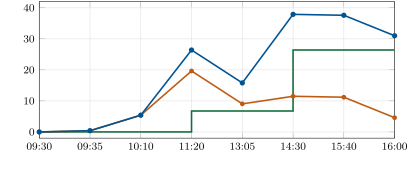
The day of , observed at each fill and at the close, marked at the mid. Realised P&L moves only when a sale reduces the position; the last point falls because the closing mid is below the afternoon’s prices while she is still long 30 000 shares. Data: the chapter’s fill list.
Figure 7.1. The day of Example 7.7, observed at each fill and at the close, marked at the mid. Realised P&L moves only when a sale reduces the position; the last point falls because the closing mid is below the afternoon’s prices while she is still long 30 000 shares. Data: the chapter’s fill list.

أمثلة

Example 7.7 (Six fills)

The trader of the opening paragraph buys 20 000 at 49.30 and 20 000 at 49.55 (pˉ=49.425\bar p = 49.425), sells 10 000 at 50.10 (realising 10 000×0.675=6 75010\,000 \times 0.675 = 6\,750), buys 10 000 at 49.70 (pˉ=49.494\bar p = 49.494), sells 25 000 at 50.28 (realising 19 65619\,656), and buys 15 000 at 50.20 (pˉ=49.847\bar p = 49.847). She ends long 30 000 with $26 406 realised. Under first in, first out the same sales are matched to the oldest purchases and realise $28 750. Marked at 50.00 the unrealised parts are $4 594 and $2 250: both conventions total $31 000, as Proposition 7.5 says they must. The split matters for tax and for performance statistics (“win rate”); it never changes what the firm is worth.

اقرأ في الفصل →