 Coach
CoachUnder the average cost convention an open position carries the quantity-weighted average price of the fills that built it. A fill that reduces the position by units at price realises (plus for a long, minus for a short) and leaves unchanged; a fill that increases it updates ; a fill that flips it closes the old position entirely and opens the remainder at . The realised P&L is the sum of these amounts; the unrealised P&L is .
Voorbeelden
Example 7.7 (Six fills)
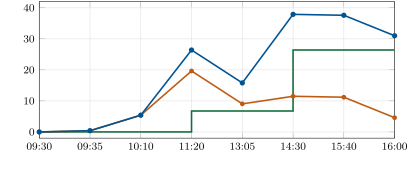
The trader of the opening paragraph buys 20 000 at 49.30 and 20 000 at 49.55 (), sells 10 000 at 50.10 (realising ), buys 10 000 at 49.70 (), sells 25 000 at 50.28 (realising ), and buys 15 000 at 50.20 (). She ends long 30 000 with $26 406 realised. Under first in, first out the same sales are matched to the oldest purchases and realise $28 750. Marked at 50.00 the unrealised parts are $4 594 and $2 250: both conventions total $31 000, as Proposition 7.5 says they must. The split matters for tax and for performance statistics (“win rate”); it never changes what the firm is worth.