
সব বই

পেশাদার

1 Markets I: The Ecosystem and Exchange-Traded Marketsবাজার অনলাইন 2 Markets II: Rates, FX and Creditবাজার অনলাইন 3 Markets III: Commodities, Energy and Cryptoবাজার অনলাইন 4 Quantitative Methodsপদ্ধতি অনলাইন 5 Derivatives and Volatilityডেরিভেটিভস অনলাইন 6 Rates, Credit, XVA and Riskসুদহার, ঋণ ও ঝুঁকি অনলাইন 7 Research Craft: Predictors, Backtests, Measurement, Portfoliosগবেষণা অনলাইন 8 Strategies I: Equities and Futuresকৌশল অনলাইন 9 Strategies II: Volatility, Relative Value, Macro and the Bank Desksকৌশল অনলাইন 10 Microstructure and Executionএক্সিকিউশন অনলাইন 11 Market Making and High-Frequency Tradingমার্কেট মেকিং অনলাইন 12 Machine Learning for Marketsমেশিন লার্নিং অনলাইন 13 Low-Latency Softwareপ্রযুক্তি অনলাইন 14 Networks, Hardware and Trading Infrastructureপ্রযুক্তি অনলাইন 15 Research, Data and Risk Platformsপ্রযুক্তি অনলাইন 16 The Desk and the Firmপ্রতিষ্ঠান অনলাইন 17 The Industry: Firms, Roles and Careersক্যারিয়ার অনলাইন 18 Interviews I: Maths, Probability and Speedক্যারিয়ার অনলাইন 19 Interviews II: Markets, Trading Games and the Final Roundক্যারিয়ার অনলাইন 20 Interviews III: Codeক্যারিয়ার অনলাইন
অ্যাপ পরিচিতি Coach সাইন ইন পড়া শুরু করো

বইগুলো এখনো বাংলা ভাষায় পাওয়া যায় না — ইংরেজি সংস্করণ দেখানো হচ্ছে।

Quantitative Finance · পরিভাষা

Benchmark fix, fixing window, fixing order কী?

অন্য নাম: benchmark fix · fixing window · fixing order

Definition 17.1 Markets II: Rates, FX and Credit · অধ্যায় 17 — Fixings and Flows

A benchmark fix is an exchange rate published at a set time of day by an administrator, from trades and quotes observed in a short period around that time, the fixing window. A fixing order is a client’s order to buy or sell an amount of currency at the fix, whatever it turns out to be; the dealer that accepts it guarantees the rate and bears the cost of obtaining it.
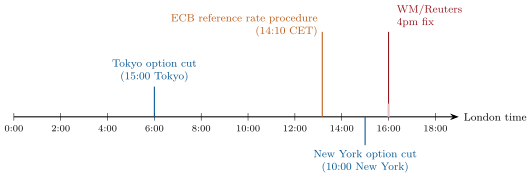
The day’s reference moments in London time, in winter. The WM/Reuters fix is taken over five minutes around 16:00; the ECB’s reference rates come from a procedure around 14:10 Central European time; FX options expire most often at 10:00 New York or 15:00 Tokyo. The clocks of summer time shift some of them by an hour. Schematic.
Figure 17.1. The day’s reference moments in London time, in winter. The WM/Reuters fix is taken over five minutes around 16:00; the ECB’s reference rates come from a procedure around 14:10 Central European time; FX options expire most often at 10:00 New York or 15:00 Tokyo. The clocks of summer time shift some of them by an hour. Schematic.
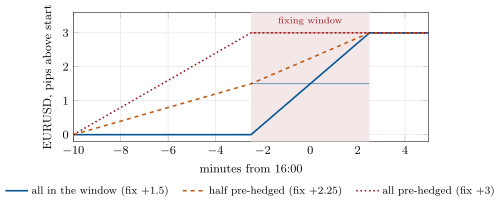
The price of EURUSD while a dealer buys EUR 1 billion for a client’s fixing order, with a permanent impact of 0.3 pips per EUR 100 million, when it buys all of it in the five-minute window, half before, or all before. The thin lines mark the fix in the first and last cases. The dealer’s average cost is 1.5 pips in each case; the fix is not. Illustrative; data: the chapter’s tutorial.
Figure 17.2. The price of EURUSD while a dealer buys EUR 1 billion for a client’s fixing order, with a permanent impact of 0.3 pips per EUR 100 million, when it buys all of it in the five-minute window, half before, or all before. The thin lines mark the fix in the first and last cases. The dealer’s average cost is 1.5 pips in each case; the fix is not. Illustrative; data: the chapter’s tutorial.

উদাহরণ

Example 17.3 (A billion euros at the fix)

With λ=0.3\lambda = 0.3 pips per EUR 100 million, buying EUR 1 billion moves the price 3 pips. Bought evenly in the window, the fix is 1.5 pips above the start and the dealer’s average cost is the same. Half bought before the window, the fix is 2.25 pips up and the dealer earns 0.75 pips on EUR 1 billion, USD 75 000; all before, USD 150 000. The client pays the same amounts more than with no pre-hedging.

প্রসঙ্গসহ পড়ো →