Markets II: Rates, FX and Credit · Markets
17Fixings and Flows
Between December 2007 and January 2013, euro–dollar traders at four of the world’s largest banks, members of a chat room they called “The Cartel”, used coded language to coordinate their trading around two moments of the day: 1:15 in the afternoon in London, when the European Central Bank’s reference rate was taken, and 4:00, when WM/Reuters struck the benchmark rate used to price the orders of many large customers. They told each other their clients’ orders, traded together into the fix, and held back bids or offers to protect each other’s positions. In May 2015 the four banks agreed to plead guilty in the United States and to pay more than USD 2.5 billion in criminal fines, after regulators in London and Washington had fined five banks more than USD 3 billion between them in November 2014. This chapter explains what a benchmark fix is, why so much currency changes hands at it, the month-end and option-expiry flows that meet there, and what was done wrong and what was changed.
17.1 The benchmark fix
Definition 17.1 (Benchmark fix, fixing window, fixing order)
A benchmark fix is an exchange rate published at a set time of day by an administrator, from trades and quotes observed in a short period around that time, the fixing window. A fixing order is a client’s order to buy or sell an amount of currency at the fix, whatever it turns out to be; the dealer that accepts it guarantees the rate and bears the cost of obtaining it.
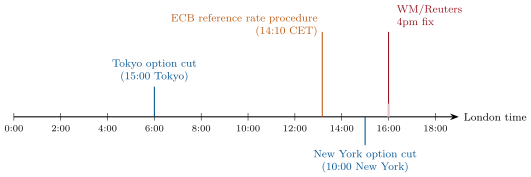
The most used is the WM/Reuters 4pm London closing rate (Figure 17.1), which, in the US regulators’ words, is used to price orders for many large customers and to price derivatives around the world. A manager whose portfolio is valued against a benchmark at that rate (One Quant Book 1, chapter 3) has a reason to trade exactly at it: a trade done at the fix adds no tracking error. Until February 2015 the fix was computed from trades in a one-minute window around 16:00; following recommendations of the Financial Stability Board in September 2014, WM widened it on 15 February 2015 to five minutes, from 2.5 minutes before the hour to 2.5 minutes after. The ECB publishes its own euro reference rates around 16:00 Central European time from a procedure around 14:10, and says that using them for transactions is “strongly discouraged”.
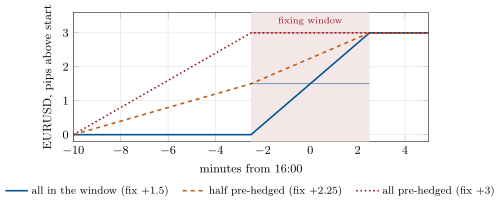
The dealer’s position is delicate. A client asks it to buy EUR 1 billion at the fix. The dealer does not know the fix in advance; it must buy the euros itself, and its own buying pushes the price up. If it buys them evenly during the window, it pays on average about the fix and makes nothing but its fee. If it buys some of them before the window, it pays the lower prices before its own buying moved the market, then its remaining purchases and everyone else’s push the fix up, and it sells to the client at the higher fix.
Proposition 17.2 (What pre-hedging a fixing order earns)
Let the dealer buy with linear permanent impact per unit, a share before the window and the rest evenly during it, and let the fix be the window’s average price. Then, from a starting price and with no other price moves,
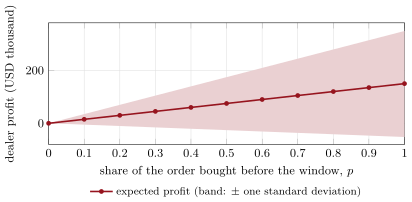
The profit is paid by the client, whose fix is higher by than with no pre-hedging.
Proof. Before the window the dealer buys at prices rising from to , on average . In the window it buys at prices rising from to , whose average is the fix, . The average cost is , whatever . The profit is times the difference. ∎
Example 17.3 (A billion euros at the fix)
With pips per EUR 100 million, buying EUR 1 billion moves the price 3 pips. Bought evenly in the window, the fix is 1.5 pips above the start and the dealer’s average cost is the same. Half bought before the window, the fix is 2.25 pips up and the dealer earns 0.75 pips on EUR 1 billion, USD 75 000; all before, USD 150 000. The client pays the same amounts more than with no pre-hedging.
17.2 Month-end and index rebalancing flows
Definition 17.4 (Month-end rebalancing)
Month-end rebalancing is the trading that investors do at the end of each month, some of it at the 4pm fix, to restore currency hedges and portfolio weights that the month’s price moves have disturbed.
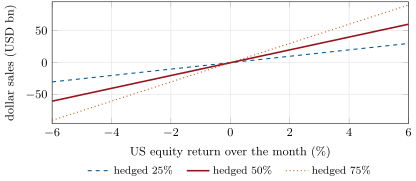
Two mechanisms make month-end flows predictable. A foreign investor that hedges half of its dollar equities finds, after a month in which they rose 4%, that its hedge covers less than half: it sells more dollars forward, half of 4% of its holdings. A fund that keeps 60% in American assets and 40% in European ones finds, after a month in which the first rose 5% and the second fell 1%, that it holds too much of the first; it sells American assets, and dollars, and buys European ones. Both flows are known in sign, and roughly in size, days in advance (Figure 17.3).
Example 17.5 (Two month-end flows)
Investors holding USD 2 trillion of American equities, hedged at 50%, sell trillion USD 40 billion forward after a 4% rise. A fund of USD 100 billion at 60/40, after the American part gained 5% and the European part lost 1%, must sell USD 1.44 billion of American assets and buy the same value of European ones.
Anyone can make these estimates, so flows that are known in advance may be traded ahead: a dealer or hedge fund that expects dollar sales at the fix can sell first, and the price may move before the fix rather than at it. What the investor pays for the certainty of a benchmark rate is therefore uncertain, a reason to spread large month-end trades over a longer period or across execution algorithms.
As of September 2026 — The size of the stock
Holdings of US corporate equities by the rest of the world were valued at USD 22.2 trillion in the second quarter of 2026 (Federal Reserve Financial Accounts). No official figure gives the share of it that is currency-hedged, and hedge ratios differ by investor and country.
17.3 Option expiries and the cuts
Definition 17.6 (Option cut)
An option cut is the time of day at which an FX option expires: most commonly 10:00 New York time (the New York cut) or 15:00 Tokyo time (the Tokyo cut).
Large options expiring at a cut with strikes near spot create flows of their own. A dealer long an option hedges it by selling as the price rises and buying as it falls, which pins the price near the strike as expiry approaches; a dealer short it does the opposite and adds to moves. At the cut the option’s delta jumps to zero or one and its hedge must be unwound or completed. Traders watch lists of large expiries near spot for the day’s cut; the options themselves are the subject of Chapter 19.
17.4 The fixing scandal and what changed
Definition 17.7 (Banging the close)
Banging the close is concentrating trades in the moments that set a benchmark or settlement price, in order to move it in a direction that benefits a position.
The regulators’ findings describe the mechanism of Proposition 17.2 turned into collusion. In November 2014 the UK Financial Conduct Authority fined Citibank, HSBC, JPMorgan Chase, the Royal Bank of Scotland and UBS GBP 1.11 billion for failing to control their G10 spot FX businesses between January 2008 and October 2013, during which traders shared confidential information about clients’ orders and attempted to manipulate rates, including in collusion with traders at other firms; the US Commodity Futures Trading Commission fined the same five banks more than USD 1.4 billion for attempted manipulation of FX benchmarks, primarily the 4pm fix. In May 2015 Citicorp, JPMorgan, Barclays and the Royal Bank of Scotland agreed to plead guilty to a US antitrust conspiracy to fix prices and rig bids in euros and dollars, with fines from USD 395 million to USD 925 million each.
The fix changed with them. The wider window makes the average harder to move, and WM added price sources. The FX Global Code (Chapter 15) says that a dealer handling fixing orders should not share information inappropriately or try to influence the rate, whether by collusion or otherwise, should not intentionally influence the fix to benefit from it, and should price such orders transparently and consistently with the risk it bears. Its Principle 11 allows pre-hedging only by a dealer acting as principal, to manage the risk of an anticipated client order in a way designed to benefit the client, and requires the practice to be explained to clients. Trading ahead of a fixing order is therefore neither banned nor free: whether it serves the client is the test, and the line is argued over still.
17.5 Tutorial: month-end flows and a fixing order
Goal. Estimate month-end hedge and portfolio rebalancing flows, and price a fixing order with and without pre-hedging. End state: Figures 17.2 and 17.4, Examples 17.3 and 17.5 and the numbers of the weekend problem.
The flows: hedge and weight rebalancing.
def hedge_rebalance(value_usd: float, asset_return: float, hedge_ratio: float) -> float:
    """Dollars to sell forward so the hedge again covers `hedge_ratio` of the assets' dollar value."""
    return hedge_ratio * value_usd * asset_return


def weight_rebalance(values: dict[str, float], targets: dict[str, float]) -> dict[str, float]:
    """Amounts (in the portfolio's base currency) to buy in each region to restore target weights;
    negative numbers are sales."""
    total = sum(values.values())
    return {k: targets[k] * total - v for k, v in values.items()}
Listing 17.1. Month-end hedge and portfolio rebalancing flows. code/firm/fixflow/firm_fixflow.py The fixing order: the closed form of Proposition 17.2, and a simulation with a random move.
def fix_and_cost(q: float, lam: float, p: float, p0: float = 0.0) -> tuple[float, float]:
    """(fix, dealer's average purchase price) when it buys q with permanent impact lam, a share p
    before the window and the rest evenly inside it; the fix is the window's average price."""
    fix = p0 + lam * q * (1.0 + p) / 2.0
    cost = p0 + lam * q / 2.0
    return fix, cost


def dealer_pnl(q: float, lam: float, p: float) -> float:
    """Expected profit of guaranteeing the fix: q * (fix - average cost) = lam q^2 p / 2."""
    fix, cost = fix_and_cost(q, lam, p)
    return q * (fix - cost)


def simulate_pnl(q: float, lam: float, p: float, sigma_pre: float, n: int = 20_000,
                 seed: int = 1) -> tuple[float, float]:
    """Mean and standard deviation of the dealer's profit when the price also moves randomly, by a
    normal amount with standard deviation `sigma_pre`, between the pre-hedge and the window."""
    rng = random.Random(seed)
    out = []
    for _ in range(n):
        move = rng.gauss(0.0, sigma_pre)            # affects the window, not the pre-hedge
        fix, cost = fix_and_cost(q, lam, p)
        out.append(q * (fix + move - (cost + (1.0 - p) * move)))
    m = sum(out) / n
    return m, math.sqrt(sum((x - m) ** 2 for x in out) / (n - 1))
Listing 17.2. Fix, dealer cost and profit of a fixing order. code/firm/fixflow/firm_fixflow.py - Run
fixflow_demo.month_end(),fixflow_demo.fixing_orderfor , 0.5 and 1, andfig_fixflow.py.
What to change next. Add temporary impact, which decays after each trade, and show that it makes buying inside the window cost more than the fix; then find the pre-hedge share that minimises the dealer’s risk for a fixed expected profit of zero.
17.6 Build: the month-end flow estimator
Purpose. The miniature firm handles clients’ fixing orders and trades around month ends: it must estimate the flows it will face and know, and disclose, the economics of how it executes fixing orders.
Interface. hedge_rebalance(value_usd, asset_return, hedge_ratio); weight_rebalance(values, targets); fix_and_cost(q, lam, p, p0); dealer_pnl(q, lam, p); simulate_pnl(q, lam, p, sigma_pre, n, seed).
Rules. Dollar sales positive; linear permanent impact; the fix as the window’s average price; the random move applied after the pre-hedge.
Acceptance tests. code/firm/fixflow/tests/: signs of the hedge flow; the fund sells its outperforming region; with no pre-hedge the dealer buys at the fix; the cost independent of ; pre-hedging adds risk.
Stretch. Flows by country from public holdings data and monthly index returns; temporary impact; the fix computed from a simulated order book as WM computes it, as a median of observed rates.
Sources and further reading
- US Department of Justice, “Five major banks agree to parent-level guilty pleas”, 20 May 2015.
- Financial Conduct Authority, press release, 12 November 2014; Commodity Futures Trading Commission, press release 7056-14, 12 November 2014.
- Financial Stability Board, Foreign Exchange Benchmarks: Final Report, September 2014; WM/Reuters presentation to the ECB FX Contact Group, November 2015.
- European Central Bank, euro foreign exchange reference rates; Federal Reserve, Financial Accounts of the United States.
17.7 Exercises
Exercise 17.1 ★
Why would an index fund want to trade currency at the 4pm fix rather than earlier in the day at a better price?
Solution
Solution of Exercise 17.1.
Its index is computed with currencies valued at the fix. A trade at the fix matches the index exactly; a trade earlier, even at a better price, leaves a difference against the index that the fund must explain as tracking error.
Exercise 17.2 ★
A Japanese investor holds USD 50 billion of US equities hedged at 70%. They rise 3% over the month. What does it trade at month-end?
Solution
Solution of Exercise 17.2.
Its hedge must grow by billion: it sells USD 1.05 billion forward against yen.
Exercise 17.3 ★
What changed in the WM/Reuters fix in February 2015, and why does it make manipulation harder?
Solution
Solution of Exercise 17.3.
On 15 February 2015 WM widened the window from one to five minutes, from 2.5 minutes before to 2.5 minutes after the hour, and added price sources. To move the average price of five minutes a trader must trade much more, for longer and more visibly than to move one minute.
Exercise 17.4 ★★
In Example 17.3, give the fix and the dealer’s profit if it pre-hedges 30%.
Solution
Solution of Exercise 17.4.
The fix is pips above the start; the dealer’s cost is still 1.5, so it earns 0.45 pips on EUR 1 billion, USD 45 000.
Exercise 17.5 ★★
A fund at 60/40 US/Europe with USD 100 billion sees the American part fall 3% and the European part rise 2% in dollars. What does it trade?
Solution
Solution of Exercise 17.5.
It buys USD 1.2 billion of American assets and sells USD 1.2 billion of European ones: the losing region is bought back to its weight, and dollars are bought.
Exercise 17.6 ★★
A dealer is long a large EURUSD option struck just above spot, expiring at the New York cut. How does its hedging affect the price in the morning?
Solution
Solution of Exercise 17.6.
Long the option, it is long gamma: it sells EURUSD as the price rises towards the strike and buys as it falls, damping moves and pinning the price near the strike into the cut. At the cut the delta hedge must be unwound or completed.
Exercise 17.7 ★★★
Coding. With simulate_pnl, give the mean and standard deviation of the dealer’s profit at and with the chapter’s parameters.
Solution
Solution of Exercise 17.7.
At , a mean of about USD 74 346 and a standard deviation of about USD 100 276; at , about USD 148 692 and USD 200 552.
Exercise 17.8 ★★★
Find the flaw. “The dealer’s buying before the window is just hedging: its average cost is the same whatever it does, so the client is not harmed.” Correct it.
Solution
Solution of Exercise 17.8.
The dealer’s cost is the same, but the fix is not: buying before the window lets the dealer’s own impact raise the fix at which it sells to the client. The client pays per unit more than with no pre-hedging, and that is the dealer’s profit. Whether pre-hedging is legitimate depends on whether it is done to manage the dealer’s risk in a way that benefits the client, not on the cost.
17.8 Problem: Guaranteed at the Fix
Problem 17.1
Weekend problem — what a fixing order earns a dealer
A pension fund asks a dealer to buy EUR 1 billion at the 4pm fix at month end. The dealer estimates a permanent impact of 0.3 pips per EUR 100 million, and a random move of two pips (standard deviation) between 15:50 and the window.
Part I — No pre-hedging.
- How far does the dealer’s buying move EURUSD?
- Give the fix, relative to the start.
- Give the dealer’s average cost and profit.
- What risk does the dealer bear?
- What does the dealer charge for the service, and how?
Part II — Pre-hedging.
- The dealer buys half before 15:57:30. Give the fix.
- Give its expected profit, and who pays it.
- Give the standard deviation of its profit.
- Give the same for full pre-hedging.
- Why does the average cost not depend on the share pre-hedged?
Part III — Other flows.
- Other clients sell EUR 600 million at the same fix. What changes?
- Month-end hedge rebalancing adds USD 40 billion of dollar sales. Which way does it push EURUSD, and when?
- Why might the price move before the window rather than in it?
- How would the fund reduce its cost?
- What does the FX Global Code require of the dealer?
Part IV — Judgement.
- When is pre-hedging legitimate risk management?
- What made the conduct of 2008–2013 criminal?
- Why does a five-minute window help, and what does it not prevent?
- State the named result: the dealer’s expected profit on the order with and without pre-hedging.
- In one sentence: who pays when a dealer trades ahead of a fixing order?
Solution
Solution of Problem 17.1.
1. pips. 2. 1.5 pips above the start. 3. Also 1.5 pips; profit zero. 4. None from impact in this model; in reality the uncertainty of prices within the window against the fix, and the operational risk of executing a billion in five minutes. 5. A fee or spread agreed in advance, as a few pips added to the fix, or a commission. 6. 2.25 pips above the start. 7. USD 75 000, paid by the client through a fix 0.75 pips higher. 8. About USD 100 000, from the random move between the pre-hedge and the window. 9. USD 150 000 expected, with a standard deviation of about USD 200 000. 10. Every unit bought raises the price by the same amount, whenever it is bought; the order of purchases changes who pays what, not the total cost. 11. The dealer’s net need falls to EUR 400 million if it can match the two orders internally at the fix, and the impact with it; matching at the fix is fair to both clients. 12. Dollar sales push EURUSD up; around month end, and some of it before the window if others trade ahead. 13. Because those who expect the flow trade before it, and the dealer’s own pre-hedging moves the price before the window. 14. By splitting the order over a longer period or an algorithm, by asking dealers for a price earlier, or by negotiating how the dealer executes and what it charges. 15. Not to share the order or collude, not to influence the fix to benefit from it, to price transparently, and to pre-hedge only as principal, in a way designed to benefit the client, and after telling it how it does so. 16. When the dealer bears a real risk from the anticipated order, trades to reduce it in a way meant to benefit the client, and has told the client. 17. Collusion: traders at competing banks shared clients’ orders and coordinated their trading, and withheld bids or offers, to move the fixes; the US charge was a conspiracy to fix prices and rig bids. 18. Moving a five-minute average takes more trading, for longer, and is easier to see; it does not stop a large order from moving the price, nor a dealer from trading ahead of it. 19. Named result: the fixing order’s profit, zero without pre-hedging, USD 75 000 with half pre-hedged and USD 150 000 with all pre-hedged, on EUR 1 billion, paid by the client through a higher fix. 20. The client, through a fix moved by the dealer’s own trades.
17.9 Interview questions
Interview question 17.1 ★ trader, bank
What is the WM/Reuters fix, and who uses it?
Solution
Solution of Interview question 17.1.
A benchmark exchange rate published for each pair at 4pm London time from trades and quotes in a five-minute window (one minute before February 2015). Asset managers and index providers value portfolios and indices with it, and many clients’ orders and derivatives are priced at it.
What the interviewer is looking for: the window, and why managers trade at it.
Interview question 17.2 ★ trader, researcher
Why are month-end FX flows predictable, and in which direction are they after a strong month for US equities?
Solution
Solution of Interview question 17.2.
They follow the month’s asset returns: hedged foreign investors adjust hedges to the new value of their holdings, and fixed-weight portfolios sell what rose and buy what fell. After a strong month for US equities, foreign hedgers sell more dollars, and global funds sell US assets and dollars: dollar sales.
What the interviewer is looking for: the two mechanisms and the sign.
Interview question 17.3 ★★ trader
A client gives you a EUR 2 billion fixing order. How do you execute it, and what do you tell the client?
Solution
Solution of Interview question 17.3.
Net it against other fixing orders and flows; execute the remainder mostly in the window, evenly or with an algorithm matching the window’s weighting; pre-hedge only if the risk warrants it, as principal and in a way meant to benefit the client; tell the client beforehand how the order will be handled and what it will cost, and document the execution.
What the interviewer is looking for: netting, window execution, disclosure and the Code.
Interview question 17.4 ★★ researcher
Show that pre-hedging a fixing order earns the dealer money in a linear-impact model. Where does the money come from?
Solution
Solution of Interview question 17.4.
With permanent impact , buying before the window at average and the rest in the window, whose average is the fix , gives an average cost whatever . The profit comes from the client, who pays a fix raised by the dealer’s own earlier buying.
What the interviewer is looking for: the cost invariance and the source of the profit.
Interview question 17.5 ★★ bank, trader
What were the FX benchmark cases of 2014 and 2015 about, and what changed as a result?
Solution
Solution of Interview question 17.5.
Traders at several banks shared clients’ orders in chat rooms and coordinated trading to move the 4pm and ECB fixes; regulators in the UK, US and elsewhere fined banks billions in 2014, and four pleaded guilty to US criminal charges in 2015. The fix window was widened to five minutes, the FX Global Code set standards for fixing orders and pre-hedging, and banks tightened their controls.
What the interviewer is looking for: facts, outcomes and reforms.
Interview question 17.6 ★★★ developer, researcher
Design a surveillance system that detects banging the close around the 4pm fix.
Solution
Solution of Interview question 17.6.
Record every order and trade with timestamps; for each trader and account, measure the share of volume traded in and just before fix windows, the direction relative to their fixing orders and positions, and the price impact in the window against a model of normal activity; flag concentrations that move the fix in the direction of a position, and link them with communications surveillance. Test with synthetic cases and review alerts’ precision.
What the interviewer is looking for: features tied to positions and fixes, baselines, and communications.