
Todos os livros

Profissional

Apps Sobre Coach Entrar Começar a ler

Quantitative Finance · Glossário

O que é Buffer rule?

Definition 15.5 Markets I: The Ecosystem and Exchange-Traded Markets · Capítulo 15 — Index Construction and Rebalancing

A buffer rule gives incumbents an advantage at the boundary: with a buffer bb, a current member of a top-nn index remains while it ranks n+bn+b or better, and a non-member enters only when it ranks n−bn-b or better; any places left are filled by rank. Providers express bb in ranks, in percentiles of cumulative capitalisation, or as a percentage band around the breakpoint.
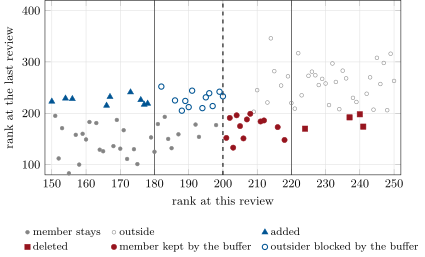
One simulated review of a top-200 index with a buffer of 20 ranks (thin lines), for the stocks now ranked 150 to 250. Between ranks 180 and 220 history decides: members stay, outsiders wait. Data: the tutorial’s simulation.
Figure 15.2. One simulated review of a top-200 index with a buffer of 20 ranks (thin lines), for the stocks now ranked 150 to 250. Between ranks 180 and 220 history decides: members stay, outsiders wait. Data: the tutorial’s simulation.
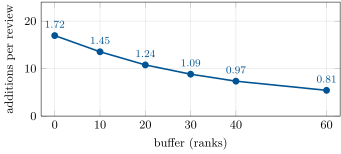
Average number of additions per annual review of a simulated top-200 index from a universe of 600, against the width of the buffer. The number above each point is the one-way turnover in percent of index weight. A buffer of 30 ranks halves the number of changes. Data: the tutorial’s simulation, 20 paths of 20 years.
Figure 15.3. Average number of additions per annual review of a simulated top-200 index from a universe of 600, against the width of the buffer. The number above each point is the one-way turnover in percent of index weight. A buffer of 30 ranks halves the number of changes. Data: the tutorial’s simulation, 20 paths of 20 years.
Ler no capítulo →