
Alle boeken

Professioneel

Apps Over Coach Inloggen Begin met lezen

Quantitative Finance · Begrippenlijst

Wat is Bund and syndication?

Ook bekend als: Bund · syndication

Definition 7.2 Markets II: Rates, FX and Credit · Hoofdstuk 7 — European and Japanese Government Bonds

A Bund is a German federal government bond (Bundesanleihe), issued at 7, 10, 15 or 30 years with an annual coupon; the ten-year Bund’s yield is the euro area’s benchmark long rate. Syndication is the sale of a new bond through a group of banks that build a book of investor orders and set the price, instead of an auction; some issuers use it for new long bonds, where demand is hardest to predict.
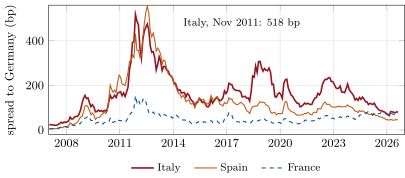
Ten-year spreads to Germany, monthly averages, 2007 to August 2026. The sovereign debt crisis took Italy’s to 518 basis points in November 2011 and Spain’s to 555 in July 2012; spreads fell after the ECB announced outright monetary transactions in September 2012. By August 2026 France’s spread, 82 basis points, was slightly wider than Italy’s, 81. Data: OECD, via FRED.
Figure 7.1. Ten-year spreads to Germany, monthly averages, 2007 to August 2026. The sovereign debt crisis took Italy’s to 518 basis points in November 2011 and Spain’s to 555 in July 2012; spreads fell after the ECB announced outright monetary transactions in September 2012. By August 2026 France’s spread, 82 basis points, was slightly wider than Italy’s, 81. Data: OECD, via FRED.

Voorbeelden

Example 7.3 (Anatomy of a widening)

Between June and November 2011 (monthly averages) Italy’s ten-year spread to Germany widened by 326 basis points. Italy’s yield rose 224 basis points; the other 102 came from Germany’s yield falling by as much, as investors fled into Bunds. A spread measures relative credit, but half of a crisis widening can be the benchmark rallying: a hedge that shorts the benchmark against the spread loses on that half.

Lees in het hoofdstuk →