
সব বই

পেশাদার

1 Markets I: The Ecosystem and Exchange-Traded Marketsবাজার অনলাইন 2 Markets II: Rates, FX and Creditবাজার অনলাইন 3 Markets III: Commodities, Energy and Cryptoবাজার অনলাইন 4 Quantitative Methodsপদ্ধতি অনলাইন 5 Derivatives and Volatilityডেরিভেটিভস অনলাইন 6 Rates, Credit, XVA and Riskসুদহার, ঋণ ও ঝুঁকি অনলাইন 7 Research Craft: Predictors, Backtests, Measurement, Portfoliosগবেষণা অনলাইন 8 Strategies I: Equities and Futuresকৌশল অনলাইন 9 Strategies II: Volatility, Relative Value, Macro and the Bank Desksকৌশল অনলাইন 10 Microstructure and Executionএক্সিকিউশন অনলাইন 11 Market Making and High-Frequency Tradingমার্কেট মেকিং অনলাইন 12 Machine Learning for Marketsমেশিন লার্নিং অনলাইন 13 Low-Latency Softwareপ্রযুক্তি অনলাইন 14 Networks, Hardware and Trading Infrastructureপ্রযুক্তি অনলাইন 15 Research, Data and Risk Platformsপ্রযুক্তি অনলাইন 16 The Desk and the Firmপ্রতিষ্ঠান অনলাইন 17 The Industry: Firms, Roles and Careersক্যারিয়ার অনলাইন 18 Interviews I: Maths, Probability and Speedক্যারিয়ার অনলাইন 19 Interviews II: Markets, Trading Games and the Final Roundক্যারিয়ার অনলাইন 20 Interviews III: Codeক্যারিয়ার অনলাইন
অ্যাপ পরিচিতি Coach সাইন ইন পড়া শুরু করো

বইগুলো এখনো বাংলা ভাষায় পাওয়া যায় না — ইংরেজি সংস্করণ দেখানো হচ্ছে।

Quantitative Finance · পরিভাষা

Cache miss, working set কী?

অন্য নাম: cache miss · working set

Definition 3.2 Low-Latency Software · অধ্যায় 3 — Memory Hierarchy and Caches

A cache miss is an access to a line that is not in a given level, which must then be fetched from the next level down. The working set of a piece of code over an interval is the set of lines it touches in that interval; the level whose capacity it fits in sets its speed.
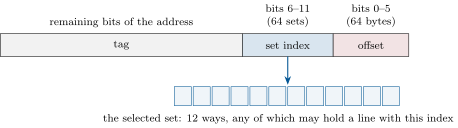
How an address selects its place in a set-associative cache. A 48 KiB, 12-way cache of 64-byte lines has 64 sets; bits 6 to 11 of the address choose the set, so addresses 4 KiB apart share a set.
Figure 3.1. How an address selects its place in a set-associative cache. A 48 KiB, 12-way cache of 64-byte lines has 64 sets; bits 6 to 11 of the address choose the set, so addresses 4 KiB apart share a set.
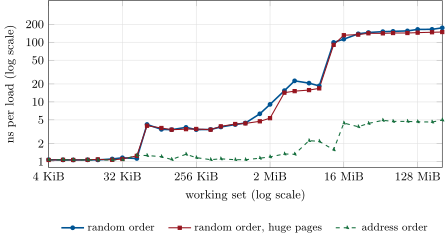
The memory staircase: time per dependent load through a buffer of one slot per cache line, against the buffer’s size. In address order the prefetcher hides almost all of it. Measured on a laptop (Intel Core Ultra 7 155H) under WSL2, no isolated cores, pinned to one CPU, the machine otherwise idle. Data: bench_mem.py.
Figure 3.2. The memory staircase: time per dependent load through a buffer of one slot per cache line, against the buffer’s size. In address order the prefetcher hides almost all of it. Measured on a laptop (Intel Core Ultra 7 155H) under WSL2, no isolated cores, pinned to one CPU, the machine otherwise idle. Data: bench_mem.py.

উদাহরণ

Example 3.3 (Geometry of a first-level cache)

A 48 KiB, 12-way cache with 64-byte lines has 48×1024/(64×12)=6448 \times 1024 / (64 \times 12) = 64 sets. The set index is bits 6 to 11; addresses that are equal modulo 64×64=4 09664 \times 64 = 4\,096 bytes fall into the same set. Thirteen hot structures placed at the same offset of thirteen 4 KiB pages cannot all stay in this cache, although together they occupy 832 bytes.

প্রসঙ্গসহ পড়ো →