
सभी किताबें

पेशेवर

1 Markets I: The Ecosystem and Exchange-Traded Marketsबाज़ार ऑनलाइन 2 Markets II: Rates, FX and Creditबाज़ार ऑनलाइन 3 Markets III: Commodities, Energy and Cryptoबाज़ार ऑनलाइन 4 Quantitative Methodsविधियाँ ऑनलाइन 5 Derivatives and Volatilityडेरिवेटिव्स ऑनलाइन 6 Rates, Credit, XVA and Riskब्याज दरें, क्रेडिट और जोखिम ऑनलाइन 7 Research Craft: Predictors, Backtests, Measurement, Portfoliosअनुसंधान ऑनलाइन 8 Strategies I: Equities and Futuresरणनीतियाँ ऑनलाइन 9 Strategies II: Volatility, Relative Value, Macro and the Bank Desksरणनीतियाँ ऑनलाइन 10 Microstructure and Executionनिष्पादन ऑनलाइन 11 Market Making and High-Frequency Tradingमार्केट मेकिंग ऑनलाइन 12 Machine Learning for Marketsमशीन लर्निंग ऑनलाइन 13 Low-Latency Softwareतकनीक ऑनलाइन 14 Networks, Hardware and Trading Infrastructureतकनीक ऑनलाइन 15 Research, Data and Risk Platformsतकनीक ऑनलाइन 16 The Desk and the Firmफ़र्म ऑनलाइन 17 The Industry: Firms, Roles and Careersकरियर ऑनलाइन 18 Interviews I: Maths, Probability and Speedकरियर ऑनलाइन 19 Interviews II: Markets, Trading Games and the Final Roundकरियर ऑनलाइन 20 Interviews III: Codeकरियर ऑनलाइन
ऐप्स परिचय Coach लॉग इन पढ़ना शुरू करें

Quantitative Finance · शब्दावली

Cache miss, working set क्या है?

अन्य नाम: cache miss · working set

Definition 3.2 Low-Latency Software · अध्याय 3 — Memory Hierarchy and Caches

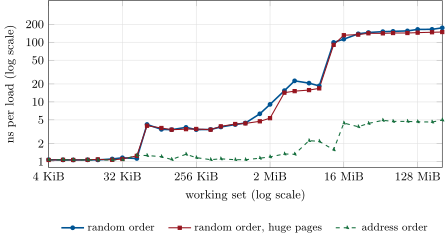
A cache miss is an access to a line that is not in a given level, which must then be fetched from the next level down. The working set of a piece of code over an interval is the set of lines it touches in that interval; the level whose capacity it fits in sets its speed.
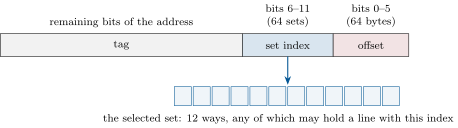
How an address selects its place in a set-associative cache. A 48 KiB, 12-way cache of 64-byte lines has 64 sets; bits 6 to 11 of the address choose the set, so addresses 4 KiB apart share a set.
Figure 3.1. How an address selects its place in a set-associative cache. A 48 KiB, 12-way cache of 64-byte lines has 64 sets; bits 6 to 11 of the address choose the set, so addresses 4 KiB apart share a set.
The memory staircase: time per dependent load through a buffer of one slot per cache line, against the buffer’s size. In address order the prefetcher hides almost all of it. Measured on a laptop (Intel Core Ultra 7 155H) under WSL2, no isolated cores, pinned to one CPU, the machine otherwise idle. Data: bench_mem.py.
Figure 3.2. The memory staircase: time per dependent load through a buffer of one slot per cache line, against the buffer’s size. In address order the prefetcher hides almost all of it. Measured on a laptop (Intel Core Ultra 7 155H) under WSL2, no isolated cores, pinned to one CPU, the machine otherwise idle. Data: bench_mem.py.

उदाहरण

Example 3.3 (Geometry of a first-level cache)

A 48 KiB, 12-way cache with 64-byte lines has 48×1024/(64×12)=6448 \times 1024 / (64 \times 12) = 64 sets. The set index is bits 6 to 11; addresses that are equal modulo 64×64=4 09664 \times 64 = 4\,096 bytes fall into the same set. Thirteen hot structures placed at the same offset of thirteen 4 KiB pages cannot all stay in this cache, although together they occupy 832 bytes.

अध्याय में पढ़ें →