
Todos os livros

Profissional

Apps Sobre Coach Entrar Começar a ler

Quantitative Finance · Glossário

O que é Calibration, identifiability, multistart?

Também chamado de: calibration · identifiability · multistart

Definition 24.6 Quantitative Methods · Capítulo 24 — Numerical Optimisation in Practice

Calibration is the choice of a model’s parameters to reproduce observed quantities (prices, quotes, moments), usually by nonlinear least squares. A parameter is locally unidentifiable, and identifiability fails, when the objective is flat in some direction at the optimum, so that data cannot pin it down. Multistart runs a local optimiser from many starting points to explore distinct minima.
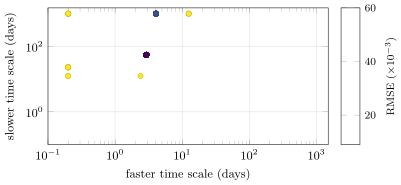
End points of 100 Levenberg–Marquardt runs from random starts on one day’s autocorrelation, plotted by their two time scales (sorted, so mirror-image solutions coincide) and coloured by fit error: a cluster at the best fit (3 and 55 days; 63 runs including the mirror images), runs stuck at the 1 000-day boundary, and a few elsewhere. Data: the chapter’s tutorial, seeded.
Figure 24.2. End points of 100 Levenberg–Marquardt runs from random starts on one day’s autocorrelation, plotted by their two time scales (sorted, so mirror-image solutions coincide) and coloured by fit error: a cluster at the best fit (3 and 55 days; 63 runs including the mirror images), runs stuck at the 1 000-day boundary, and a few elsewhere. Data: the chapter’s tutorial, seeded.
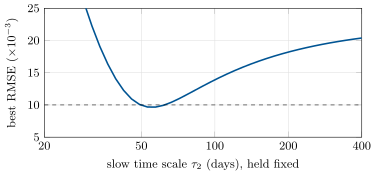
Profile of the calibration objective along the slow time scale: for each fixed _2 the best root-mean-squared error over the other two parameters, on one day’s curve. The dashed line is the noise level of the measured autocorrelation. Data: the chapter’s tutorial, seeded.
Figure 24.3. Profile of the calibration objective along the slow time scale: for each fixed τ2\tau_2 the best root-mean-squared error over the other two parameters, on one day’s curve. The dashed line is the noise level of the measured autocorrelation. Data: the chapter’s tutorial, seeded.
Ler no capítulo →