
सभी किताबें

पेशेवर

1 Markets I: The Ecosystem and Exchange-Traded Marketsबाज़ार ऑनलाइन 2 Markets II: Rates, FX and Creditबाज़ार ऑनलाइन 3 Markets III: Commodities, Energy and Cryptoबाज़ार ऑनलाइन 4 Quantitative Methodsविधियाँ ऑनलाइन 5 Derivatives and Volatilityडेरिवेटिव्स ऑनलाइन 6 Rates, Credit, XVA and Riskब्याज दरें, क्रेडिट और जोखिम ऑनलाइन 7 Research Craft: Predictors, Backtests, Measurement, Portfoliosअनुसंधान ऑनलाइन 8 Strategies I: Equities and Futuresरणनीतियाँ ऑनलाइन 9 Strategies II: Volatility, Relative Value, Macro and the Bank Desksरणनीतियाँ ऑनलाइन 10 Microstructure and Executionनिष्पादन ऑनलाइन 11 Market Making and High-Frequency Tradingमार्केट मेकिंग ऑनलाइन 12 Machine Learning for Marketsमशीन लर्निंग ऑनलाइन 13 Low-Latency Softwareतकनीक ऑनलाइन 14 Networks, Hardware and Trading Infrastructureतकनीक ऑनलाइन 15 Research, Data and Risk Platformsतकनीक ऑनलाइन 16 The Desk and the Firmफ़र्म ऑनलाइन 17 The Industry: Firms, Roles and Careersकरियर ऑनलाइन 18 Interviews I: Maths, Probability and Speedकरियर ऑनलाइन 19 Interviews II: Markets, Trading Games and the Final Roundकरियर ऑनलाइन 20 Interviews III: Codeकरियर ऑनलाइन
ऐप्स परिचय Coach लॉग इन पढ़ना शुरू करें

Quantitative Finance · शब्दावली

Caplet stripping क्या है?

Definition 4.5 Rates, Credit, XVA and Risk · अध्याय 4 — Vanilla Rates Options

Caplet stripping is the calibration of a term structure of caplet volatilities that reprices every quoted cap of a strike: with caps of increasing maturity, the caplets between two consecutive maturities are given one volatility, solved so that the longer cap reprices, the shorter caplets’ volatilities held.
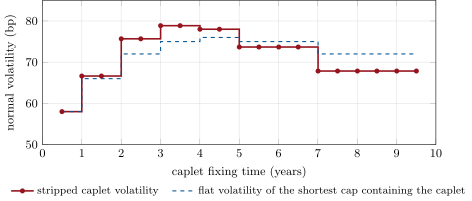
Caplet volatilities stripped from the flat volatilities of caps struck at 3%, one per interval between quoted maturities. Data: the chapter’s illustrative quotes on chapter 2’s euro curves; the chapter’s tutorial.
Figure 4.2. Caplet volatilities stripped from the flat volatilities of caps struck at 3%, one per interval between quoted maturities. Data: the chapter’s illustrative quotes on chapter 2’s euro curves; the chapter’s tutorial.
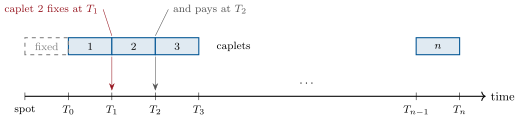
A cap on six-month Euribor from spot: each caplet’s rate fixes at the start of its period and is paid at the end. The first period’s rate is already fixed at trade, so the market’s caps start with the second caplet.
Figure 4.3. A cap on six-month Euribor from spot: each caplet’s rate fixes at the start of its period and is paid at the end. The first period’s rate is already fixed at trade, so the market’s caps start with the second caplet.

उदाहरण

Example 4.6 (A euro cap strip)

Flat normal volatilities of caps struck at 3% on six-month Euribor of 58, 66, 72, 75, 76, 75 and 72 basis points at one, two, three, four, five, seven and ten years (illustrative; the first caplet, already fixed, excluded) strip into caplet volatilities of 58.0, 66.6, 75.7, 78.9, 78.0, 73.7 and 67.9 basis points on the successive intervals (Figure 4.2). Where flat volatilities rise, the new caplets must be above the flat level to lift the average; the hump of the caplet curve is higher and earlier than that of the flat curve.

अध्याय में पढ़ें →