
Semua buku

Profesional

Aplikasi Tentang Pelatih Masuk Mulai membaca

Quantitative Finance · Glosarium

Apa itu Caplet stripping?

Definition 4.5 Rates, Credit, XVA and Risk · Bab 4 — Vanilla Rates Options

Caplet stripping is the calibration of a term structure of caplet volatilities that reprices every quoted cap of a strike: with caps of increasing maturity, the caplets between two consecutive maturities are given one volatility, solved so that the longer cap reprices, the shorter caplets’ volatilities held.
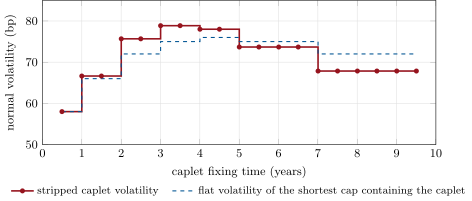
Caplet volatilities stripped from the flat volatilities of caps struck at 3%, one per interval between quoted maturities. Data: the chapter’s illustrative quotes on chapter 2’s euro curves; the chapter’s tutorial.
Figure 4.2. Caplet volatilities stripped from the flat volatilities of caps struck at 3%, one per interval between quoted maturities. Data: the chapter’s illustrative quotes on chapter 2’s euro curves; the chapter’s tutorial.
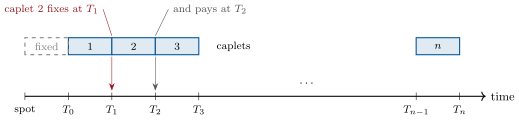
A cap on six-month Euribor from spot: each caplet’s rate fixes at the start of its period and is paid at the end. The first period’s rate is already fixed at trade, so the market’s caps start with the second caplet.
Figure 4.3. A cap on six-month Euribor from spot: each caplet’s rate fixes at the start of its period and is paid at the end. The first period’s rate is already fixed at trade, so the market’s caps start with the second caplet.

Contoh

Example 4.6 (A euro cap strip)

Flat normal volatilities of caps struck at 3% on six-month Euribor of 58, 66, 72, 75, 76, 75 and 72 basis points at one, two, three, four, five, seven and ten years (illustrative; the first caplet, already fixed, excluded) strip into caplet volatilities of 58.0, 66.6, 75.7, 78.9, 78.0, 73.7 and 67.9 basis points on the successive intervals (Figure 4.2). Where flat volatilities rise, the new caplets must be above the flat level to lift the average; the hump of the caplet curve is higher and earlier than that of the flat curve.

Baca dalam konteks →