
全部书籍

专业

应用 关于 Coach 登录 开始阅读

书籍暂未推出简体中文版——当前显示英文版。

Quantitative Finance · 术语表

什么是 Clustering, k-means, hierarchical clustering?

又称: clustering · k-means · hierarchical clustering

Definition 20.1 Machine Learning for Markets · 第 20 章 — Clustering, Regimes and Anomaly Detection

Clustering partitions objects into groups whose members are more similar to each other than to others, without labels. k-means chooses kk centres and assigns each object to the nearest, alternating the two steps to minimise the within-group sum of squared distances (Lloyd’s algorithm). Hierarchical clustering merges the closest groups step by step into a tree and cuts it at the desired number of groups; for assets the usual distance is 2(1−ρij)\sqrt{2(1-\rho_{ij})} between return series (Mantegna, 1999), the one behind hierarchical risk parity (Book 7, chapter 26).
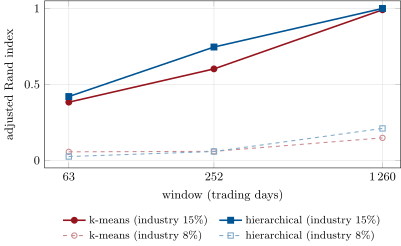
Agreement of return-based clusters with the planted industries, by the length of the return history and the strength of the industry factor. Data: ml_regimes.clustering.
Figure 20.1. Agreement of return-based clusters with the planted industries, by the length of the return history and the strength of the industry factor. Data: ml_regimes.clustering.
在原文中阅读 →