সব বই

পেশাদার

1 Markets I: The Ecosystem and Exchange-Traded Marketsবাজার অনলাইন 2 Markets II: Rates, FX and Creditবাজার অনলাইন 3 Markets III: Commodities, Energy and Cryptoবাজার অনলাইন 4 Quantitative Methodsপদ্ধতি অনলাইন 5 Derivatives and Volatilityডেরিভেটিভস অনলাইন 6 Rates, Credit, XVA and Riskসুদহার, ঋণ ও ঝুঁকি অনলাইন 7 Research Craft: Predictors, Backtests, Measurement, Portfoliosগবেষণা অনলাইন 8 Strategies I: Equities and Futuresকৌশল অনলাইন 9 Strategies II: Volatility, Relative Value, Macro and the Bank Desksকৌশল অনলাইন 10 Microstructure and Executionএক্সিকিউশন অনলাইন 11 Market Making and High-Frequency Tradingমার্কেট মেকিং অনলাইন 12 Machine Learning for Marketsমেশিন লার্নিং অনলাইন 13 Low-Latency Softwareপ্রযুক্তি অনলাইন 14 Networks, Hardware and Trading Infrastructureপ্রযুক্তি অনলাইন 15 Research, Data and Risk Platformsপ্রযুক্তি অনলাইন 16 The Desk and the Firmপ্রতিষ্ঠান অনলাইন 17 The Industry: Firms, Roles and Careersক্যারিয়ার অনলাইন 18 Interviews I: Maths, Probability and Speedক্যারিয়ার অনলাইন 19 Interviews II: Markets, Trading Games and the Final Roundক্যারিয়ার অনলাইন 20 Interviews III: Codeক্যারিয়ার অনলাইন
অ্যাপ পরিচিতি Coach সাইন ইন পড়া শুরু করো

বইগুলো এখনো বাংলা ভাষায় পাওয়া যায় না — ইংরেজি সংস্করণ দেখানো হচ্ছে।

Quantitative Finance · পরিভাষা

CMS spread option কী?

Definition 6.11 Rates, Credit, XVA and Risk · অধ্যায় 6 — Convexity Adjustments and Constant-Maturity Products

A CMS spread option pays max⁡(S1(T)−S2(T)−K,0)\max(S_1(T)-S_2(T)-K,0) at TpT_p on the difference of two CMS rates of different tenors observed at the same date, typically the ten-year and the two-year; a strip of them with K=0K=0 pays a steepener coupon.

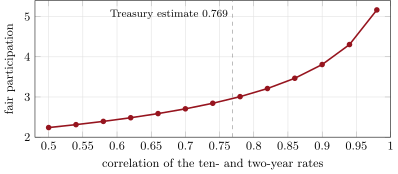
Fair participation of a ten-year steepener note (the weekend problem) as a function of the correlation between the ten- and two-year swap rates: the higher the correlation, the less volatile the spread and the cheaper each unit of its floor, so the more of it the note can pay. Data: the chapter’s tutorial.
Figure 6.4. Fair participation of a ten-year steepener note (the weekend problem) as a function of the correlation between the ten- and two-year swap rates: the higher the correlation, the less volatile the spread and the cheaper each unit of its floor, so the more of it the note can pay. Data: the chapter’s tutorial.

উদাহরণ

Example 6.12 (The spread’s volatility)

Over 2016–2026 daily changes of the two- and ten-year Treasury par yields had a correlation of 0.769 (chapter 3’s data, a proxy for swap rates). With the cube’s at-the-money volatilities for the one-year expiry, the spread of the ten- and two-year euro rates has a normal volatility of 45.1 basis points, well below either rate’s.

প্রসঙ্গসহ পড়ো →