Tous les livres

Professionnel

Applis À propos Coach Connexion Commencer la lecture

Quantitative Finance · Glossaire

Qu'est-ce que « CMS spread option » ?

Definition 6.11 Rates, Credit, XVA and Risk · Chapitre 6 — Convexity Adjustments and Constant-Maturity Products

A CMS spread option pays max⁡(S1(T)−S2(T)−K,0)\max(S_1(T)-S_2(T)-K,0) at TpT_p on the difference of two CMS rates of different tenors observed at the same date, typically the ten-year and the two-year; a strip of them with K=0K=0 pays a steepener coupon.

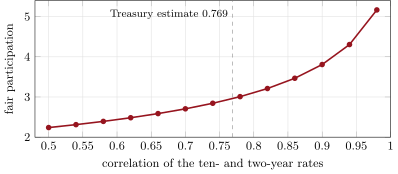
Fair participation of a ten-year steepener note (the weekend problem) as a function of the correlation between the ten- and two-year swap rates: the higher the correlation, the less volatile the spread and the cheaper each unit of its floor, so the more of it the note can pay. Data: the chapter’s tutorial.
Figure 6.4. Fair participation of a ten-year steepener note (the weekend problem) as a function of the correlation between the ten- and two-year swap rates: the higher the correlation, the less volatile the spread and the cheaper each unit of its floor, so the more of it the note can pay. Data: the chapter’s tutorial.

Exemples

Example 6.12 (The spread’s volatility)

Over 2016–2026 daily changes of the two- and ten-year Treasury par yields had a correlation of 0.769 (chapter 3’s data, a proxy for swap rates). With the cube’s at-the-money volatilities for the one-year expiry, the spread of the ten- and two-year euro rates has a normal volatility of 45.1 basis points, well below either rate’s.

Lire dans le chapitre →